

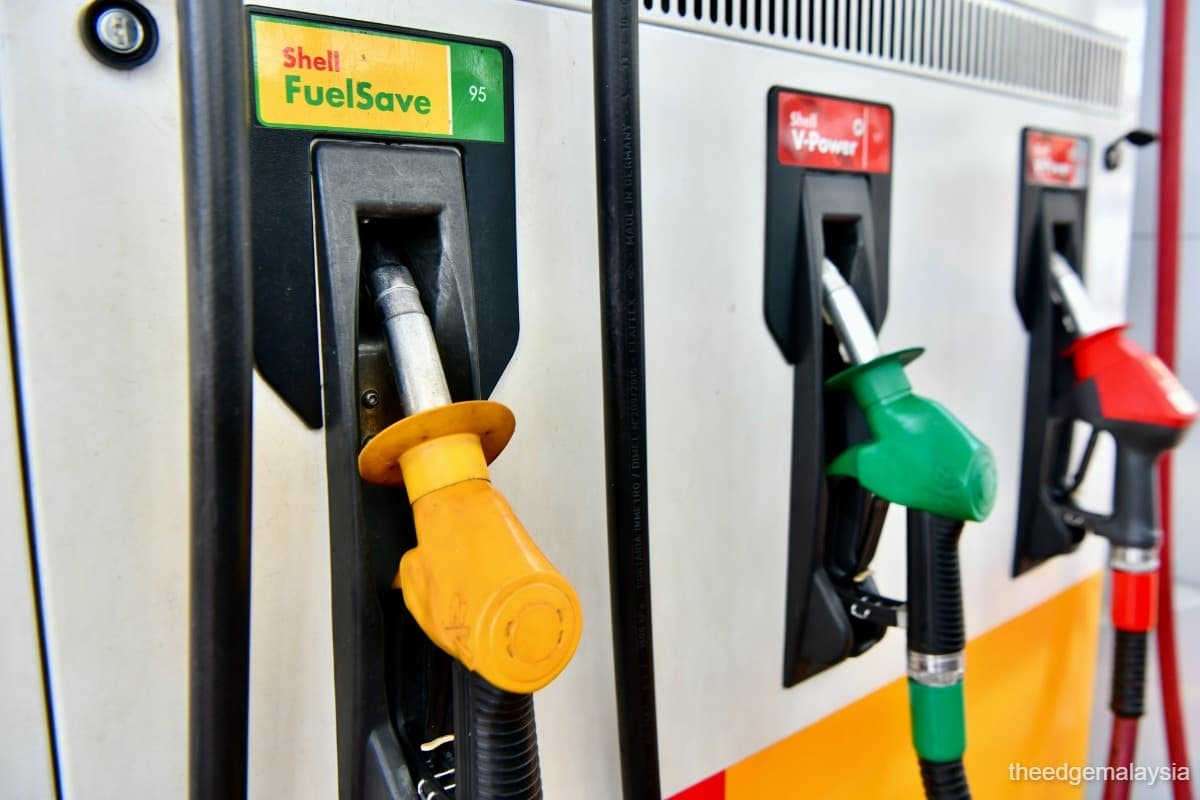
KUALA LUMPUR (July 22): Economists foresee that potential delays in the implementation of the RON95 fuel subsidy retargeting could soften Malaysia’s inflation trajectory, even as prices are expected to rise from July onwards due to policy adjustments.
This follows the release of official data on Tuesday showing that headline inflation in June eased to 1.1% year-on-year—the slowest pace since February 2021 and below the median 1.2% increase projected in a Bloomberg poll. Malaysia’s full-year inflation rate in 2024 stood at 1.8%.
Economists from OCBC Global Markets Research, UOB Global Economics & Markets Research, RHB Investment Bank, CIMB Investment Bank and BIMB Securities have forecast Malaysia’s full-year inflation for 2025 to range between 1.5% and 2.2%, citing expectations of moderate price pressures.
OCBC revised its inflation forecast to 1.5% from 2%, citing subdued headline inflation and reduced prospects for RON95 rationalisation. “Subdued headline inflation of 1.4% in 1H25 and reduced prospects of RON95 rationalisation, following the government’s need for a more detailed review of the mechanism, have led us to reduce our full-year forecast,” it said.
BIMB, which had projected inflation at 2%, revised its baseline timeline for the petrol subsidy rollout to the fourth quarter of 2025 from June. “Given the latest developments and the growing possibility of further delays beyond this year, average inflation in 2025 could trend lower, in the range of 1.5% to 2.0%,” it noted.
RHB, meanwhile, noted that inflation averaged a soft 1.4% in the first half of 2025 and is projected to rise to 2.4%–2.5% in the second half, driven by upside risks from policy changes. “We also see downside risks to our current inflation projections, particularly due to possible delays in the implementation of the RON95 subsidy retargeting,” it added.
UOB commented that the inflationary impact from tax adjustments is expected to be one-off but flagged the RON95 subsidy rationalisation—anticipated in the second half of 2025—as a key uncertainty that could alter the inflation trajectory.
CIMB projected a stable inflation outlook of 2.2% for 2025. “The relatively limited impact of recent policy adjustments supports our view. Notably, the SST [sales and service tax] expansion affects only 3% of the overall CPI [consumer price index] basket, while the electricity tariff reform—targeting high-consumption households—has minimal pass-through to broader inflation.”
Rate cut or hold?
On the monetary policy front, OCBC and UOB see room for a 25-basis-point cut in the Overnight Policy Rate (OPR), projecting a reduction to 2.50% by year-end.
OCBC said, “Given our view that GDP growth will slow in 2H25 to 3.5% year-on-year from 4.4% in 1H24 and that inflation will remain low, we see monetary policy as having room to ease further in 2H25.”
UOB noted that should growth risks escalate, a more accommodative monetary policy stance may be warranted to support domestic growth into 2026, especially considering the typical 12-month lag for monetary policy to fully transmit through the economy.
In contrast, the other three research houses expect Bank Negara Malaysia to maintain the OPR at 2.75% for the rest of the year, citing the need to preserve policy flexibility.
“For the upcoming meetings in September and November, officials will likely stay data-dependent,” RHB noted.