

This article first appeared in The Edge Malaysia Weekly on July 21, 2025 - July 27, 2025
Malaysia’s plan to implement a carbon tax in 2026 and Tenaga Nasional Bhd’s increase in electricity tariffs are putting pressure on manufacturers and commercial players with high energy consumption to decarbonise.
Wong Yin Kee, managing director of Engie Services Malaysia Sdn Bhd, says energy-efficient solutions such as district cooling have already started maturing in countries in Europe and Singapore. As such, now would be the ideal time for companies in Malaysia to adopt this technology and remain competitive.
Engie is a global energy and services group that provides low-carbon electricity solutions and energy infrastructure such as district cooling, as well as heating solutions that are available in European regions. Heating networks produce and distribute heat in the form of hot water or steam for heating or domestic water use, while cooling networks produce and distribute cooling energy through a chilled water network.
District heating and cooling systems are seen to be more efficient and reduce overall energy consumption, as buildings in the same area share the resources.
Wong says developers that use district cooling can typically save 15% to 30% on energy bills. With the inclusion of solar energy, the cost of cooling can be reduced beyond 30%.
Engie’s partnership with medical equipment device manufacturer Mölnlycke in setting up its manufacturing plant in Kulim Hi-Tech Park in Kedah is an example of how this technology can be implemented.

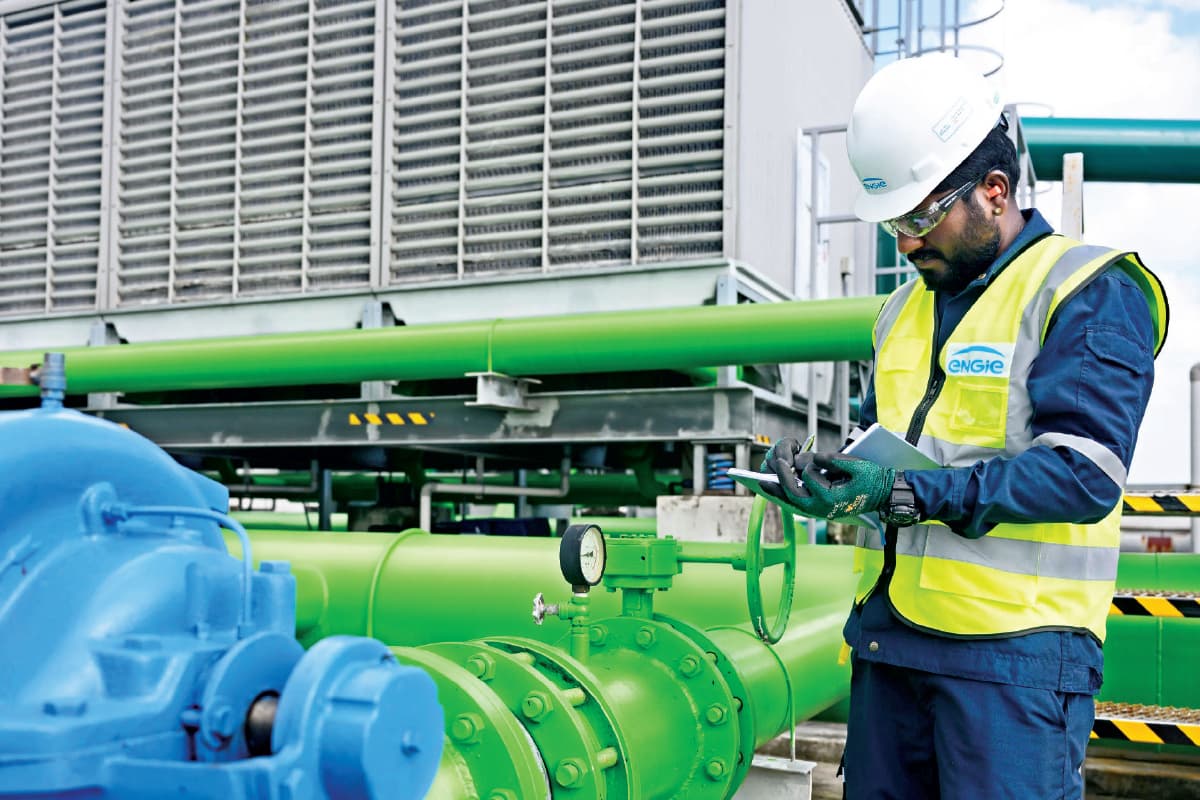
Engie installed rooftop solar panels; a thermal oil system; a compressed air system; process chillers, which supply chilled and iced water; and cooling towers that support the process chillers.
According to Engie’s decarbonisation road map for Mölnlycke, the company will be able to reduce the carbon footprint of its factories by more than 40% by 2030.
“Following the success of this first project, we extended a similar offer for another site for chilled water and compressed air in Kuala Ketil in Kedah, about 30 minutes away. Now, they are asking us to look at their third site with a similar approach,” says Wong.
“All these will contribute to their decarbonisation road map next year for the long term. They are also facing pressure from their headquarters in Europe to lower their carbon footprint.”
Another project that Engie has been involved in is the Cyberjaya district cooling plant, developed in partnership with Pendinginan Megajana Sdn Bhd. The project began back in 2013 and has seen a 28.7% increase in energy efficiency for the latter.
"Megajana is a city-scale effort. We are running two mega chiller plants, which are interconnected, and will supply chilled water to over 40 buildings to cool down the air conditioning systems. They’re taking the water from our centralised system, and we have about 12km of underground piping delivering all this chilled water,” Wong explains.
“We deploy a lot of digitalised solutions, where everything is monitored in real time. You can look at it anywhere, anytime, so we don’t need to be on-site to measure those numbers and data.”
Having a baseline on the company’s energy pattern data analytics allows Engie to get more insights into how energy is being used at each site.
The implementation of district cooling varies by project size. Wong says the projects can fall anywhere between US$1 million and US$30 million. Engie offers a zero capital expenditure model.
“Companies will have to pay a monthly utility bill across a certain number of years during the contract, and they don’t have to fork out a single sen after the investment. Overall, they still achieve nice savings after paying us the monthly bill,” Wong says.
Greenfield developments especially are costly and take a longer time to be deployed, because designs need to be started from scratch, requiring engagement with consultants, architects, as well as the government for permits and approvals.
Brownfield developments, on the other hand, can be done via simpler transformations. One example of Engie’s brownfield project is UAC Bhd’s boiler plant, where the company wants to switch from non-renewable fuel to renewable sources.
“We are transitioning from dirty fuels like diesel to less dirty ones such as natural gas. The next phase is to look at biomass because that’s much more renewable than natural gas,” shares Wong.
Save by subscribing to us for your print and/or digital copy.
P/S: The Edge is also available on Apple's App Store and Android's Google Play.