

This article first appeared in The Edge Malaysia Weekly on July 21, 2025 - July 27, 2025
The rise of fast fashion has led to an abundance of cheap, low-quality and mass-produced clothing that contributes to overconsumption. This poses a challenge to textile recyclers globally, as they are unable to extend the lifespan of these materials that would end up in a landfill.
Second-hand market sellers are also facing stiff competition from fast fashion manufacturers that can churn out lower-priced clothing, usually made of polyester, in large quantities.
These are the trends observed by social enterprise Kloth Circularity and used textiles collector Life Line Clothing Malaysia Sdn Bhd (LLCM) that have been collaborating to handle the collection, sorting and recycling of used textiles in the Klang Valley.
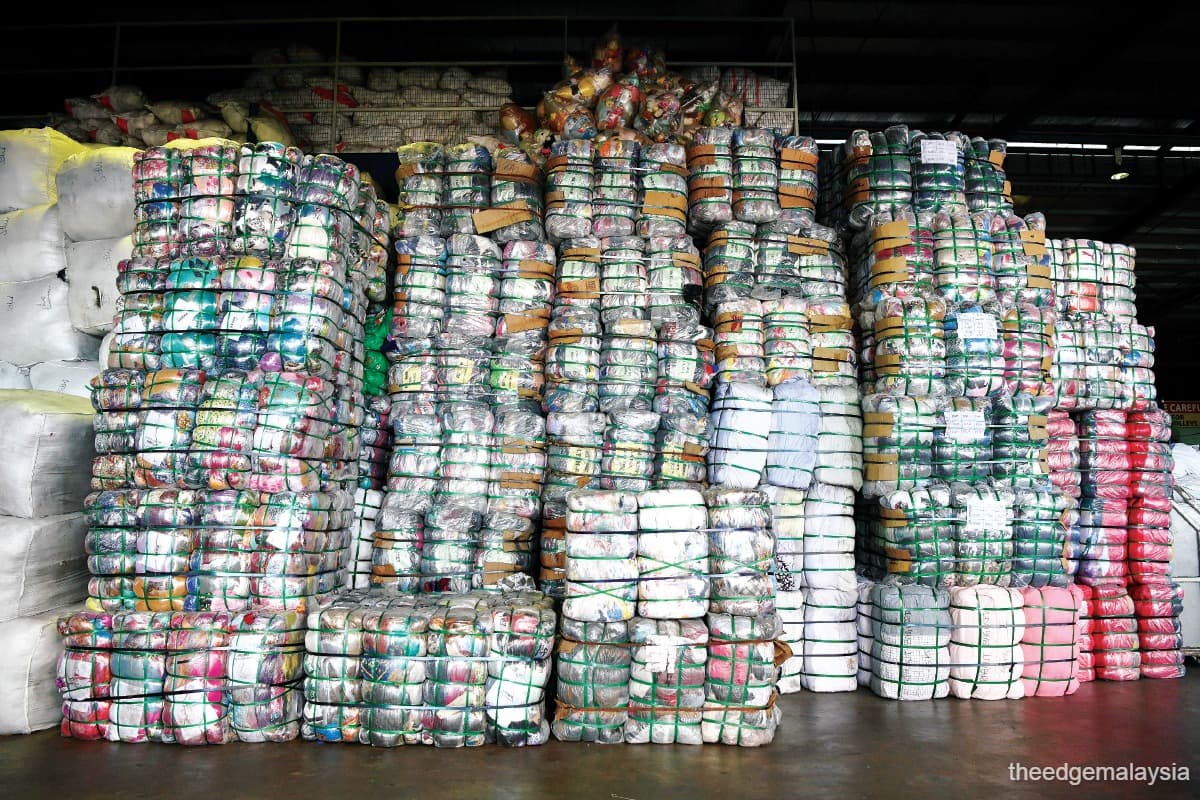
A visit to LLCM’s warehouse in Port Klang reflects the scale of textile waste in Malaysia. Mounds of used clothing are baled and sorted according to 560 separate categories, waiting to be sold to buyers.
According to the Solid Waste and Public Cleansing Management Corporation in 2021, fabric waste constituted 3.1% (432,901 tonnes) of the total waste generated (13.9 million tonnes) that year in Malaysia.
Globally, 92 million tonnes of textile waste are produced annually, according to the United Nations Environment Programme. Production rates doubled from 2000 to 2015, while the duration of garment use fell 36%.
With the popularity of e-commerce and the availability of fast fashion clothing items, the overconsumption of polyester clothing means that more unrecyclable textiles are being sent to LLCM’s factory.
The result is a glut of second-hand clothes in the market that are of low quality and low demand from consumers who prefer to buy new and cheaper products.

“A lot of fast fashion is not built to last, and because it's so accessible to buy clothes from [fast fashion brands], people are throwing [them ] away easily, which is actually bringing the quality of the clothes that come through our factory a lot lower,” says Andrew Jackson, head of business development at LLCM.
“What we’d like to actually see is for the quality of clothes [to become] better, but it’s very hard to do that because the trend is to buy cheap and buy more.”
Thrift shopping for second-hand clothes is popular, but there are fewer low-value items in thrift stores nowadays, Jackson observes.
“People buying from thrift stores want higher-quality items as well, which makes our business a little more difficult. There’s a huge gap in the market,” he adds, bringing up the bankruptcy of SOEX, one of Germany’s big textile recyclers, in 2024 as an example of the challenging market conditions.
SOEX facilitated clothing take-back schemes for big fashion brands like H&M, Levi’s and Decathlon as well. The company cited the “collapse of traditional markets in Europe and competitors from Asia putting pressure on markets with their excess capacity” as the driving factor.
The trend where developed countries export used textiles to developing countries is also over, he adds. “African [countries] are not like that anymore. They want high-quality clothes … the stuff that they want is a small percentage of what we get.
“Realistically, without support, the second-hand [clothing] industry will continue to fall until something is done. People want better-quality clothes and they want to pay less for it,” says Jackson.
At LLCM, 55% of clothes in good condition are either upcycled into new products or exported to local and foreign second-hand clothes markets, and 25% of damaged but water-absorbent textiles are converted into cleaning rags.
The remaining 15% are sent to LLCM’s partner in India to undergo mechanical separation. Mechanical separation splits the fibres, which are then respun into yarn and crafted into rugs.
Around 3% to 4% of the collected used textiles are turned into processed engineered fuel (PEF), an alternative fuel source to fossil fuels that can power up kilns in factories. Most of the polyester clothing is turned into PEF, as the material cannot be turned into industrial rags due to its non-water-absorbent qualities.
However, turning clothes into PEF is considered the last resort for Kloth Circularity and LLCM. Their priority is to extend the life cycle of fabrics and enhance their value by reusing or selling the textiles as upcycled products.
“For us, processed engineered fuel is the last stop. If we can turn [textiles] into cleaning cloth, that's better than PEF because you still get a little bit more use out of them. But the reality is, the number one thing you can do is just prolong the life of your clothes,” says Jackson.

Government support and EPR
The challenges faced by used textile collectors and recyclers in Malaysia are compounded by the lack of subsidies by the government for this industry, unlike in the European Union (EU).
The EU's Strategy for Sustainable and Circular Textiles sets design requirements to enhance textile durability, facilitate repairs and recycling and establish minimum recycled content standards.
The EU Waste Framework Directive is undergoing revision, requiring countries to set up separate collection systems for used textiles and implement extended producer responsibility (EPR) schemes, making textile producers responsible for managing their products at end-of-life.
Such regulations would ensure that used textiles do not end up in landfills, and that there would be a demand for recycled fabrics. In fact, SOEX cited these regulations as a potential lifeline for the company to continue operating.
“Demand for our [upcycle] brand Kloth Wear can be challenging since fabrics made from recycled plastic bottles are generally at least 20% more expensive than virgin materials. We source fabrics from internationally certified sourcing partners, mostly from China, and the upcycling of our clothes is done by local workers, but customers want prices [of clothes to match] virgin polyester sewn in China,” says Nik Suzila, co-founder of Kloth Circularity.
It is difficult for social enterprises to raise funds, she shares. The drop in prices for second-hand clothes has also made it more challenging for Kloth Circularity to operate at this time.

“Since our partnership with LLCM, we have brought in 11.7 million kg [of used textiles], and that is equivalent to more than 70 million pieces of T-shirts. But because they are facing global market challenges, as a result, our overall income last year has also been compromised,” says Nik Suzila.
Sales for upcycled textile products are also tricky to secure. The social enterprise promises fair wages to the local women it employs to sew the upcycled products, but the clients sometimes expect the prices for these items to be as low as mass-produced ones in the market that use virgin materials, she says.
Jackson and Nik Suzila agree that an EPR would be a good solution to curb textile waste. However, proposed EPR policies in Malaysia currently do not include the fabric industry. Nik Suzila and Jackson say they are currently engaging the government on this matter.
“If you talk to the policymakers, they want to make it happen, but the [focus is on] what is our country's income, what are the more pressing issues and which items should we be talking about in the government and parliament,” says Nik Suzila.
Inspired to take action
Nik Suzila co-founded the social enterprise Kloth Circularity with Sarah Kedah in 2013, aiming to introduce a circular ecosystem in the textile industry. The company operates over 500 clothes collection bins nationwide and collaborates with corporations to promote used textile collection, recycling and upcycling.
It has four flagship brands, including Kloth Woman Up, which works with marginalised, struggling and vulnerable communities to upcycle used fabric into corporate gifts. Kloth Textiles, meanwhile, has sold over 340,000 pieces of textiles and clothing containing recycled plastic bottles.
More than 11.7 million kg of used textiles and clothing have been saved from incinerators and landfills since 2018, says Nik Suzila, and the quantity in 2025 is expected to reach an average of 90,000kg per week.

The collected textiles are sent to Life Line Clothing Malaysia Sdn Bhd’s (LLCM) factory in Port Klang, where they are sorted. According to the company, it is the only one in this industry to hold the ISO 14001:2015 certification for environmental management in Malaysia currently.
Nik Suzila shares that corporations have shown growing interest in textile collection and recycling over the years, in part to fulfil their ESG responsibilities and reduce waste.
For instance, companies like Aeon Co (M) Bhd, Sunway Group and MBSB Bank Bhd have engaged with Kloth Cares to install fabric recycling bins or organise fabric donation drives, she says. Shell Malaysia, meanwhile, has partnered with Kloth Cares by placing bins at the petrol stations, and contributed to the collection of 3.7 million kg of used textiles since 2019.
Constantly upcycling
Kloth Circularity and LLCM have their own upcycling hubs that transform old garments into new products. Kloth Circularity’s Kloth Woman Up, for instance, which is active in Selangor, trains women in local communities to pick up sewing skills and earn an income.
“Kloth Woman Up has helped women in the community earn some side income, but the programme also helps women in marginalised communities who are housewives or women who have stopped working. Even if they don’t know how to sew, they can do jobs such as fabric cutting, and it's up to me to delegate the tasks to them,” says Shayida Salmi Roslan, the head seamstress who runs Kloth Woman Up’s fabric upcycling station in Teluk Panglima Garang, Selangor.
Some of the women are able to earn RM2,000 to RM2,500 a month, depending on the workload. So far, over RM250,000 has been paid to all the women who have participated in sewing and cutting, says Nik Suzila.
Companies like Hilton Orchard Singapore and Petronas have partnered with the Kloth Woman Up programme to transform old uniforms into corporate gifts, promoting fabric reuse and giving new life to materials that would otherwise end up in landfills.
Save by subscribing to us for your print and/or digital copy.
P/S: The Edge is also available on Apple's App Store and Android's Google Play.