

This article first appeared in The Edge Malaysia Weekly on July 7, 2025 - July 13, 2025
PRECISION machining solutions provider CPE Technology Bhd (KL:CPETECH), which primarily serves the semiconductor sector, reckons it has a shot at achieving a record revenue for the financial year ending June 30, 2026 (FY2026), on the back of expanded capacity, enhanced services and robust demand.
Already, stronger demand from US and Japanese semiconductor customers has helped shore up the topline for the nine months ended March 31, 2025, to RM96.71 million, above the RM90.07 million booked for the full year ended June 20, 2024 (FY2024), when its utilisation rates were lower as chipmakers navigated heightened geopolitical tensions and excess inventory.
The group, which will report full-year results by late August, expects revenue of between RM125 million and RM130 million for FY2025, which is deliverable if one were to annualise the amount in the first three quarters.
Though falling short of its current record-high revenue of RM145.3 million booked in FY2023, CPE Tech says revenue for FY2025 will still be one of its best years. The performance is boosted by the demand for precision-machined parts by semiconductor process system manufacturers, which contributes about two-thirds of the group’s annual revenue.
CPE Tech also sees opportunities arising from the global realignment of semiconductor supply chains, with more US and Japanese clients seeking suppliers in neutral markets like Malaysia and Singapore.

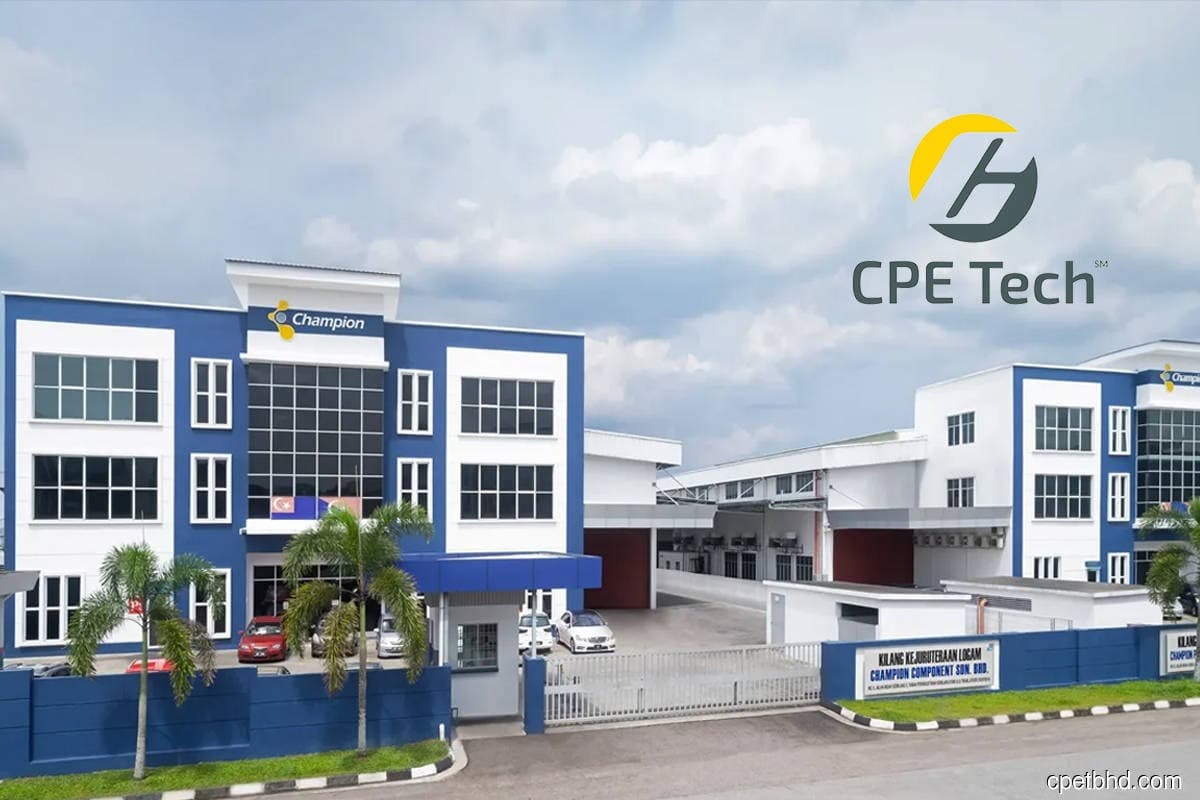
“Some US companies are moving operations out of China and setting up in Southeast Asia — we are seeing more inquiries and development projects as a result,” its chief financial officer Hun Jiang Yann says during The Edge’s recent visit to its facilities in Taman Perindustrian Gemilang, Ulu Tiram, Johor Baru. CPE Tech currently operates six manufacturing plants, with the latest being a RM15 million detached facility.
The expansion into another separate facility in Ulu Tiram, instead of the original plan to consolidate all its capacity into one facility as per its initial public offering (IPO) prospectus in December 2023, was because of customers’ requests for exclusivity, says Hun.
CPE Tech is expanding its fleet of 333 computer numerical control (CNC) machines to 370 units. It has already ordered 18 CNC machines from Japan, which Hun says will increase its production capacity and raise its annual revenue to around RM180 million by FY2026, 20% above its current installed annual capacity of RM150 million worth of precision machined products. Each machine costs RM250,000 to RM300,000.
Ulu Tiram is about 30 minutes’ drive from Senai International Airport, 40 minutes to Johor Port in Pasir Gudang and around an hour to Port of Tanjung Pelepas in Gelang Patah, Iskandar Puteri.
CPE Tech’s facilities are just an hour away from Singapore, depending on traffic conditions on the Causeway. In fact, clients based in Singapore make the most orders for CPE Tech’s services, although the final destinations of the products could be elsewhere.
Based on CPE Tech’s financial results for the quarter and nine months ended March 31, 2025, about 44% of its revenue comes from contracts with Singapore-based customers, which eclipsed orders from customers from the US, which was the biggest in the previous corresponding period.
Nonetheless, as Singapore is a regional hub for companies operating in Southeast Asia, an order from a Singapore-based company does not necessarily mean that the products are intended for Singapore. Hun says there are orders from their Singapore-based customers that ended up in manufacturing facilities in Kulim, Kedah.
US tariff war beneficiary
While there are industry-wide recalibrations because of the US’s policy aimed at bringing manufacturing activities back home, the economics of doing so remain uncompetitive due to significantly higher labour and material costs.
“We’ve asked customers directly — making parts in the US can cost three to four times more than in Malaysia,” Hun assures.
CPE Tech, which exports over 80% of its output, says it is receiving more direct export orders to Japan, the US, India and Europe, though many of its clients operate via Singapore.
Despite the uncertainties, Han believes the demand shift into Southeast Asia provides a long-term structural benefit for Malaysian suppliers like CPE Tech that can meet advanced specifications from customers based in the US, Japan and Europe.
“We are already seeing Chinese and American semiconductor firms expanding in Penang and Johor. That creates more opportunities for us, even if the geopolitical backdrop remains tense,” he adds.
The group is focused on organic growth, Hun says, having successfully reduced reliance on a single customer and deepened relationships across its semiconductor client base.
CPE Tech’s largest customer, a US-based semiconductor company referred to as “E”, currently contributes around 25% of its revenue, followed by a Japanese semiconductor process manufacturing firm “F” at 18% and a Japanese fishing equipment brand at 11%.
The group is also working with several US-based clients in the area of mass flow controller (MFC) and regulator components — niche precision parts that can fetch US$200 (RM843.50) to US$400 per unit — and expects further capacity ramp-up, pending approvals from their end-customers.
That said, CPE Tech is maintaining a conservative stance on expansion amid rising geopolitical uncertainties, particularly from the ongoing US-China technology conflict and wider global instability.
While the group says it has not felt a direct negative impact from US tariffs, it remains cautious about capital expenditure, citing concerns over the broader implications of policy shifts and regional conflicts.
“The Trump tariffs didn’t hurt us much but we are not rushing to invest in big facilities when conditions are this volatile,” says Hun, referring to recent geopolitical developments, including tensions in the Middle East.
Instead of committing to large capital projects, Hun says the group has parked its IPO proceeds in interest-earning accounts while observing developments and will only accelerate spending when customer demand becomes clearer.
Out of the RM179.58 million of proceeds raised from its December 2023 IPO, CPE Tech still has about RM110 million or just over 60% left unutilised. This is due to the cancellation of the plan to consolidate all its facilities into one giant facility, says Hun.
The group continues to monitor the industrial property market for potential acquisitions while still investing in machinery, having spent RM15 million on a new building and RM16 million on equipment in FY2025.
Although the company has no immediate plans to expand to Penang or Kedah — Malaysia’s semiconductor hotspots — CPE says it is able to serve global customers effectively from Johor through its Singapore operations, says Hun.
The group, which pivoted from automotive to semiconductor components in 2017 due to higher margins and long-term prospects, remains confident in growing its market share in the semiconductor parts and components manufacturing space.
It is currently developing components for multiple US and Japanese semiconductor clients and is one of the few Malaysian firms capable of meeting “copy exactly” precision requirements, says Hun.
Still unclear on JS-SEZ
While the Johor-Singapore Special Economic Zone (JS-SEZ) looks promising and is progressing well with strong commitments by both the Singapore and Malaysia governments, as well as the Johor state government, CPE Tech says the full picture of the potential benefits for players that had already established themselves in the state remains unclear.
According to Hun, CPE Tech, which has been operating in Johor and Singapore for over 30 years, has yet to receive any clear guidance from the governments on the exact incentives that it stands to benefit from further expanding its activities in the zone.
“Even when we try to expand to a new site, there’s no benefit [offered] because we’re doing the same activity,” says Hun, adding that the JS-SEZ appears geared more towards attracting new entrants rather than rewarding long-established manufacturers like CPE Tech.
Still, the group believes that the JS-SEZ may still generate indirect opportunities by attracting new semiconductor investments into the region, which could become potential customers in the future, Hun says.
On the labour front, Hun says managing costs amid rising wages and tightening foreign labour policies is important for CPE Tech. Besides these two challenges, potential power tariff increases are also likely to impact the group’s margins, he adds.
The group is working out efficiencies to mitigate margin pressures from higher labour and utility costs through automation and solar panel installation to keep the profit margin above 20%.
The group currently employs 650 workers, of which 40% are foreigners, and has not hired new foreign labour since the pandemic, he says.
“We don’t rely heavily on highly skilled workers — instead, we simplify processes and use advanced machinery so that even basic operators can manage production,” says Hun.
The company also avoids expanding to Malaysia’s northern region — including Penang and Kedah — due to intense competition for skilled labour and high turnover rates there.
“Up north, there are too many players chasing a small pool of talent,” says Hun, adding that Johor continues to offer a more stable operating environment.
Maybank Investment Bank, which initiated coverage on CPE Tech with a “buy” call and RM1 target price based on 25 times FY2026 earnings on June 12, opines that CPE Tech is well-positioned to ride on the global ramp-up of wafer fab capacity, driven by advancements in leading-edge nodes and surging demand for AI technologies.
“We believe CPE Tech offers a long-term demand play, with strong earnings visibility from 2026 as tariff uncertainties ease. Risks include trade policy changes, semicon capex delays, slower customer onboarding, ringgit strength and key client loss,” Maybank IB wrote in its June 12 report.
Valuations, it says, “is backed by its strong three-year earnings compound annualised growth rate of 32%, strategic front-end semiconductor market exposure, niche role in integrated gas system components for leading global players with a solid market share”.
Meanwhile, Kenanga Research states that CPE Tech stands to deliver robust earnings growth with net profit expected to rise by 121% year on year to RM24.5 million in FY2025 and a further 7% y-o-y to RM26.2 million in FY2026.
“The sharp earnings rebound is underpinned by stronger turnover and margin expansion, driven primarily by the growing contribution from the higher-value semiconductor segment.
“We forecast revenues of RM129 million in FY2025 and RM132 million in FY2026, with gross profit margins projected to improve from 31% to 33% over the same period,” the research firm said in a non-rated note dated June 25.
Net profit for the nine months ended March 31, 2025, of RM20.4 million was up 58.2% from RM8.53 million booked in the previous corresponding period.
Closing at 90.5 sen on July 2, giving it a valuation of RM607.54 million, CPE Tech’s shares have nearly doubled over three months from the intraday low of 45.5 sen on April 8 but are still 40.5% below their all-time-high of RM1.52 on July 4.
Save by subscribing to us for your print and/or digital copy.
P/S: The Edge is also available on Apple's App Store and Android's Google Play.