

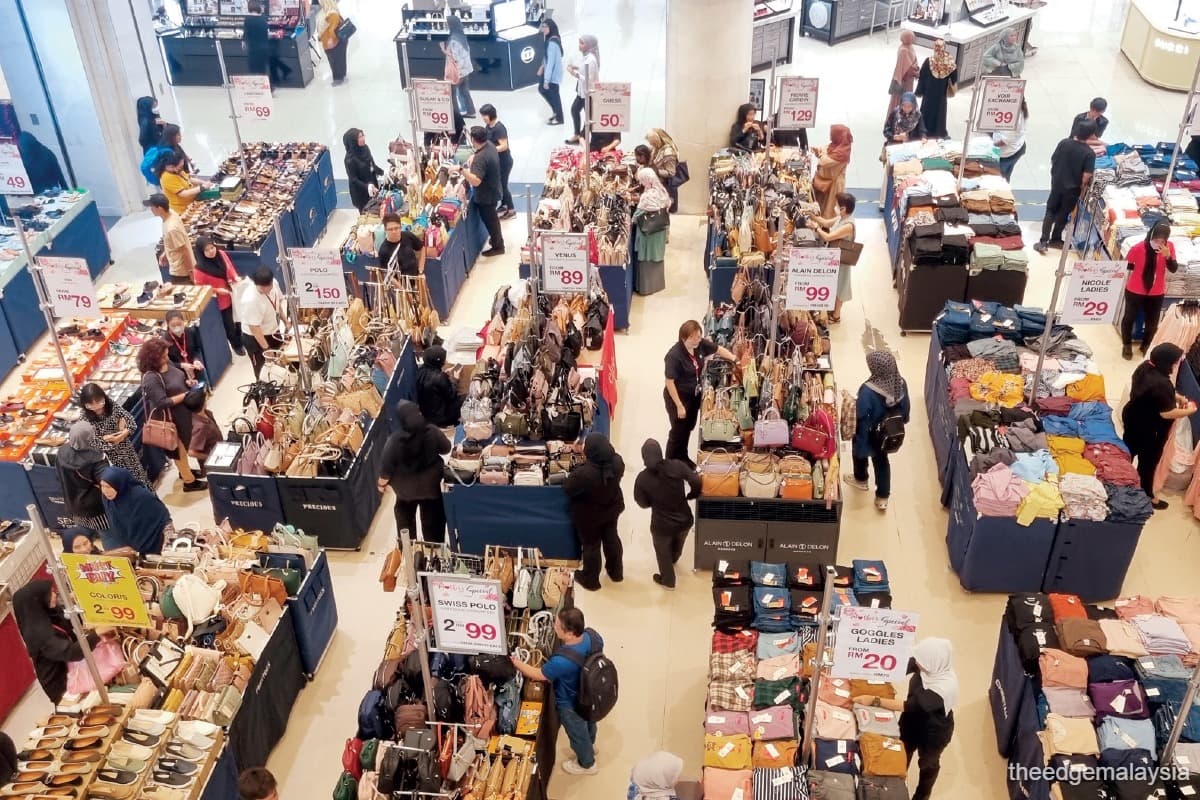
This article first appeared in City & Country, The Edge Malaysia Weekly on July 7, 2025 - July 13, 2025
For its 28th Malaysia Retail Industry Report, Retail Group Malaysia Sdn Bhd noted that Malaysia’s retail sales were expected to decline by 1% overall, with retail growth revised down to 3.1%, from 4.3%, for the remaining quarters of 2025. This adjustment is attributed to a weaker projection for the second quarter (2Q2025) and broader economic challenges.
The findings were based on feedback gathered from the members of the Malaysia Retailers Association (MRA) and Malaysia Retail Chain Association (MRCA).
Nevertheless, the report highlights that Malaysia’s retail industry recorded a positive growth of 5.6% in retail sales for 1Q2025, slightly below the estimated 5.9%.
Retail sales were boosted by festival shopping sprees and the month-long national school holidays. In 1Q2025, Chinese New Year fell on Jan 29, while Hari Raya Aidilfitri was celebrated on March 31 and April 1.
Malaysia’s attractive currency and visa-free entry for visitors from China and India also contributed to a surge in tourist arrivals, reaching 10.1 million and making Malaysia the most visited country in Southeast Asia during the quarter.
Looking ahead, the retail sector is expected to grow moderately by 2.8% in 3Q2025, with hopes for a 3.5% increase in the final quarter.
Retail and the economy
In 1Q2025, the Malaysian economy recorded 4.4% growth, driven mainly by sustainable private consumption, steady private investment, robust tourism and stronger government spending on investment projects.
Private consumption grew 5%, supported by resilient retail spending and a strong labour market, with unemployment easing to 3.1%. Labour force participation reached a record high of 70.7% in the quarter. The services sector expanded by 5% and the construction sector grew 14.2%.
The ongoing US tariff war has had a direct impact on Malaysia’s economy, causing growth to slow slightly below Bank Negara Malaysia’s earlier forecast of 4.5% to 5.5%. Disrupted supply chains and higher import costs have contributed to a slowdown in the export market.
Inflation remains moderate at 1.5%, although daily expenses continue to rise. The report highlights that prices for restaurants and accommodation services increased 2.9%, while food and beverage prices rose 2.5%. Costs for housing, water, electricity, gas and other fuels went up by 1.9%.
Personal care, social protection and miscellaneous goods recorded the highest price growth at 3.6% compared to 1Q2024.

Subsector retail sales show mixed results in 1Q2025
The year-on-year sales performances of retail subsectors in 1Q2025 were mixed. Top performers included fashion, which grew 12.2%, mini markets and convenience stores at 8.2%, and pharmacies at 4.6%.
The combined department store and supermarket subsector recorded positive growth of 5.8%, whereas the department store subsector alone grew 2.7%. The supermarket and hypermarket subsector posted encouraging growth of 3.7%.
Conversely, sales in the children and baby products subsector declined by 2.4%, while personal care dropped 3.7%. The home furnishing, electrical and electronics subsectors saw a decrease of 1.1%.
Sales in other subsectors fell 5.8% compared to the same period last year, including photo shops, fitness equipment stores, musical instrument retailers, sports stores, second-hand goods outlets and lifestyle product stores.
Asked about 2Q2025, members of the two retailer associations foresee business shrinking 1%, owing to changes in spending patterns for Hari Raya. Many subsectors are anticipated to see a drop as well.
The report highlights that department store-cum-supermarket operators expect a 0.7% decline in business, while department store operators foresee a sharper drop of 10.6% — the worst retail sales forecast for the quarter. Supermarket and hypermarket operators are also pessimistic, projecting a 9.5% decline in sales for 2Q2025.
In contrast, operators of mini-markets, convenience stores and cooperatives are optimistic, anticipating a 5.9% expansion — the highest forecast among retail subsectors. The fashion and fashion accessories subsectors expect moderate growth of 1.1%, while pharmacy operators predict slower but steady growth at 2.1%. Retailers in personal care foresee a strong recovery, with a 5.7% growth rate in 2Q2025.
Photo shops, sports stores and retailers of fitness equipment, musical instruments, second-hand goods and lifestyle products project a 9.4% decline, though. Children and baby product retailers expect a 2.7% drop, while operators in the furniture, home improvement, electrical and electronics sectors anticipate a slight decline of 0.8%.
F&B sector outperforms amid global and policy headwinds
In 1Q2025, food and beverage (F&B) establishments saw a surge in sales, driven by the Chinese New Year festival, the month-long school holiday and increased foreign tourist arrivals. Cafés and restaurants recorded a promising 6.5% growth compared to the same quarter last year, outperforming the 5.4% growth estimated by F&B operators in March.
Take-away outlets, kiosks and stalls experienced even stronger growth, with sales rising 12.3% — far exceeding their modest 0.1% projection.
Looking ahead to 2Q2025, café and restaurant operators remain optimistic, expecting sales to increase by 8.5%. However, kiosk and stall operators anticipate a decline of 8.2%.
Despite this positive momentum, the F&B sector faced challenges in 1Q2025. Global coffee prices surged because of adverse conditions in key producing countries, forcing many independent and chain coffee shops to raise prices.
In addition, the ongoing Israel-Palestine conflict has negatively affected several international F&B franchises in Malaysia. Consumer boycotts have led to significant losses, resulting in numerous outlets shutting down permanently or temporarily.
Malaysia 2025’s policy updates
An electricity tariff hike is set to take effect in the second half of the year. While 85% of Malaysian households will continue receiving government subsidies for electricity, businesses are expected to face higher operating costs.
From July 1, new tax changes have been introduced, with adjustments to the sales and service tax (SST). Selected luxury items — including king crab, truffle mushrooms, essential oils, imported fruits, silk, antique hand paintings and racing bicycles — will face increased sales tax rates ranging from 5% to 10%.
E-invoicing in Malaysia has been mandatory for all large corporations with revenue of more than RM100 million since Aug 1, 2024. Businesses with an annual turnover below RM500,000 are currently exempt from the e-invoice system.
These phased policy changes are expected to have minimal impact on the majority of small retail businesses in Malaysia.
On the other hand, the monthly minimum wage increased to RM1,700, from RM1,500, effective from Feb 1, 2025, affecting retailers and food operators reliant on foreign workers. Enforcement for companies with fewer than five employees will begin on Aug 1, 2025.
In May, the Ministry of Finance announced a delay in implementing the RON95 subsidy rationalisation to the second half of the year. The authorities are considering using the MyKad system to verify eligibility and better target subsidies to those in need.
Furthermore, in March, the Dewan Rakyat passed amendments to the Employees Provident Fund Act 1991, making EPF contributions mandatory for all foreign workers in Malaysia. Both employers and foreign workers are now required to contribute 2% starting from this October.
Save by subscribing to us for your print and/or digital copy.
P/S: The Edge is also available on Apple's App Store and Android's Google Play.