

This article first appeared in Capital, The Edge Malaysia Weekly on June 30, 2025 - July 6, 2025
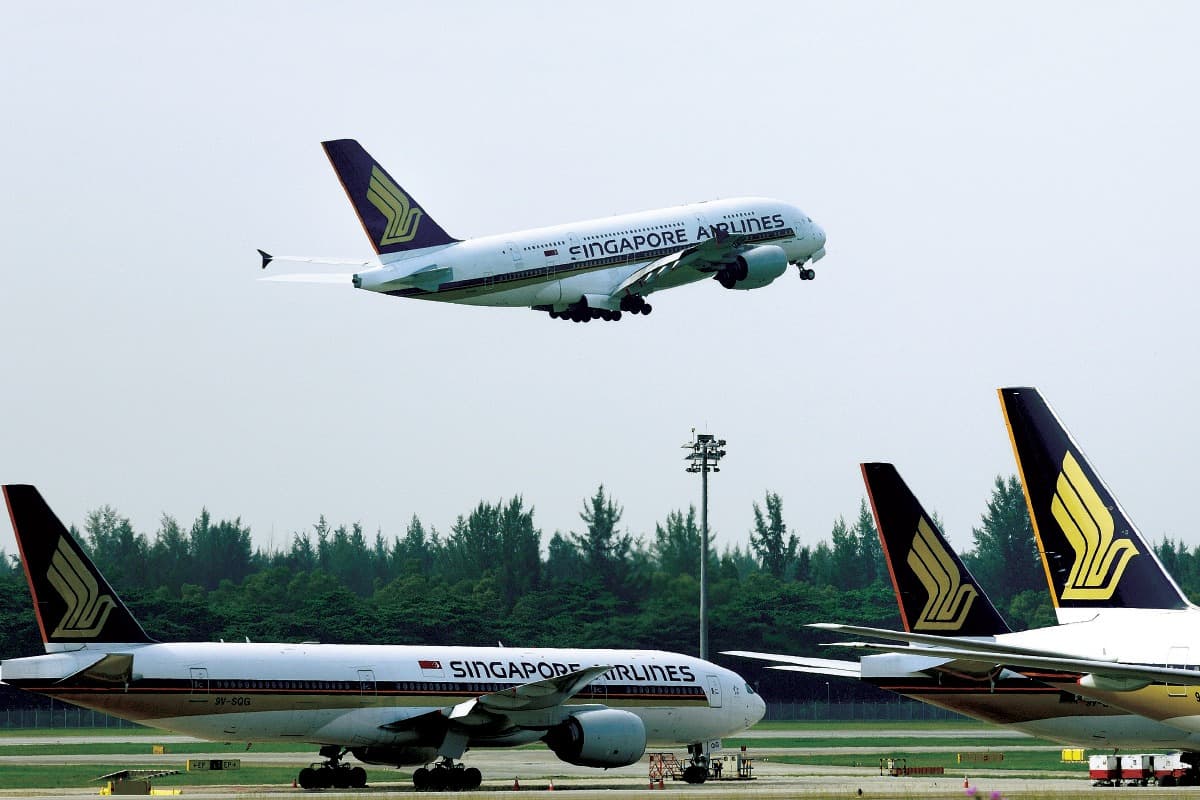
GLOBAL aviation markets are experiencing robust demand, with carriers such as Singapore Airlines Ltd (SIA) and Japan Airlines Co Ltd (JAL) emerging as standout performers.
The SIA Group, comprising full-service airline SIA and its low-cost subsidiary Scoot, reported a record net profit of S$2.8 billion (RM9.3 billion) for the financial year ended March 31, 2025. This marks the group’s third consecutive year of record earnings.
JAL also posted its highest profit since relisting in 2012, reporting a record net profit of ¥107.0 billion (RM3.1 billion) for the financial year ended March 31, 2025 (FY2025) — a 12% increase from ¥95.5 billion in FY2024.
Despite the strong post-Covid-19 profit streak, Asian airline stocks, including SIA, have struggled to maintain sustained investor interest. Year to date (YTD), SIA’s share price has risen just 6.2%, closing at S$6.85 last Tuesday (June 24).
Investor sentiment towards the airline stock has also been weighed down by the recent Air India plane crash, which claimed 270 lives. SIA holds a 25.1% stake in the airline.

JAL is leading the region with a 15.7% gain in its share price so far this year, while Hong Kong’s Cathay Pacific Airways Ltd has climbed 12.1%.
On the home front, AirAsia X Bhd’s (KL:AAX) share price has declined 19.7%, while Capital A Bhd (KL:CAPITALA) has fallen 17.16% over the same period.
Thai aviation stocks have largely underperformed in 2025. The share price of Asia Aviation pcl (AAV) has dropped 58.78%, while Bangkok Airways pcl is down 46.61%. Airports of Thailand pcl (AOT) has shed 48.95% YTD.
In a May 8 report, Maybank Securities downgraded its view on the Thai aviation sector to “neutral” as it expects international passenger growth in the country to remain muted at least until the third quarter of 2025.
“Significant slowdown of tourist arrivals from China is the main culprit [for the downgrade]. Airlines that operate China-Thailand routes continue to cut capacity as they do not see demand,” it says.
“AAV, as the leader of domestic market share, will be impacted the most as it has to face domestic competition after rotating capacity away from China. AOT will be impacted due to less benefit from operating leverage.”
The Thai aviation sector has been suffering since reports of an actor’s kidnapping went viral in China and fuelled safety concerns.
The research house is of the view that the sweeping US tariff announcements are likely to pose operational challenges for airlines, impacting both top-line revenue and operating costs. Travel demand growth in Asia is expected to decelerate, while expenses related to maintenance, leasing and personnel are likely to rise, it adds.
Despite this uncertainty, Bangkok Airways remains Maybank Securities’ top pick due to its high proportion of recurring income, cheaper valuation and attractive dividend yield of 8%.
Shukor Yusof, founder of aviation advisory firm Endau Analytics, believes investor interest in airline stocks has not fully recovered since billionaire Warren Buffett’s Berkshire Hathaway dumped all of its US airline holdings in May 2020.
“First of all, not many people invest in airline stocks — largely because many follow Warren Buffett, who gave up on airlines a long time ago. He was once heavily invested in US carriers. But after losing money, he decided they weren’t a good investment. I tend to share that view,” he tells The Edge.
“Airline stocks are part of the overall buoyancy, if you like, of the broader index. But the reality is that airline valuations aren’t keeping pace with [soaring post-pandemic travel demand]. Margins are still very thin and airlines are still struggling to make ends meet. Airlines historically have been vulnerable to downturns — the risks are still there,” he points out.
The global aviation industry continues to face a difficult operating environment, with no respite from ongoing challenges. Uncertainty surrounding trade policies and tariffs, broader macroeconomic instability and persistent supply chain disruptions are weighing on the sector. This could hurt consumer and business confidence, thus potentially impacting the demand for both passenger and cargo markets, according to airlines.
In recent days, airlines have been cancelling or rerouting flights to and from the Middle East amid the conflict between Israel and Iran, which has also driven oil prices sharply higher. Brent crude briefly hit a five-month high of US$77 per barrel on June 20 before retreating to settle at US$67.20 last Tuesday.
“I think it will be very challenging for national carriers like SIA and Cathay Pacific to sustain the momentum, returns and profits they’ve enjoyed in the post-Covid-19 period. I also expect global events, particularly geopolitical tensions, to worsen,” says Shukor.
“When tensions escalate, there will be significant repercussions for national airlines, especially in Southeast Asia, where many carriers operate flights to Europe. Much of the airspace over Iran and the broader Middle East is affected, and the closure of Ukrainian airspace further complicates routing.”
“As a result, the cost of flying has already risen, and I expect airfares to increase further as airlines try to offset these additional expenses. Airlines will have no choice but to factor this in as insurance premiums are also expected to rise.”
An analyst, who wishes to remain anonymous, says supply chain challenges have persisted since the onset of the pandemic. “Oil price disruption is definitely negative for airlines. At this point, we’ll have to see how the tensions unfold over the next one to two weeks. Hopefully, the situation doesn’t escalate further,” he says.
“Asian airlines should be largely unaffected by the Iran-Israel conflict. At least in Asia-Pacific, I don’t foresee any significant impact.”
The analyst believes SIA’s valuation appears far more compelling than that of Capital A, Asia’s largest low-cost carrier.
“Of course, oil prices are the main headwind at the moment, but I reckon SIA would have already built a substantial hedge buffer to mitigate this. I’m not overly concerned. They should remain profitable.”
He also highlights that frontloading activity is underway, which could benefit the air cargo segment. “Tourism may soften slightly — perhaps if China chooses to slow down — but overall, industry demand for travel is still expected to grow. The more pressing issue, in my view, is rising competition in the airline sector,” he says.
“Airfares are increasingly competitive. AirAsia, for example, is applying a wide range of ancillary charges — even for carry-ons. Consumers may respond by switching to alternatives like Batik Air.
“Competition is definitely the key challenge right now. That’s why I remain generally cautious on Capital A, despite the continued strength in underlying demand.”
Meanwhile, some analysts view Capital A’s plan to acquire smaller regional jets as a sensible move. The carrier’s CEO Tan Sri Tony Fernandes recently said the airline is in discussions to purchase up to 100 Airbus A220 or Embraer E2 regional jets.
“The load factor on an A320 may reach 100% in some months, but in others, the plane might not be full. In such cases, using smaller aircraft like the A220 could be more efficient,” says Maybank Investment Bank (IB) aviation analyst Samuel Yin Shao Yang.
“The A320 is relatively heavy and consumes a fixed amount of fuel. When the load factor is low, the fuel burn per passenger increases significantly. So, from an operational standpoint, switching to smaller jets like the A220 — which has lower fuel burn per passenger — makes logical and economic sense.”
Capital A gets a “buy” rating from Yin, who has a target price of RM1.09 — representing an upside potential of 29% from last Tuesday’s closing price of 84.5 sen. He notes that the group plans to complete the disposal of its aviation business to its medium-haul affiliate AAX by July in an effort to eliminate its negative shareholders’ equity.
Following two consecutive quarters of profitability, Capital A is aiming to have its Practice Note 17 (PN17) classification for financially distressed companies lifted by September this year.
“The change in strategy, in my view, suggests that AirAsia is now looking at regional jets because that’s where they see the most promising growth in the foreseeable future,” says Endau Analytics’ Shukor.
“They’re moving away from the A320 or A321 because margins are getting increasingly thin. The low-cost model is no longer truly low cost — financing costs have risen significantly and operational expenses have gone up as well. So, it probably makes sense to rightsize the fleet.
“Rightsizing means that for routes like Kuala Lumpur to Bangkok, Phuket or other nearby cities, you don’t necessarily need 170- to 180-seat aircraft, which is what AirAsia currently operates. A smaller regional aircraft like the A220, with a seating capacity of around 100 to 150, would be more efficient.
“It makes a lot more sense because your yields will improve. If you operate larger aircraft but can’t fill them, your yields will take a hit. The A220 allows them to optimise fleet size and give them flexibility to explore new destinations.”
In a June 3 note, Nomura Global Markets Research transport analysts Ahmad Maghfur Usman and Mishu Agarwal reiterated a “reduce” rating on Capital A, citing its demanding valuation amid the ongoing PN17 regularisation and restructuring plans.
“Our target price of 60 sen implies a FY2025 price-earnings ratio (PER) of 108.6 times. The stock currently trades at a FY2025 PER of 153.5 times. Our earnings estimates for Capital A (excluding aviation, which will then be transferred to AAX) stands unchanged at RM23 million for FY2025 and RM97 million for FY2026. These estimates assume that the restructuring begins on the first day of FY2025.”
Nomura adds that it expects the aviation business, excluding AAX, to generate core earnings of RM434 million in FY2025, up from RM169 million in FY2024.
Airfares trending lower
Maybank IB’s Yin says airfares are currently lower year on year, largely due to a stronger ringgit and lower oil prices. “When oil prices and currency costs drop, airlines tend to pass some of the savings on to passengers — though not entirely.
“Oil prices are still lower compared to last year, so we’re operating in a more favourable cost environment than in the previous two years. Of course, we can’t predict what will happen in the coming days. If geopolitical tensions escalate — like when Israel attacked Iran’s oil facilities — crude oil prices could spike, and that would be a different situation. But for now, it’s still business as usual.”
He points out that the second quarter has traditionally been the quietest period for the aviation sector.
As for the potential impact of natural disasters, Yin acknowledges the risks but does not see long-term structural effects. “Indonesia is dealing with a volcanic eruption and Japan has always had the risk of earthquakes. Yes, these events could impact Capital A, but I don’t believe the effects will be permanent,” he says.
“Indonesia and Japan are high-traffic destinations for Malaysian carriers. They’re essential rather than discretionary markets.”
He cites an example. “Years ago, AAX used to fly to New Zealand. But after the devastating Christchurch earthquake, passenger numbers dropped sharply and they pulled out of the market entirely. However, Indonesia and Japan are much more integral to Capital A’s network, so while natural disasters may affect revenue temporarily, I don’t expect a structural shift in their operations there.”
Shukor concurs, noting that national carriers such as Malaysia Airlines and SIA are now offering highly competitive prices for economy class. “It has become very affordable. From Kuala Lumpur International Airport, even Batik Air has been giving AirAsia a run for its money, especially on routes to India and Bangladesh,” he says.
He observes that AirAsia has lost its early advantage in the low-cost market. “AirAsia had a first-mover advantage for about five to seven years and was the dominant low-cost carrier. But that competitive edge has been significantly eroded — even before the pandemic,” he says.
“Looking ahead, the future of both low-cost and full-service airlines will largely depend on their ability to consolidate operations and adapt to the increasingly fluid geopolitical environment.”
Shukor also believes the aviation and air travel market has already plateaued.
“From here on, it’s likely to trend downwards. That’s why I believe the profitability of airlines like Cathay Pacific and SIA will also decline. They’re still strong performers, but the growth ahead isn’t likely to be significant, especially with escalating global conflicts. The world is so interconnected now that any geopolitical tensions have wide-reaching effects. And we’ve yet to see the full impact of potential tariffs under the second Trump administration,” he says.
“This is where our airline industry is very susceptible to all this uncertainty and unpredictability in the oil market. Aviation is a discretionary sector, right? So, people will travel only when they feel confident that there will be jobs, that there is growth, there is more savings. There is a wait-and-see attitude. So, that is the risk that the airline industry will face.”
Amid these conditions, identifying stocks trading below their estimated worth can offer potential opportunities for investors seeking value in an otherwise cautious market environment.
Maybank IB’s Yin remains positive on AAX, citing its attractive valuation. He maintains a target price of RM2.69 for the stock, based on an FY2025 PER of six times, which is below the global low-cost carrier average of nine times.
Looking ahead to the second quarter of 2025, Yin expects a seasonal easing in both passenger traffic and airfares for AAX.
“Despite the anticipated seasonal dip, we expect AAX earnings to be buoyed by the weaker US dollar and jet fuel prices. We estimate that every 10 sen depreciation in the US dollar relative to the ringgit will accrete about RM55 million to earnings on a full-year basis, while every RM1 per barrel decline in jet fuel prices will accrete about RM15 million to earnings on a full-year basis. Maintenance costs also ought to ease due to lower utilisation of aircraft and fewer unscheduled checks,” he says.
In a May 19 report, Nomura upgraded SIA to a “buy” from “neutral”, raising its target price to S$8.04, which represents an upside potential of 17.4% from last Tuesday’s closing price.
“We have revised higher our earnings estimates for FY2026 and FY2027 by 29% and 15% respectively, amid a benign jet fuel environment, which will help boost margins, in our view. This is partly mitigated by lower passenger yield for FY2026/FY2027 (-2%/-3%) for full-service airlines as more capacity enters the market due to increased competition,” it says.
“We believe uncertainty stemming from the impact of ongoing trade tensions and easing of shipping disruptions will lead to softer cargo demand, leading to lower yields (-2%/-3%) for FY2026/FY2027 respectively.”
With its shares currently trading at an FY2026 PER of 8.6 times, SIA appears relatively attractive compared with its peers, which are trading at an average PER of 17.2 times, says Nomura.

Save by subscribing to us for your print and/or digital copy.
P/S: The Edge is also available on Apple's App Store and Android's Google Play.