

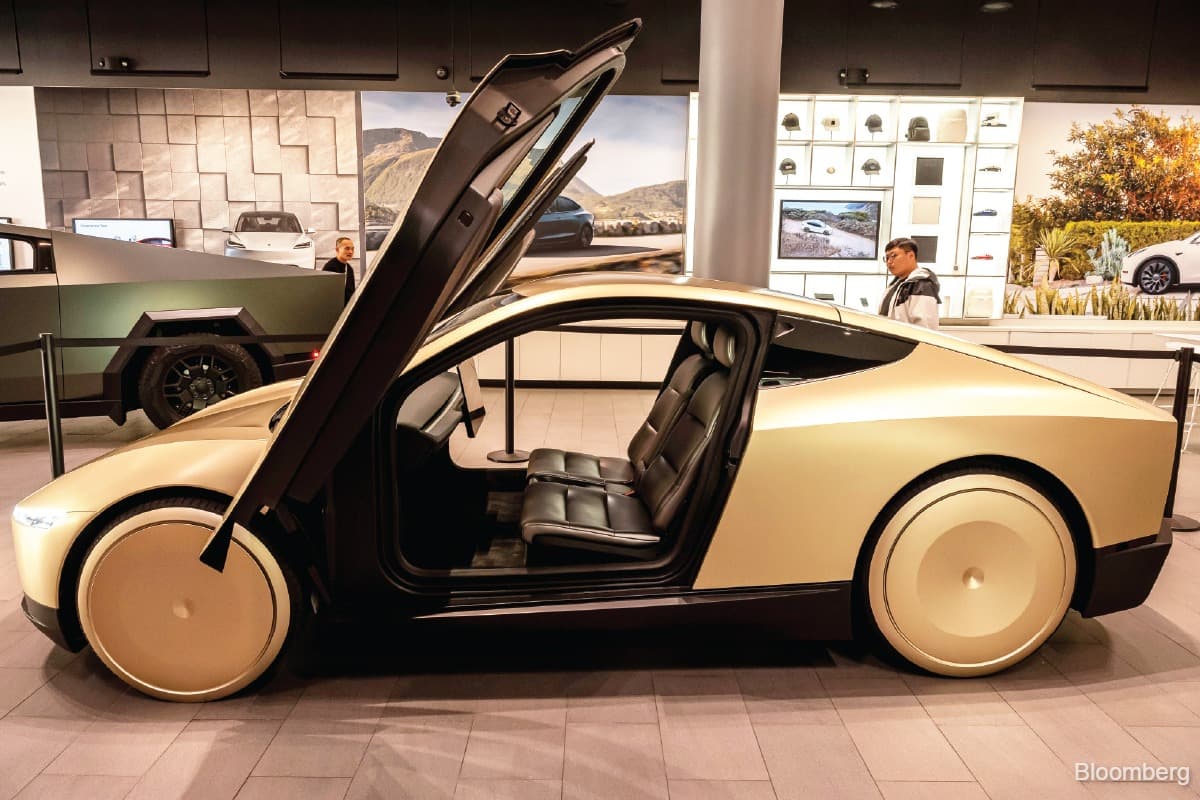
This article first appeared in The Edge Malaysia Weekly on June 30, 2025 - July 6, 2025
ON Sunday, June 22, billionaire entrepreneur Elon Musk’s pioneering electric vehicle (EV) maker Tesla Inc launched its first robotaxi service in Austin, Texas, with its Model Y. But robotaxis are old news. Google owner Alphabet Inc’s Waymo has been operating driverless cabs in San Francisco, Silicon Valley and Phoenix for four years now. Over the past year, Waymo has expanded its service to Los Angeles, Austin and Miami, Florida. Just this past week, Waymo introduced its robotaxi service to Atlanta, Georgia. Washington DC, New York and Tokyo are its next major destinations.
Although I have written about my rides on rival Waymo robotaxis in Phoenix in this column, I was not in Austin for Tesla’s weekend launch. For one thing, currently the rides are limited to invited guests and influencers. For another, I would rather wait until Tesla starts operating its Cybercabs, which have no steering wheel, next year.
Here is what I know about robotaxis, having made multiple trips. Robotaxis are a better ride than cars driven by humans. They are also far safer. Over 40,000 people die in road accidents in the US every year. And given the option of riding an Uber driven by human or a robotaxi driven by data, sensors and radars, I will always choose the latter. There is now data that shows a lot of people agree with me. Waymo is gaining share from Uber and Lyft in San Francisco even though its service is up to 40% more expensive than Uber’s. One in five people using ride hailing in cities where robotaxis are available chose them over ordinary ride hailing alternatives. In Austin, 19% of Uber users chose a Waymo driverless cab even though it was more expensive. It is unclear if users are choosing Waymo for the novelty or because they genuinely like to ride robotaxis or hate being driven around by a human driver. Waymo robotaxis now make up 20% of Uber rides in Austin.
Tesla’s maiden Austin robotaxi is nothing like Waymo’s. It only plies within a small geo-fenced area in Austin. Trips to and from airports are currently excluded and Tesla says its service may be limited or unavailable due to bad weather. Most importantly, for the first several weeks at least, Tesla will have a safety monitor sitting in the front passenger seat of the vehicle, while remote drivers also closely monitor each ride, as backup.
After General Motors Co’s robotaxi subsidiary Cruise’s operations were shuttered two years ago following a San Francisco incident in which an elderly woman was killed, Tesla is clearly taking no chances. An accident like Cruise’s could severely damage Musk’s reputation and derail Tesla’s ambitious plans to become a global leader in autonomous vehicles, artificial intelligence (AI), humanoid robots and energy storage.
Tesla currently has a market capitalisation of US$1.1 trillion (RM4.7 trillion). That’s more than the value of all other listed and unlisted car manufacturers in the world combined. Tesla produced just 1.77 million EVs last year and is expected to manufacture 2.07 million vehicles this year. It now has a 2.75% share of the total global passenger car market and about 11% share of the global EV market. Tesla sales in Europe and China hit a speed bump soon after its main Chinese rival BYD overtook it to become the world’s No 1 EV maker.
The move from EV manufacturer to robotaxi operator dramatically transforms Tesla’s business model. It is shifting from selling hardware or EVs to a recurring revenue model with software-like margins. Tesla’s aim is to eventually scale up its robotaxi business by expanding to a number of cities, initially in the US and eventually in China, Europe and around the world. There would be over eight million Teslas on roads around the world by the end of this year. Think of Tesla’s robotaxi business like Airbnb. Anyone who has a home or part of a home to rent can do so on the Airbnb platform. Tesla is betting that whenever unsupervised full self-driving or FSD is available, Tesla owners will happily rent their vehicles out to earn some money rather have them sit in their driveway or office car park.
The average American drives his or her car for no longer than an hour every day. That means for 23 hours a day, the car is not utilised. There are two ways the robotaxis could evolve. People will give up their cars and switch entirely to robotaxis because the cost of car ownership, insurance, road taxes, petrol and car parking fees makes them prohibitive. Or they can afford the car but are happy to earn some money renting it out for robotaxi duty.
Vertically integrated player
The way Musk sees it, Tesla is neither a car maker nor an EV maker. It wants to be an integrated robotaxi maker that designs and manufactures robotaxis as well as run a ride-hailing service that competes with Uber and Lyft in North America, Grab in Southeast Asia and Didi Chuxing in China.
Little, wonder then, that robotaxis are critical to the Tesla investment case because once Tesla is able to prove that it can provide a reliable and safe service using a camera-based supervised FSD system, it could dominate robotaxi services on price and scale despite Waymo having the first-mover advantage.
Waymo first introduced its robotaxis in San Francisco in late 2018. It currently has a fleet of over 1,500 cars with plans to add another 2,000 robotaxis over the next 12 months. Tesla is starting with about 16 cars in Austin, raising that to 36 robotaxis later this year in the city. Tesla makes over 5,600 cars a day, all of which can be converted into robotaxis with FSD software. Yet while Waymo has been on the roads since 2018, Tesla is a Johnny-come-lately in the robotaxi game. Musk has been talking about “switching on” a million Teslas with FSD software since 2018.
Waymo uses Jaguar’s all-electric I-PACE cars that retail for around US$72,500 in the US. Tesla, for its part, is using its Model Y whose most basic version costs US$45,000 in the US. Add more bells and whistles and you’d be paying much more. On the eve of the Austin launch, Musk reminded followers on his X platform that Tesla is a vertically integrated robotaxi operator. “These are unmodified Tesla cars coming straight from the factory, meaning that every Tesla coming out of our factories is capable of unsupervised self-driving,” he added. Tesla sells FSD software to facilitate self-driving. There are more than eight million Teslas on the road, most of which are capable of working on FSD software. All those cars could effectively be ‘‘turned on’’ and operate as robotaxis.
Yet pricing is still key. It’s not just the US$45,000 Model Y Tesla being pitted against the US$72,500 Jaguar I-PACE. For starters, US$45,000 is the retail price for the Model Y. It probably costs Tesla less than US$35,000 to make the car. As a vertically integrated robotaxi operator, Tesla has advantages that Waymo doesn’t. Moreover, customising a Jaguar I-PACE for robotaxi operations is expensive. Google’s total per car cost is reportedly just over US$250,000. Essentially, a US$35,000 Tesla is competing against a US$250,000 Waymo. As Tesla switches to Cybercabs with no steering wheel and no pedals, analysts predict prices could drop even further to nearly US$15,000 per Cybercab.
Here’s why converting the I-PACE into a robotaxi is so expensive: Waymos need an expensive array of sensors, radars and Lidar, or light detection and ranging, a method for determining ranges by targeting an object or a surface with a laser and measuring the time for the reflected light to return to the receiver. Tesla robotaxis have no Lidars or radars; they use a more machine learning-oriented approach. Musk’s idea is that a Tesla car using FSD software should be able to make decisions on its own, more like a human driver might.
Adjusted for inflation, the cost of owning and operating a personal car has not changed since Ford’s Model T rolled off the first assembly line in 1908. A personal car currently costs an average American US$1.10 per mile. A human-driven ride-hailing car costs on average US$2 per mile. Tech-focused fund manager ARK Invest estimates that autonomous taxis at scale could cost consumers as little as US$0.25 per mile within 10 years, which will spur widespread adoption.
Data-gathering juggernauts
EVs are essentially data-gathering juggernauts. Waymo topped nine million rides last year, while its main Chinese peer Baidu’s Apollo Go completed three million rides last year. Yet with the largest data lake of all players globally, Tesla’s proprietary data advantage should give it a competitive edge. Tesla is gathering just under 10 million miles of FSD data per day. Compare that with Waymo’s 250,000 miles per day.
Why is gathering data so important? For one thing, it helps train Tesla’s and Waymo’s AI algorithms. In a recent white paper that it published, Waymo mentioned it has noted that with increased data and compute, the performance of autonomous vehicles improves. Though Tesla only introduced its robotaxi service this past week, its cars have been collecting data for years wherever they go.
One big issue for driverless cars until recently was regulators, who took years before they would allow state-of-art mobility services on the streets. Before his recent row with President Donald Trump, Musk moved swiftly in his role as the head of the Department of Government Efficiency, or DOGE, to convince regulators like the National Highway Traffic Safety Administration, or NHTSA, that they needed to expedite permission to companies like Tesla so they could compete with rivals at home and abroad. NHTSA has cut approval times from a few years to a few months. On June 23, Texas enacted a law requiring operators of autonomous cars like robotaxis to get approval from the state’s Department of Motor Vehicles before operating on public streets without a human driver.
Waymo’s entry last week into Atlanta in partnership with Uber will bring additional competition to the state. Lyft Inc, Uber’s main North American rival, is expected to launch its own Atlanta robotaxi service — with safety operators on board — in partnership with Japan’s Toyota Motor Corp-backed May Mobility Inc in August. Another robotaxi start-up, Amazon.com Inc’s Zoox Inc, has also been testing its driverless technology in Atlanta. And then there is Tesla, which is eager to take on the other three with its version of robotaxis next year.
Toyota isn’t the only legacy automaker that’s toying with a robotaxi project. German auto giant Volkswagen, which has been making EVs for the past four years, is getting into robotaxis as well with Uber. The duo will launch their first service in Los Angeles, where Waymo has been operating for the past year. Uber already has a partnership with WeRide Inc to operate robotaxis in the United Arab Emirates.
Robotaxis are coming to Asia too. China has had limited robotaxi service for a few years. Goldman Sachs in a recent report predicted there would be 500,000 robotaxis operating in over 10 cities in China by 2030. Waymo will start trials in Tokyo this year. China’s Apollo Go recently announced it is looking to start a robotaxi service in Singapore and Malaysia. Baidu, WeRide, Pony.ai and Volkswagen are looking at several European cities to launch robotaxis. Unlike ride hailing with just one or two dominant players in each market, there will be multiple robotaxi operators globally because the aim is not just to be a ride hailing service but a car replacement. Since Tesla already sells globally and can activate the robotaxi function with its FSD software, Musk’s EV firm will clearly be a formidable robotaxi player globally. “With the largest data lake of all players globally, its proprietary data advantage should give Tesla a competitive edge” against rivals, notes ARK Invest’s Cathie Wood. Because Musk is back running Tesla, it will likely be a memorable but bumpy ride.
Assif Shameen is a technology and business writer based in North America
Save by subscribing to us for your print and/or digital copy.
P/S: The Edge is also available on Apple's App Store and Android's Google Play.