

This article first appeared in The Edge Malaysia Weekly on June 30, 2025 - July 6, 2025
SOUTHERN Acids (M) Bhd (KL:SAB) continues to fly under the radar despite its strong balance sheet and potentially undervalued strategic assets.
As at end-March, the group reported net assets per share of RM5.69, nearly 1.8 times the RM3.20 its share price closed at on June 24. It had total assets of RM1 billion and liabilities of just RM125 million.
Southern Acids has a net cash position of RM370.42 million, with RM385.42 million in total cash against short-term borrowings of RM15 million. Together with RM205.41 million worth of property, plant and equipment and RM139.87 million in land held for development, these three components represent 72.5% of the group’s total assets.
From a valuation perspective, Southern Acids’ enterprise value stands at just RM67.77 million, calculated from its market capitalisation of RM438.19 million less net cash. This suggests that the market may be underpricing its intrinsic worth.
Among the group’s most strategic assets is the 644.49-acre Thangamallay Estate, owned via its wholly-owned unit Pembinaan Gejati Sdn Bhd. The land sits adjacent to major township developments such as Gamuda Bhd’s (KL:GAMUDA) twentyfive7, Eco World Development Group Bhd’s (KL:ECOWLD) Eco Sanctuary, Tropicana Corp Bhd’s (KL:TROP) Tropicana Aman and IJM Land Bhd’s Bandar Rimbayu.
Despite its prime location, the land is recorded at a book value of only RM5 per sq ft (psf) due to its classification as “inventory” under land held for property development. Southern Acids stated that the classification prevents the land from being revalued. As a result, its valuation reflects its historical acquisition cost rather than market potential as the company originally acquired the estate in June 1995 with plans for a mixed-use development.
In contrast, land transactions in the vicinity were recorded at RM35 psf in 2014, particularly those involving Gamuda and EcoWorld. Should Southern Acids divest the estate at that price, it could fetch RM982 million — some RM842 million above its book value. This latent gain would translate into a surplus of about RM6.15 per share.
Despite the land’s potential, Southern Acids has taken a cautious stance. In 2024, it reiterated that it had no immediate plans to develop Thangamallay, citing the need for the right timing and capabilities. The estate is currently planted with prime aged oil palm trees that generate consistent agricultural revenue.
Management maintains that any property venture would only proceed under favourable market conditions and when internal readiness aligns with external opportunities. This conservative posture has been consistent since 2016, with the company preferring to preserve value rather than rush into development.
Currently, the Thangamallay land benefits from improved accessibility, with Bandar Rimbayu Sdn Bhd having constructed and maintained a 2.2km, two-lane dual carriageway on its northern parcel. In June 2021, Southern Acids surrendered 960m of the 2.2km stretch to the Kuala Langat Land Office in exchange for a surrender incentive of RM10 million.

Consistently paying dividends
Southern Acids was founded in 1980, initially focusing on oleochemical manufacturing before expanding upstream into the palm oil sector. This strategic move allowed the company to capitalise on palm oil as an alternative feedstock for the oleochemical industry, which was then primarily reliant on tallow and coconut oil.
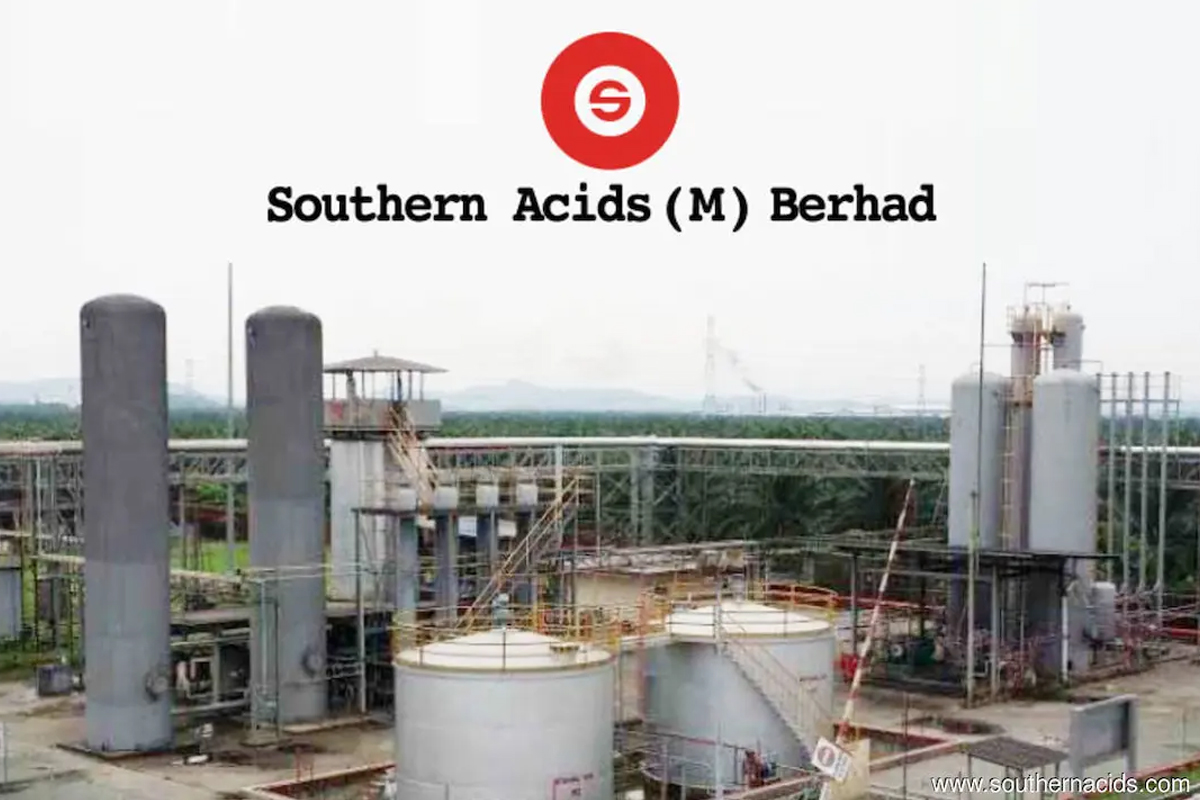
The group operates two palm oil mills across 7,236.7ha of plantation land in Riau, Indonesia, along with an oleochemical production facility in Klang. Palm oil operations account for about 85% of its total revenue.
Additionally, Southern Acids owns the Sri Kota Specialist Medical Centre, a 232-bed private tertiary hospital in Klang that was commissioned in September 1999. Contributing about 11% to the group’s total revenue, the hospital specialises in cancer, heart and spine treatments through its centres of excellence.
The company also holds 27 million shares, or 4.34% equity interest, in Paramount Corp Bhd (KL:PARAMON). It has held the shares since at least April 2000. The stake is now worth about RM28 million, with an indicative dividend yield of 7%.
Since its listing in 1991, Southern Acids has consistently paid dividends. It has been profitable every year, except for FY2009, which was impacted by extreme fluctuations in oleochemical feedstock and crude palm oil (CPO) prices.
Despite posting a record-high net profit of RM94.45 million in FY2022, benefiting from a windfall due to elevated CPO prices, management has remained prudent and conservative, maintaining a dividend per share of five sen, or a payout ratio of just 7.3%.
Management has defended its stance, citing its RM300 million cash balance as modest given the scale of its three operating divisions. The cash will be allocated to future business expansions as opportunities arise. Over the past decade, the group has invested a total of RM270 million in net capital expenditure, averaging RM27 million per year.
In the financial year ended March 31 (FY2025), Southern Acids recorded a net profit of RM36.7 million, a significant increase from RM13.63 million in the previous year, driven by the strong performance of its upstream palm oil segment. Total revenue rose 20% to RM1.09 billion, from RM907.96 million.
High cash reserves essential for operational scale
Southern Acids’ downstream oleochemical segment has been in the red for six of the past seven years, facing significant challenges and intense global competition from Indonesia. In 2024, management indicated that the division was expected to incur losses over the next few years, emphasising that turning the situation around would take time.
Notably, the oleochemical plant is more than 30 years old, making it less efficient and increasingly vulnerable to rising energy costs. The statutory requirements of higher energy tariff, minimum wage policy and reduced working hours have further strained the group’s cost structure.
Its board of directors previously estimated that replacing the entire plant would cost between RM300 million and RM500 million. However, rather than upgrading its size or technology, the company is focused on improving its cost efficiency. The board also stated that it would explore ways to ensure the company remained competitive over the long term.
As for its upstream segment, since 2024, the group has committed RM85 million over the next four years to plant an additional 2,200ha in Riau. Its current planted hectarage stands at about 4,900ha, with an evenly distributed age profile of young, prime and old trees, averaging 10 years.
This expansion is driven by the fact that its internal estates currently supply only 16.8% of the required volume for its two palm oil mills, which have a combined milling capacity of 100 tonnes per hour. By increasing in-house supply, the company aims to mitigate exposure to feedstock price fluctuations. Management previously indicated plans to expand the planted area to about 10,000ha.
As for its hospital operations, the segment has seen a steady upward trend in net profit over the years. Southern Acids stated that it would continue upgrading services to retain existing clients while exploring new market segments to attract additional customers. The company highlighted that improvements to the oncology centre have contributed to new revenue growth in recent years.
Despite this performance, management has taken a cautious stance, emphasising that healthcare services come with inherent risks and are not guaranteed to remain stable. So far, hospital-related capital expenditure has been focused on equipment purchases and renovation works. In FY2025, the hospital recorded 72,645 outpatient visits and 11,747 inpatient admissions, maintaining stable patient numbers.
Southern Acids will require substantial financial resources if it chooses to develop the Thangamallay land for property projects in-house.
Limited market interest due to tightly held shares
Southern Acids shares are notably illiquid on the market, with an average trading volume of just 11,104 shares over the past 200 days — equivalent to 111 board lots.
The company’s free float is estimated at 17.3%, with the majority of the shares controlled by the founding families, primarily the Low and Lim groups. The top 30 shareholders collectively hold 83.6% of the company’s issued shares.
Among its institutional investors, Lembaga Tabung Haji is the only notable public entity with a significant stake, holding 11.31% of the company. The remaining major shareholdings are concentrated in joint investment vehicles and individuals affiliated with the founding families.
Managing director Dr Nick Low Kok Thye is deemed to have an interest of 47.97% in the company, while executive director Datuk Lim Kim Long is deemed to have an interest of 50.21%. The respective stakes are jointly held primarily via eight investment vehicles owned by members of the Low and Lim families, further reinforcing their control over the group.
Nick, the son of Tan Sri Low Boon Eng, was appointed managing director in 2015, filling the position that had remained vacant since Nov 2, 2007, following the resignation of former managing director, the late Datuk Low Mong Hua, one of the company’s founding members. Boon Eng, a former chairman of Southern Acids from 2010 to 2015, is the first cousin of Mong Hua.
Meanwhile, Kim Long has served on the board of directors since 2005. He is the son of Lim Boon Eng, another co-founder of the group.
At the time of writing, Southern Acids’ shares were trading at RM3.20 apiece, reflecting a 37% discount to its net assets per share of RM5.69. The share price remains slightly above its 10-year low of RM2.75 that it fell to in March 2020 during the Covid-19 pandemic, while its 10-year high was RM5.70 in June 2014. The stock has a trailing price-earnings ratio of 11.9 times and an indicative dividend yield of 1.56%.
The company declined comment when contacted for this article.
Save by subscribing to us for your print and/or digital copy.
P/S: The Edge is also available on Apple's App Store and Android's Google Play.