

This article first appeared in The Edge Malaysia Weekly on June 30, 2025 - July 6, 2025
DESTINI Bhd (KL:DESTINI), previously known as Satang Jaya Sdn Bhd from its inception in 1991, has undergone a significant transformation from being a niche aviation parts supplier to a diversified industrial group. Today, it operates across multiple sectors, including defence, oil and gas (O&G), marine, and mobility, serving both the government and commercial clients, locally and internationally.
Destini reappeared on investors’ radar screens recently, which is reflected in its share price that had more than doubled to 43.5 sen last Wednesday from an all-time low of 21 sen on Aug 23, 2024. This increased its market capitalisation more than twofold to RM238.8 million in less than 10 months.
The renewed investor interest comes on the back of the company’s financial turnaround in the nine months ended June 30 (9MFY2025) following nearly five years of consecutive losses, with the exception of 2021.
During the period in review, Destini recorded three consecutive quarters of profitability — posting a net profit of RM5.33 million in 1QFY2025, RM6.07 million in 2QFY2025 and RM8.35 million in 3QFY2025 — driven primarily by strong contributions from its mobility and aviation segments.
This marked a significant rebound from the group’s earlier performance, where it reported a net loss of RM136.76 million after a massive impairment exercise on revenue of RM160.85 million for the 18 months ended June 30, 2024. The extended reporting period followed a change in the group’s financial year end to June 30 from Dec 31.
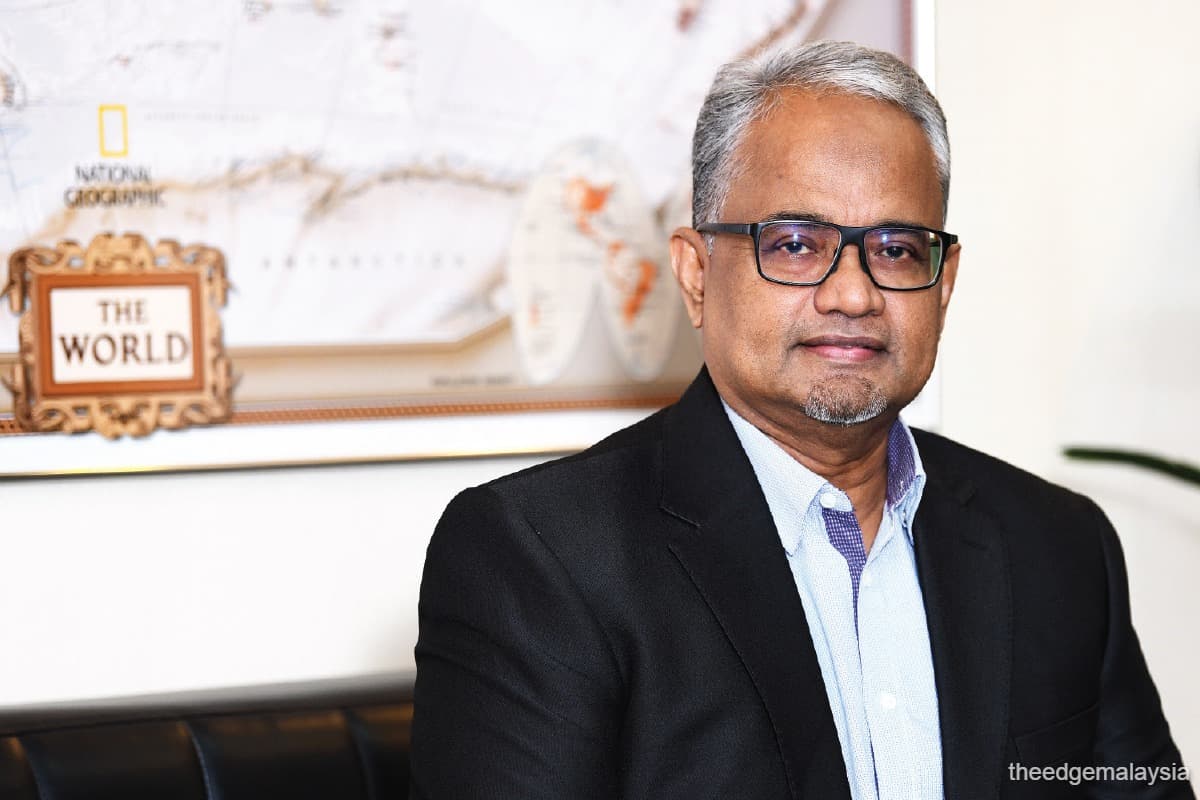
Destini executive director Ismail Mustafa believes that the worst is over for the group after more than two years of extensive corporate restructuring. These efforts included a series of corporate exercises such as kitchen sinking, asset disposals, the closure of 46 subsidiaries, cost rationalisation, a RM133 million cash call and a share consolidation.
“If you look at our order book, we have very clear visibility of contract flow over the next three years, particularly from the rail and aviation segments in the defence industry,” Ismail tells The Edge in an interview.
He reveals that Destini’s current order book stands at RM785 million, with the majority coming from its mobility segment. The tender pipeline is valued at about RM1 billion.
A major turning point for Destini came in 2021 when the group formed a 70:30 joint venture (JV) with Keretapi Tanah Melayu Bhd (KTMB), effectively entering the “rail-tec” space. In May 2022, the JV secured a RM531.39 million maintenance, repair and overhaul (MRO) contract from the Ministry of Transport (MoT) for 35 train sets operated by KTMB over 4½ years. Later that year, it secured another MRO contract involving 10 electric train sets (ETS), also operated by KTMB.
To date, six train sets have been successfully serviced and returned to the ministry, says Ismail.
Last Thursday, Destini bagged another contract from MOT for RM71 million to carry out Level 3 MRO works for nine ETS train sets. This came a day after the group clinched its first MRT-related job to overhaul the heating, ventilation and air conditioning (HVAC) systems and brake calipers on 58 ETS running on MRT Line 1, which connects Sungai Buloh to Kajang. The subcontract, awarded to its indirect subsidiary Trovon Malaysia Sdn Bhd by SMH Rail Sdn Bhd, is for 20 months from June 2025 to January 2027. There are no details of the contract value. The group acquired Trovon, a loss-making rail component remediation firm based in Australia, for A$100 (RM285.12) last year.
“We are positioning ourselves as an engineering solutions company, riding our historical expertise in providing safety and survival equipment. Looking ahead, we are targeting more opportunities in the rail sector, especially with the government’s push to expand rail utilisation,” he adds.

Leadership, restructuring and corporate exercises
Destini’s restructuring began in late 2023 with a major management shake-up. After the departure of long-time executive chairman Datuk Rozabil Abdul Rahman in February that year, the group underwent leadership and shareholding changes.
Subsequently, in July that year, Datuk Abdul Aziz Sheikh Fadzir — a former member of parliament for Kulim-Bandar Baharu and previously an independent non-executive director of Destini — rejoined the board as an independent non-executive director. He had held the same position from Aug 30, 2017, to May 18, 2018. He also emerged as a substantial shareholder of the company with an 11.4% stake.
Soon after, Aziz brought back Ismail, a seasoned Destini executive, to spearhead the group’s revival. Ismail had joined Destini in 2011 when it was a Practice Note 17 (PN17) firm and played a key role in lifting it out of the status in 2013. He later led Destini’s wholly-owned subsidiary Destini Armada Sdn Bhd in Singapore, which was involved in shipbuilding activities. He oversaw plans for a dual listing on the Catalist board of the Singapore Exchange — plans that were ultimately shelved due to the 2018 change in government and the Covid-19 pandemic. It should be noted that the bulk of Destini’s projects comes from the public sector.
The change in government led to the review and delay of key public sector projects, such as the RM740 million Offshore Patrol Vessel (OPV) programme, which was complicated by a JV with the troubled TH Heavy Engineering Bhd, which in turn hindered project financing and ultimately led to Destini divesting its 51% stake, and a RM100 million helicopter supply contract for six Li-Attack helicopters. The latter was delayed for three years, burdened by the interest for an RM18 million loan that strained the group’s cash flow.
These setbacks severely impacted Destini’s cash flow and pushed it into a challenging period, says Ismail.
Upon assuming leadership in August 2023, the new management implemented a three-pronged turnaround strategy that included cost rationalisation by closing 46 subsidiaries and asset disposals, cash injection by shareholders through a rights issue in March 2024, and focusing on delivering on the existing contract.
Destini executed two major corporate exercises, including a 2-for-1 rights issue with detachable warrants in early 2024, raising RM133 million for working capital and refinancing. A share consolidation of 10-for-1 was done in June 2024.
“The turnaround plan has been successful, and we expect to see better cash flow in the second half of 2025,” says Ismail.
Better earnings prospects ahead
Destini’s earnings outlook appears increasingly positive, buoyed by a solid order book and strategic positioning in high-growth sectors.
According to New Paradigm Research, which recently initiated coverage with a “buy” call and target price of 65 sen per share, Destini could record about 32% year-on-year earnings growth in FY2026. This projection is underpinned by the consistent execution of its MRO contracts for KTMB.
“We anticipate upside potential to our assumptions, pending variation orders to the scope of work. We believe Destini should trade more like a construction stock going forward and enjoy a rerating in valuation as it secures new contracts,” the research firm notes in a June 24 report.
While rail-related contracts provide most of Destini’s current momentum, its aviation and defence segment remains a steady contributor. The division is certified by renowned ejection seat manufacturer Martin-Baker.
“Aviation has been a consistent business for us since the company was founded in 1991. I would even call it recession-proof. Although the current order value in this segment stands at about RM28 million, we are actively pursuing more contracts,” says Ismail.
In the O&G space, Destini holds an order book worth about RM86.1 million, further diversifying its revenue stream. Additionally, the group is participating in the green energy transition through a 10mw solar installation project across 360 sites for Indah Water Konsortium Sdn Bhd.
On the international front, Destini has an operational footprint in Singapore, Australia, China and the United Arab Emirates. Ismail notes that these platforms are being assessed for potential expansion, particularly in the rail sector, which is gaining traction regionally and domestically.
“We already have strategic bases across the region and the next step is to leverage them to break into high-growth markets, especially in rail. Having said that, our immediate priority is to solidify our capabilities at home, where we see strong growth potential in the rail industry,” he adds.
Save by subscribing to us for your print and/or digital copy.
P/S: The Edge is also available on Apple's App Store and Android's Google Play.