

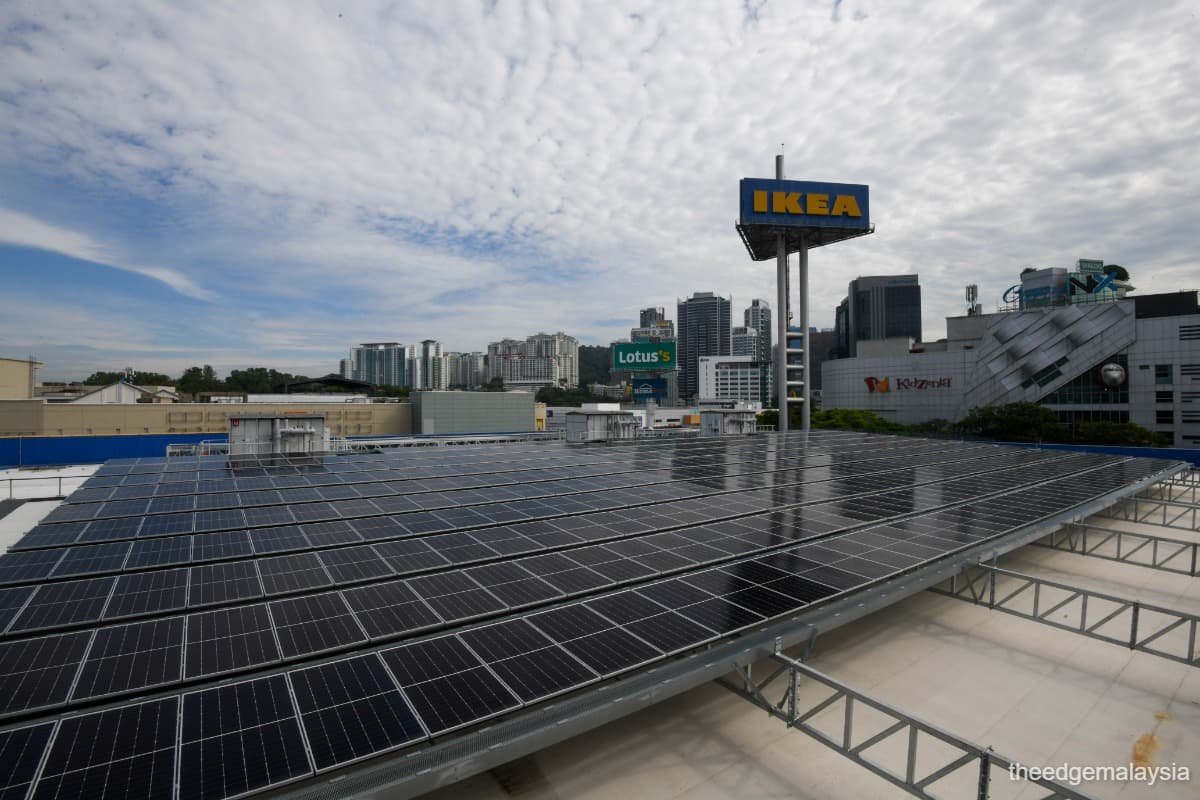
KUALA LUMPUR (July 1): Peninsular Malaysia’s rooftop solar quota saw mixed take-up as the latest net-energy metering (NEM) mechanism ended on Monday night (June 30), ahead of the start of new, itemised electricity tariff structure implementation beginning July 1.
At the time of writing, while rooftop solar quota for government buildings has achieved near full take-up of 100MW, the residential quota still has 13.19MW left of the additional 100MW opened up since late May.
Meanwhile, the commercial and industrial quota — which previously saw the fastest take-up among all categories — still has 282.69MW outstanding, the official data showed.
This trend is different from previous quota releases, which saw full take-up among households and companies in recent times when they were added, as participants moved to hedge against rising energy costs.
According to those involved in the sector, the latest trend in response came as current and potential users of solar energy digest the impact of the new electricity tariff structure on their electricity bills.
This is considering the new structure now breaks the tariffs across all user categories down into two general parts: one part for users to pay for the energy used, and the other part for non-energy costs such as infrastructure costs (such as grid development).
The non-energy charges are new for households and low-voltage users, and for medium-voltage users, it takes up a higher percentage of the tariff compared with before.
Under the aforementioned rooftop solar programme known as NEM, household and low-voltage users could use solar energy to offset their entire bill — where every kilowatt-hour (kWh) of solar generated can offset every kWh consumed.
As such, the new tariff structure has sparked debate on whether solar users’ electricity bills will jump, considering there is no clarity on how the NEM will be calculated. For example, homeowners who have already installed rooftop solar now wonder whether excess solar energy generated can offset the non-energy charges.
It is understood that the government agencies overseeing the sector such as the Energy Commission and the Sustainable Energy Development Authority, as well as the Ministry of Energy Transition and Water Transformation (Petra), are cognisant of the conundrum and could soon provide clarity on the matter.
Going back to the tariff structure, the itemised billing has been introduced — in line with international practices in more liberalised markets such as Singapore and the UK — to provide more transparency for electricity users who want to know what they are paying for. This would also help unbundle the tariffs to prepare to open up the power sector, segment by segment.
That said, proponents of solar energy usage argue that adoption is still low, and the government should incentivise the public to install rooftop solar as the nation aspires to push this segment as a driver of sustainable economic growth under the National Energy Transition Roadmap in its journey towards net-zero by 2050.
Nonetheless, those in favour of introducing the non-energy charges point out that rooftop solar users sell excess energy to the grid in daytime and use energy from the grid at night. As such, they should pay for using the national grid infrastructure, or the infrastructure cost will otherwise be borne only by non-solar users, including those in the lower income groups who do not live in landed homes.
Aside from NEM, the government has introduced other rooftop solar programmes, such as self-consumption (Selco) during daytime or using battery storage for nighttime use. Building or home owners can also get income by leasing out rooftop space to solar energy traders under the CREAM programme, or Community Renewable Energy Aggregation Mechanism.
Additionally, Petra in an earlier statement announcing the NEM programme deadline said that it was also reviewing potential new frameworks and mechanisms for future rooftop solar programmes "to ensure that the upcoming renewable energy initiatives are more inclusive and equitable and beneficial to all electricity users".