

BEIJING (June 23): Chinese state-linked China Communications Construction Co Ltd (CCCC) said it is still keen to participate in more infrastructure projects in Malaysia, as it seeks to capture growth opportunities in the country and the wider Southeast Asian region.
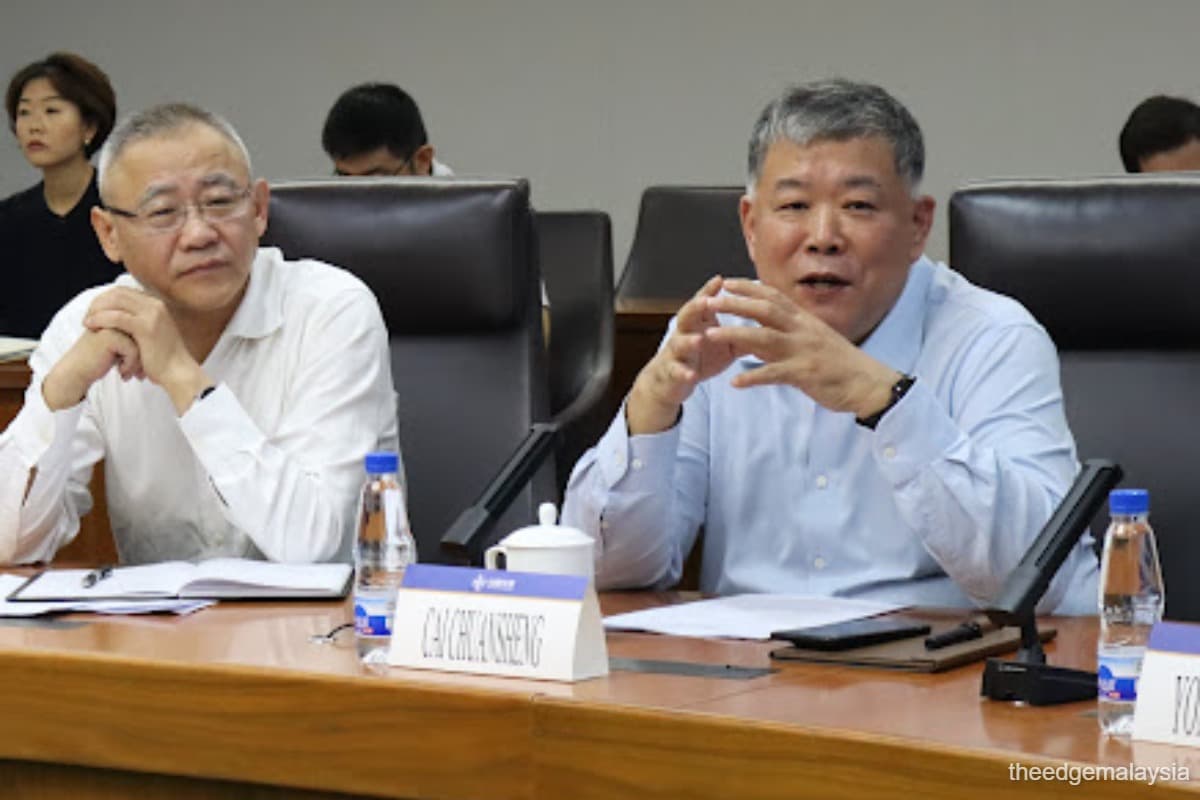
The Hong Kong-listed group, whose expertise spans from civil infrastructure to rail and sea ports, is “always on standby and keeping a close watch” of megaprojects across Southeast Asia, said CCCC international business department executive general manager Cai Chuan Sheng.
CCCC, through its indirect subsidiary China Communication Construction ECRL Sdn Bhd (CCC-ECRL), is less than two years away from completing the first phase of what it describes as its largest project in Malaysia, the 665km-long, RM74.96 billion East Coast Rail Link (ECRL), for the Ministry of Finance-owned Malaysia Rail Link Sdn Bhd (MRL).
“We have been in Malaysia for nearly 40 years,” said Cai during a briefing with the Malaysian press at CCCC’s headquarters in Beijing. “We hope to further enhance our cooperation.”
The interest towards Malaysia comes at a time when geopolitical uncertainties are spilling over into Southeast Asia, led by renewed tariff threats by the US amid ‘China plus one’ strategy by Chinese companies to circumvent trade disruptions.
China-based companies, some of which are the biggest in the world in their respective sectors, have in the recent years accelerated their global expansion outwards to improve their competitiveness as well as sustain the strong growth previously enjoyed within the world’s second largest economy the past decades.
At the same time, the move supports China’s now 12-year-long Belt and Road Initiative (BRI) — anchored by a series of rail, road, and maritime socio-economic megaprojects that connects the country with those in its surrounding regions, as well as numerous special economic zones. There are more than 100 such projects that have been signed off globally, according to official data.
The ECRL, which links the less developed states in the east coast of Peninsular Malaysia to Port Klang, is often touted as part of China’s BRI. Malaysia also has several other BRI-related projects, including the Malaysia-China Kuantan Industrial Park, and the expansion of the Kuantan Port, both in Pahang which faces the South China Sea — disputed by China as part of its international waters.
Prime Minister Datuk Seri Anwar Ibrahim earlier this year called for Malaysia to capitalise on its relations with China regardless of the latter’s tensions with the US, having called for the BRI to “regain its momentum” just four months after he took office in November 2022.
After a lull during the pandemic, China has also re-energised the BRI with fresh funding and expanded focus, including into projects involving green energy and technology as it worked towards shedding criticism of unsustainable lending practices and positioning as a 'friend' of its peers in developing economies, while the US under president Donald Trump slowed down its foreign socio-economic assistance.
In Malaysia, CCCC — the fourth largest engineering construction group in the world by revenue — saw the completion of several recent projects including the 8.5km cross-sea power transmission line in Pulau Pinang, as well as the Port Klang West Drainage Project, which has passed final inspection, according to its official website.
For the rail line construction segment, projects that spell opportunities that have been mooted in Malaysia include the Pulau Pinang LRT, the MRT3 Circle Line in Kuala Lumpur, and the KL-Singapore High-Speed Rail.
Both Malaysia’s and Southeast Asia’s gross domestic product growth are seen to hover slightly above China’s in the medium term, according to April 2025 projections by the Asian Development Bank, and similarly in the 10 years from 2024 to 2034, according to a joint report by Southeast Asian think tank Angsana Council, US-based consultant Bain & Co Inc, and banking firm DBS.
Read also:
China Communications Construction’s role in Malaysia’s infrastructure beyond ECRL
ECRL trains to be delivered in phases from October
MRL not discounting proposed ECRL extension to Thai border after KTMB revival
Police urged to take firm action on cable thefts at ECRL site
Agreement on construction of ECRL’s last railroad stretch to be finalised by July
Cable theft incidents threaten to derail ECRL completion schedule, says MRL CEO