

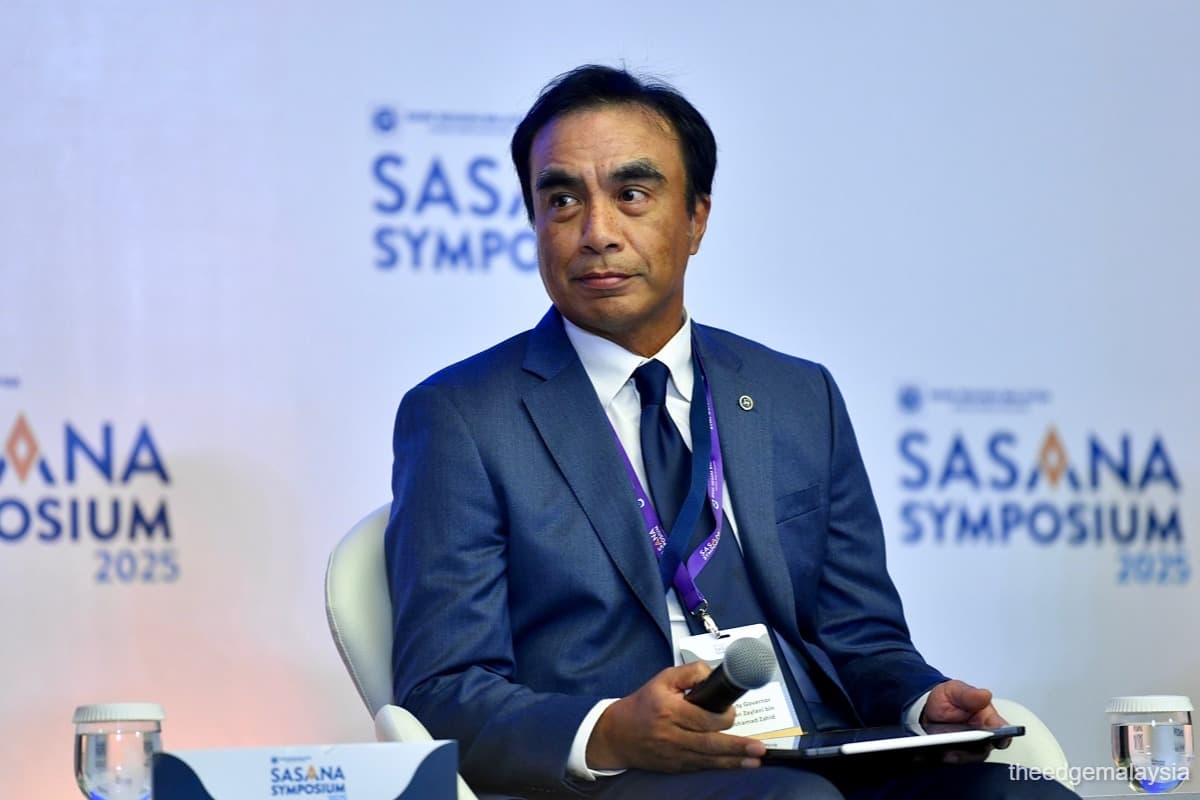
KUALA LUMPUR (June 17): Bank Negara Malaysia (BNM) flagged on Tuesday that the ringgit may experience volatility in the longer term amid the heightened market uncertainty due to US President Donald Trump's tariff play.
The central bank's deputy governor Adnan Zaylani Mohamad Zahid said that while the impact on the currency arising from the trade war and the ongoing US-Malaysia trade negotiations may be limited, the long-lasting changes in global trade dynamics could influence the long-term trajectory of currencies.
"We are not in the worst of positions; we are not in the best of positions either," Adnan said at the BNM Sasana Symposium 2025. "We are not out of the woods yet. It all depends on the level of uncertainty that is still high."
"And there are always new things, new uncertainties emerging, and now in terms of geopolitics," said Adnan.
He added that BNM will ensure that markets function properly and the exchange rate "does not run too far", stressing that currency stability and maintaining orderly conditions in the foreign exchange market are critical to the country’s economy as Malaysia is an export-driven economy.
The ringgit is currently trading near its strongest level since October.
Adnan said Malaysia should be "not so pessimistic" about the outcome of the current trade negotiations "because even in our various engagements, the vast majority of businesses don't really see a big impact."
Meanwhile, CIMB Group wholesale banking and corporate treasurer Chu Kok Wei noted that when the ringgit was highly volatile previously, not many companies, including listed firms and small and medium-sized enterprises involved in imports and exports, ran into serious trouble purely because of exchange rate fluctuations.
HSBC economist Yun Liu told the symposium that Malaysia has maintained a well-diversified export base and trading partner network; what captured investors’ attention is the steady flow of foreign direct investment (FDI) into the country since the Trump 1.0 era.
“Within Asean, there are two clear outperformers — one is Vietnam, the other one [is Malaysia],” she said.
She also said that when looking at Malaysia’s FDI as a percentage of gross domestic product compared to other Asean countries, it has consistently outperformed many regional peers since late 2021.
On the topic of de-dollarisation, Adnan noted that while meaningful change has yet to materialise given that the US remains the world’s largest economy, one clear trend is the long-term decline in global US dollar holdings.