

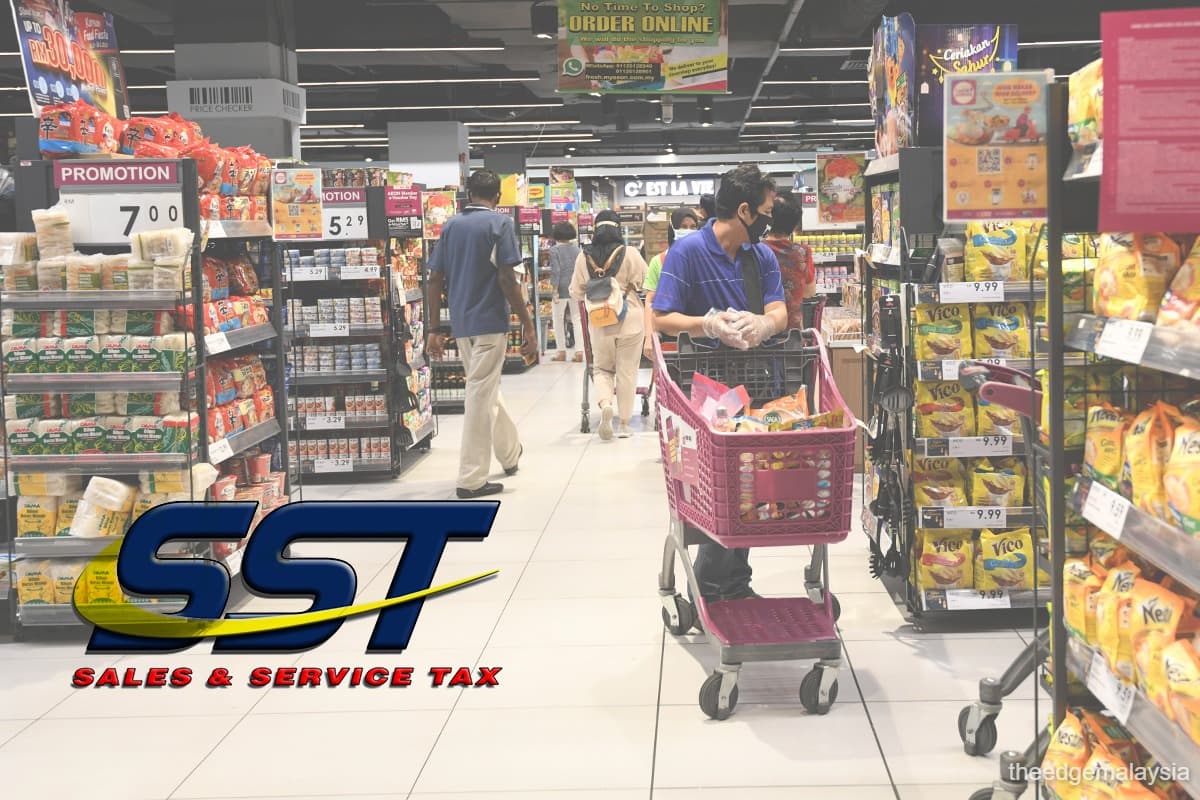
KUALA LUMPUR (June 16): The upcoming expansion of the sales & service tax (SST) will result in an additional consumer cost of RM10 billion on a full year basis, representing 0.8% of Malaysia’s total domestic consumption of RM1.1 trillion in 2024, which is unlikely to materially disrupt overall spending behaviour, according to BIMB Securities.
In a report on Monday, BIMB said it expects the impact of the expansion of the SST to be limited, as “the hike has largely been anticipated and priced in, since its announcement during the tabling of Budget 2025”.
“The expanded SST, effective July 1, is a targeted fiscal reset — broad enough to aid consolidation, yet calibrated to avoid demand shocks,” it said.
In the report on the April performance of the wholesale & retail trade sector, BIMB has forecast distributive trade sales to grow by 6%, partly driven by a 5% rise in wholesale trade, and a 6.6% expansion in retail trade.
Nevertheless, BIMB sees downside risks for the sector from higher petrol prices from the proposed retargeting of RON95 petrol subsidies, and the potentially higher utility tariffs weighing on consumer sentiment and dampening household spending.
“If not carefully managed, these cost pressures could erode part of the gains from income-driven support measures. That said, a well-calibrated and gradual implementation of subsidy rationalisation, coupled with ongoing targeted cash assistance, steady wage growth, and robust employment, could help cushion the impact and preserve consumption momentum,” it noted.
RHB Research, in a report on Monday, said the widening scope of the SST is negative for already subdued consumer sentiment.
“Our findings indicate that consumer retail players that have extensive outlet presence in shopping malls may face challenges in the form of rising rental expenses, once the new 8% service tax on rental takes effect,” it said, adding that these retailers include Padini Holdings Bhd (KL:PADINI), Focus Point Holdings Bhd (KL:FOCUSP), Aeon Co (M) Bhd (KL:AEON), and MyNews Holdings Bhd (KL:MYNEWS), although the actual impact remains unclear at this time.
RHB has kept its “neutral” call on the consumer sector, with “buy” calls for Mr DIY Group Bhd (KL:MRDIY), Farm Fresh Bhd (KL:FFB), Guan Chong Bhd (KL:GCB), Heineken Malaysia Bhd (KL:HEIM) and MyNews.
Commenting on Malaysia’s retail sector performance in April, BIMB noted that distributive trade sales (including wholesalers and retailers), which rose by 4.7% year-on-year in April 2025, was the lowest expansion since September 2024. When compared against the previous month, sales contracted across every major segment, indicating a reduction in consumer spending.
BIMB said this was due in part to higher spending during Hari Raya Aidilfitri, and the disbursement of the Phase 2 Sumbangan Tunai Rahmah (STR) in March.
“Seasonally adjusted data showed a 0.3% month on month (m-o-m) decline in overall distributive trade, with retail trade falling by 1.4%. Despite the soft patch, Malaysia’s macroeconomic fundamentals remain supportive of domestic demand. Inflation is subdued, the labour market remains tight with unemployment at a decade-low of 3.1%, and policy settings continue to be accommodative,” it added.
For the first four months of 2025 (4M2025), distributive trade sales rose by 5.0% year-on-year (y-o-y)(2024: 5.5%), while motor vehicles fell by 0.8% (2024: 6.5%). Wholesale and retail trade sales were up by 5.5% y-o-y (2024: 4.7%) and 6.3% (2024: 6.1%), respectively, said BIMB.
The country recorded a boost in the tourism sector for 4M2025, with a 10.5% y-o-y increase in foreign tourist arrivals, driven by robust growth from the key markets of India, China and Indonesia. BIMB commented that the tourism sector is on a strong recovery path, driven by increasing leisure, medical and business demand.
Meanwhile, imports of consumer goods grew 12.4% y-o-y in April, marking another month of double-digit growth since March, with all three components of consumer goods — durable, semi-durable and non-durable — experiencing steady growth.
“In addition to solid domestic fundamentals, the appreciation of the ringgit against major currencies is offering indirect support to demand for imported goods. For the first five months of 2025 (5M2025), the ringgit strengthened by 7.4% y-o-y against the US dollar (USD), with the year-to-date average USD/MYR (ringgit) rate at 4.41, compared to 4.73 in 5M2024,” BIMB added.
BIMB anticipates continued growth in private consumption, due in large part to supportive policy measures and favourable economic growth. These policies include the roll-out of government cash transfers, the first phase of civil servant salary adjustments in December 2024, and the increase in the minimum wage from RM1,500 to RM1,700 per month.
“These factors are expected to boost disposable incomes and support household spending, particularly in the lower- and middle-income segments,” it added.