

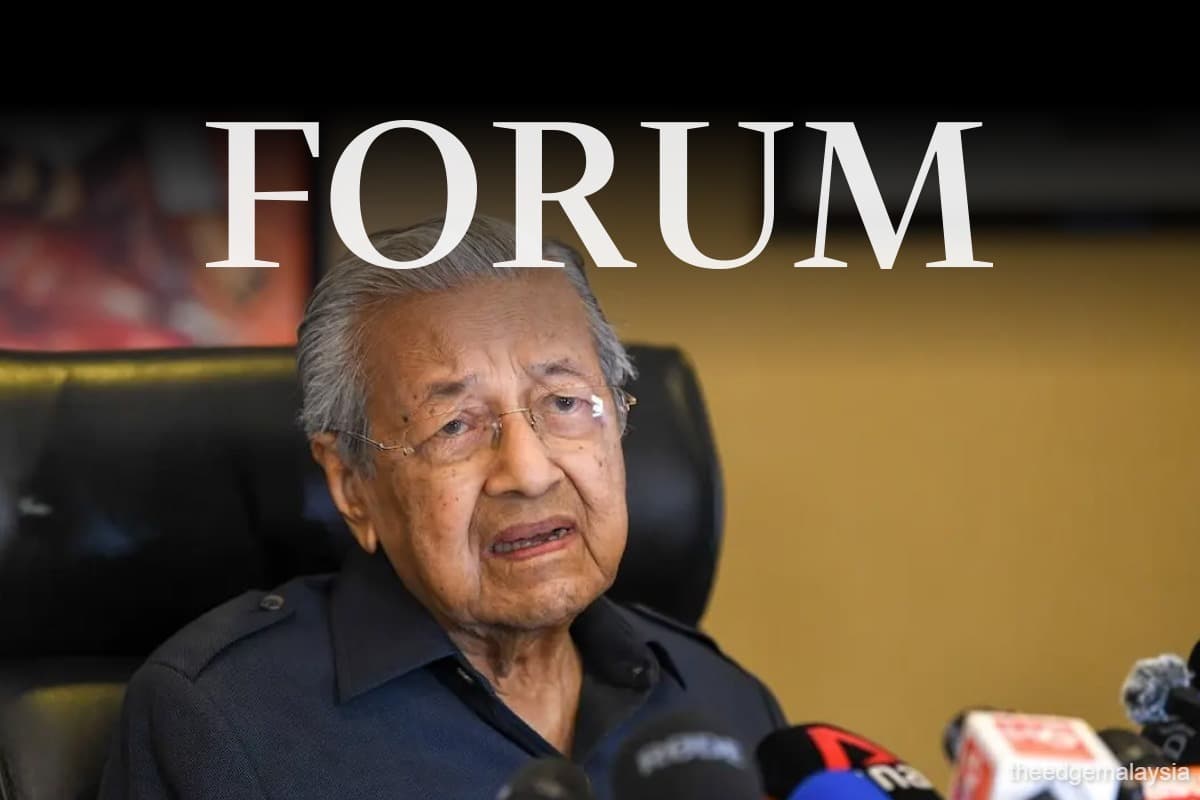
This article first appeared in Forum, The Edge Malaysia Weekly on June 16, 2025 - June 22, 2025
The King, Sultan Ibrahim, in his royal address at the investiture ceremony in conjunction with His Majesty’s birthday on June 2, reminded Malaysians, including political and community leaders, not to politicise sensitive issues that could fuel discord within society and threaten the nation’s stability. Always put unity first and avoid divisive politics for the good of the nation.
On forging unity, His Majesty has been consistent. In his Hari Raya Aidilfitri message this year, he called on Malaysians to promote unity and foster togetherness. He emphasised that unity is the foundation of the nation’s well-being.
In last year’s Merdeka Day message, on his official Facebook page, the King reminded Malaysians that unity among the different races is “the most meaningful gift for me because it is key to the country’s prosperity”.
The development formula for Malaysia is not that complicated, as when there is unity, there will be political and economic stability, which would lead to prosperity for all. This is the basic narrative that I would want to hear more firmly embedded in the hearts of the majority of Malaysians, notably politicians. Political leaders owe this to the rakyat, to help nurture unity instead of being a divisive factor.
Things only get complicated when this simple formula is mixed with racial and religious sentiments that could fuel a sense of insecurity among the masses and different races.
I felt this was the case when, while the King was promoting unity, in the same week, former prime minister Tun Dr Mahathir Mohamad launched a “big umbrella” secretariat to “save the Malays”. This new Malay unity alliance seems to indicate that the Malays, who form the majority of the population, are persistently under political and economic siege and need to be rescued.
This big umbrella Malay unity alliance, which is supposed to be non-partisan and open to all Malays — but looks like it is being dominated by Malay-based opposition political parties led by PAS and Bersatu — aims to save the Malays by addressing issues that are affecting the community, which they claim that the current Unity Government (UG) has failed to resolve.
These political leaders, however, have all been in the government before, in positions of power. While they are not specific on what type of issues they are concerned with, the secretariat’s way of solving them, it seems, is by returning the Malays to “political dominance”, which they deem that the Malays have lost under the UG.
Mahathir said the new alliance will focus on Malay issues, not political party matters, but those which concern all Malays. It will not be a formal political party for now, but a loose coalition to gather the Malays under one “big umbrella”.
“The Malays need fighters to champion their cause. Right now, they don’t have a dedicated fighter. We are not concerned with other problems, but we just want to focus on one struggle — the struggle to save the Malays,” he was quoted as saying in the press.
These myriad problems of the Malays can only be resolved if the Malays once again lead the government, in his view. “That is why our struggle is to find a way to return to power so we can address these problems.”
One critic described the alliance as more of a gathering of disgruntled leaders led by the opposition using a false narrative that Malays were losing power. Their main task is to sow division among the Malays and other races for nothing else but political gain.
Asked another: “How can the Malays lose political dominance when the current prime minister, deputy prime ministers and those who hold important portfolios in the Cabinet and government are Malays? Enough of this never-ending political rhetoric.”
While not taking things for granted, as there are many Malays who rightly or wrongly feel that they are being sidelined and that the government needs to look into some of the pressing matters facing the community, leaders on both sides of the political divide need to be more responsible in trying to resolve the issues. This can be done better by providing constructive input rather than sowing the seeds of hatred.
There are issues facing the Malay and bumiputera community, ranging from the high cost of living, notably in urban areas, low income in traditional sectors and rural areas, income inequality between rural and urban families, unemployment and under-employment among graduates to limited business presence in the small and medium-scale sectors.
These issues, however, have been tackled by the present and past governments through the many social safety net programmes and long-term economic measures, some of which will take time to come to fruition.
The fanning of racial and religious sentiments by politicians and Malay non-governmental organisations — to say that these measures were failures and partly equating them to the loss of political dominance by the Malays, and without helping to provide ways of resolving the problems — is not acceptable and simply irresponsible.
Let’s dive into the bigger picture of the narrative that the Malays are losing power and political dominance, in such a way that they need to be rescued. This sort of narrative or political scare tactic can be counter-productive and not beneficial to the community.
It gives the false impression that the Malays are weak, need socio-economic crutches and cannot stand on their own feet — which they certainly are not. It does a disservice to many hardworking Malays who strive on their own and can compete well with other races. To continue to say that the Malays are weak and need assistance is insulting to their abilities. Since Independence in 1957, while the economic progress had been slow in the early years, it has kept pace since the New Economic Policy was introduced in 1970, and the Malays have never lost political power or dominance.
Whatever the format of the government, be it the Umno-led Alliance and Barisan Nasional (BN), which ruled from 1957 to 2018, and since then Pakatan Harapan (PH), Perikatan Nasional and the current PH-led UG in which Umno-led BN is a component member, the Malays have retained political power and thus, dominance.
Malay political dominance is in fact enshrined and protected by the Federal Constitution, which stipulates that Malaysia will be headed by a Malay-Muslim King, that Islam is the official religion and that Bahasa Malaysia is the official language.
The Federal Constitution does not explicitly require the prime minister to be Malay, but political tradition, Malay dominance and the role of Islam in the government, plus Malays’ increasing percentage in terms of population, make it likely to be a de facto requirement.
Then there are the special rights, namely the economic and administrative rights of the Malays and the bumiputera communities including that of Sabah and Sarawak, which are enshrined in the Federal Constitution.
Since Independence, all prime ministers have been from the Malay/Muslim community, and most of the important administrative posts are held by members of this community. This is already a known and accepted fact among Malaysians of different races.
Why try to dismiss this notion and insist that the Malays are losing political dominance under the UG and that the way to regain this dominance is by replacing it with a new government led by political personalities in the unity umbrella?
The argument of Malays losing political dominance, thus power, is like an old song, being played again and again in the hope that many Malays will sing to its tune. I for one refuse to sing to this tune and I believe many other Malays would not want to do so.
Successful Malay political and community leaders should inspire others and help nurture self-confidence and self-belief in the community so that they can compete with other races without depending too much on assistance from the government.
There is no one better to inspire this than Mahathir, who, during the British colonial days, went against all socio-economic odds to get a place in university — the King Edward VII College of Medicine — in Singapore in 1947, where he competed with the best from other races.
Instead, today when many more Malays are successful and strong and able to compete, Mahathir is persistent in promoting the narrative that the Malays are weak, need to be rescued and their political power restored. Enough of this.
Political leaders need to be more responsible but sometimes, this is too much to ask for from people who are in politics, who want to be in power and win at all costs.
Sometimes it is good for old political and community leaders to just fade away gracefully. Leave the fight to a new generation of young, smart and confident Malay leaders to lead and compete. There are many of them out there.
Azam Aris is an editor emeritus at The Edge
Save by subscribing to us for your print and/or digital copy.
P/S: The Edge is also available on Apple's App Store and Android's Google Play.