

This article first appeared in City & Country, The Edge Malaysia Weekly on June 16, 2025 - June 22, 2025
It has been some two years since City & Country last spoke to Valerie Ong Pui Shan. She had just been appointed as CEO of KIP Real Estate Investment Trust (KIP REIT) (KL:KIPREIT). Her priorities then were acquiring value-accretive assets, actively reviewing its tenant mix, embarking on asset enhancement initiatives (AEIs) and sustainability integration, among others. Two years on, her plans have gained momentum.
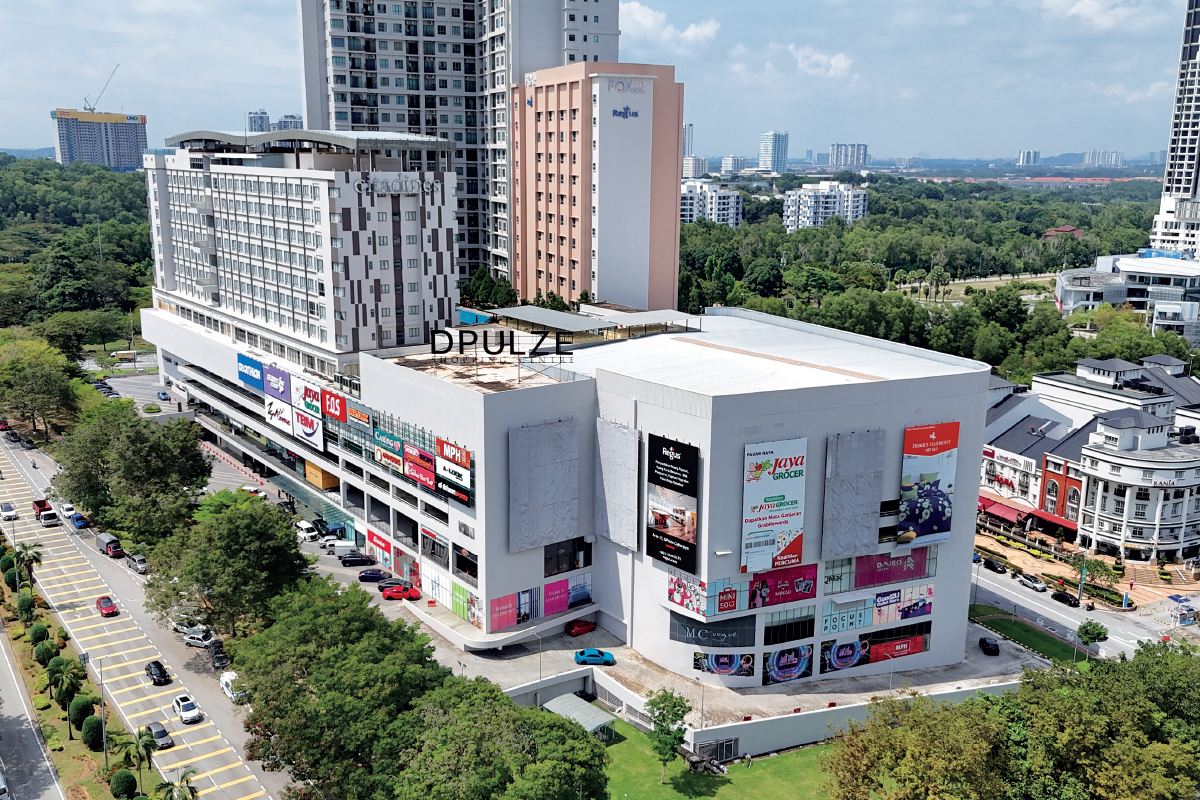
In a wide-ranging interview held at the trust’s newly acquired D’Pulze Shopping Centre in Cyberjaya, Ong outlines a confident vision of achieving RM2 billion in assets under management (AUM) by 2027, with disciplined acquisitions, a people-first culture and ESG-forward operations forming the backbone of the strategy.
Currently, KIP REIT owns 14 properties, comprising industrial and retail assets and KIPMalls, with a total net lettable area exceeding 2.54 million sq ft and total property valuation of about RM1.4 billion.

Anchored in the community
KIP REIT’s value proposition involves operating community-centric malls that meet essential needs. The trust currently has 10 malls in its portfolio, located mainly in satellite towns or cities.
Unlike lifestyle-centric mega malls, KIP REIT’s assets house tenants such as grocers, pharmacies, home improvement stores, and food and beverage (F&B) offerings — businesses that remain resilient even in economic downturns.
“Our malls offer daily essentials. They’re where people go for groceries, DIY tools and a quick meal with family. Even during the movement control order periods, we held up well,” says Ong.
That positioning has paid off. The REIT boasted an average occupancy rate of 97.1% as at March 31, 2025, for all its portfolios — both retail and industrial. The strategy lies in its flexibility. “KIP REIT employs a ‘2+2’ rent model, allowing for rental revision every two years instead of being locked into five- or six-year terms,” she says.
“This lets us adjust rents more dynamically to market conditions and tenant performance. Also, the mall management reviews the tenant mix every month to ensure a curated and resilient mix that can adapt to changes in consumer behaviour. In addition, we have cultivated strong relationships with close to 1,200 tenants, ensuring open communication and collaborative problem-solving during periods of uncertainty.
“We also host community-centric events at our malls to strengthen ties with the surrounding neighbourhoods, a crucial factor in suburban areas, where the mall is often an integral part of their daily lives.”
KIP REIT also posted record-breaking financials for the nine-month FY2025 period (as at March 31, 2025), achieving RM96.2 million in gross revenue — the highest since it was listed in 2017. Net property income (NPI) grew 51.9% year-on-year to RM68.8 million, while realised profit after tax (PAT) rose 19.8% to RM36.4 million. “This robust performance drove dividend yields up to 7.9%, based on the closing share price of 85 sen as at May 5, 2025, well above the industry average of 6.5%, underscoring the REIT’s strong fundamentals,” says Ong.
Part of this success can be attributed to a solid tenant base, comprising primarily retailers offering essential goods and services. “Nearly 20% of KIP REIT’s rental income is secured through long-term master leases, which include built-in rental escalations every three years, safeguarding cash flow even during inflationary cycles,” she adds.

Strategic acquisitions fuel growth
Organic growth can take a REIT only so far, says Ong. For KIP REIT, scaling up requires smart acquisitions. “The trust has already surpassed RM1.5 billion in AUM and is expected to reach RM1.7 billion, with three more industrial and two retail properties in the pipeline.
“We’re not acquiring just for the sake of it. We look for synergy, geographic fit and, most importantly, yield.”
She says target yields for new assets hover between 6.5% and 7.5%. “The D’Pulze Shopping Centre in Cyberjaya, acquired at a 7.1% yield, appreciated by 8% upon completion within the same year, and exceeded net property income projections by 8%.”
More importantly, the acquisition strategy is not a one-size-fits-all approach. Ong emphasises that each asset is selected based on a stringent investment framework, involving detailed due diligence and board approval processes. Locations with strong demographics and underserved catchment areas are prioritised, along with properties that allow for synergy in the existing ecosystem.
Furthermore, this strategy includes industrial properties, which make up 10% of the trust’s total portfolio and are on long-term master leases of 12 to 15 years, offering income stability and built-in rental escalations of 10% to 12% every three years. “We are still very focused on retail, but the industrial segment offers long-term resilience as well,” she notes.
KIP REIT has three industrial properties in Pulau Indah, Klang, and one in Cheras Jaya, with three more to be completed at a later date. Proposed acquisitions for this year include industrial properties in Bintulu, Sarawak; Pulau Indah, Klang; and Pasir Gudang, Johor.
Meanwhile, a recently signed memorandum of understanding (MoU) with AEON Co (M) Bhd (KL:AEON) to explore the expansion of AEON Mall Kinta City in Ipoh signals further strategic depth in KIP’s acquisition and enhancement roadmap. “This redevelopment is set to mimic AEON’s flagship outlet in Taman Maluri, Kuala Lumpur, and could yield additional retail space, expanding on the currently underutilised land parcels,” says Ong.
Since 2018, KIP REIT has completed eight strategic acquisitions, doubling its portfolio from six assets to 14. “This aggressive but selective growth strategy positions the REIT to hit RM2 billion in AUM by 2027, and potentially RM3 billion within the next five years,” she adds.

Human element behind the numbers
Ong attributes the success to the overall team of employees. “Before we look outwards, we look inwards. Many of KIP REIT’s employees have been with the company since its inception, some rising from mall managers to overseeing five or six assets.
“We always look inward first. Promotions and leadership opportunities are part of our culture,” she says. “Some of our most senior people grew with the business, and they know it inside out.”
Succession planning and upskilling are formally embedded in the company’s growth strategy. Town hall meetings, regional forums and even a dedicated female leadership initiative all contribute to staff engagement and retention. In addition, the REIT has seen a sixfold increase in the number unitholders since its initial public offering (IPO) in 2017.

Enhancing value
Several of KIP REIT’s properties are entering their second decade, prompting an aggressive rollout of AEIs, says Ong. “The REIT has already completed AEIs at malls such as KIPMall Bangi and KIPMall Senawang, with upgrades to KIPMall Tampoi underway. These enhancements focused on several upgrades without disrupting the tenant mixes.
“It’s not just facelifts. We are improving facilities, upgrading mechanical and electrical (M&E) systems and refreshing common areas to improve customer experience and operational efficiency,” she adds.
In addition, the utilisation of data is crucial. “The trust is entering a digitalisation phase, where we are implementing a footfall management system to better understand shopper behaviour and optimise tenant mix. We are also introducing ServeDeck, a digital facility management platform, to improve operational efficiency through real-time maintenance tracking, faster response times and streamlined communications.
“Our AEI roadmap is structured for the next 10 years. With most of our malls more than seven years old, phasing upgrades is crucial to avoid affecting our distribution per unit (DPU).”
Focus on ESG
Ong also chairs the REIT’s Sustainability Steering Committee, which leads efforts across environmental, social and governance pillars. “ESG isn’t a checklist. It’s integrated into our operations, as it makes business sense.”
Among the initiatives are the installation of solar panels at all malls, cutting energy costs by up to 30%. “EV (electric vehicle) chargers have been installed across six malls and we are partnering with KJ Technical Services Sdn Bhd [a subsidiary of KJTS Group Bhd (KL:KJTS)] to invest RM25 million in chiller upgrades. This is expected to yield 15% in annual energy savings,” she says.
“These measures are not only green but also financially feasible. By reducing operational expenses, KIP REIT improves margins and ensures sustainable dividend payouts. The REIT has maintained a payout ratio of over 90%, reinforcing investor confidence.”
On the social front, she emphasises community impact and employee well-being. Annual town halls, upskilling initiatives and regional engagement platforms are complemented by corporate social responsibility efforts and community-based programmes in the malls.
Looking to the horizon
KIP REIT’s expansion strategy includes underserved regions such as the east coast and northern regions of Peninsular Malaysia. “There are still many areas in these regions where we are still looking for acquisitions,” says Ong.
As such, the trust announced in April planned acquisitions in Kuantan and is eyeing growth corridors beyond the southern region.
The properties are Lotus’s Indera Mahkota hypermarket (master leased to Lotus’s at RM39 million), along with three units of 2-storey shopoffices worth RM12 million, and a 2-storey commercial building (leased to a KFC drive-through outlet) worth RM5 million.
KIP REIT also plans to acquire KIPMall Desa Coalfields in Kuala Selangor for RM62 million.
To fund this expansion, it is exploring private placements while maintaining gearing below the 50% cap, typically managing it between 40% and 45%. “Acquisition is critical to drive DPU growth. Relying solely on organic growth would eventually stagnate returns,” Ong emphasises.
Moreover, with rising construction and land costs, acquiring stabilised, income-generating properties becomes a more attractive proposition than greenfield developments.
And that growth must be future-ready. Ong says the team is finalising a 10-year AEI and acquisition roadmap, balancing expansion with sustainability and human capital development. The REIT also plans to implement more digital systems to capture tenant performance, optimise rental structures and drive strategic leasing decisions.
“We’re not just building a portfolio; we’re building a legacy,” she says.
Save by subscribing to us for your print and/or digital copy.
P/S: The Edge is also available on Apple's App Store and Android's Google Play.