

This article first appeared in The Edge Malaysia Weekly on June 16, 2025 - June 22, 2025
For Malaysia to achieve net zero emissions by 2050, existing policies are insufficient. A transformational shift, backed by trillions in investments, is needed.
These were among the conclusions of the Long-term Low Emissions Development Strategy (LT-LEDS) report and NDC (nationally determined contribution) roadmap, two much-awaited documents that chart Malaysia’s path towards its climate targets, which were released last month.
Malaysia has committed to two climate targets — achieve net zero emissions by 2050 and a reduction of emissions intensity by 45% (against gross domestic product) by 2030, as part of the NDC under the Paris Agreement.
The scenario in which Malaysia achieves net zero by 2050 includes rather ambitious targets in areas like the adoption of electric vehicles (EVs), fuel cell EVs, higher recycling rates, and deployment of carbon capture, utilisation and storage (CCUS) and green hydrogen solutions.
This would require an estimated RM2.6 trillion in investments, and could result in higher energy generation and material costs, such as for green steel, which is estimated to raise prices by 20%.
Does this mean that Malaysia’s net zero target, which is earlier than many developing countries, is unrealistic?
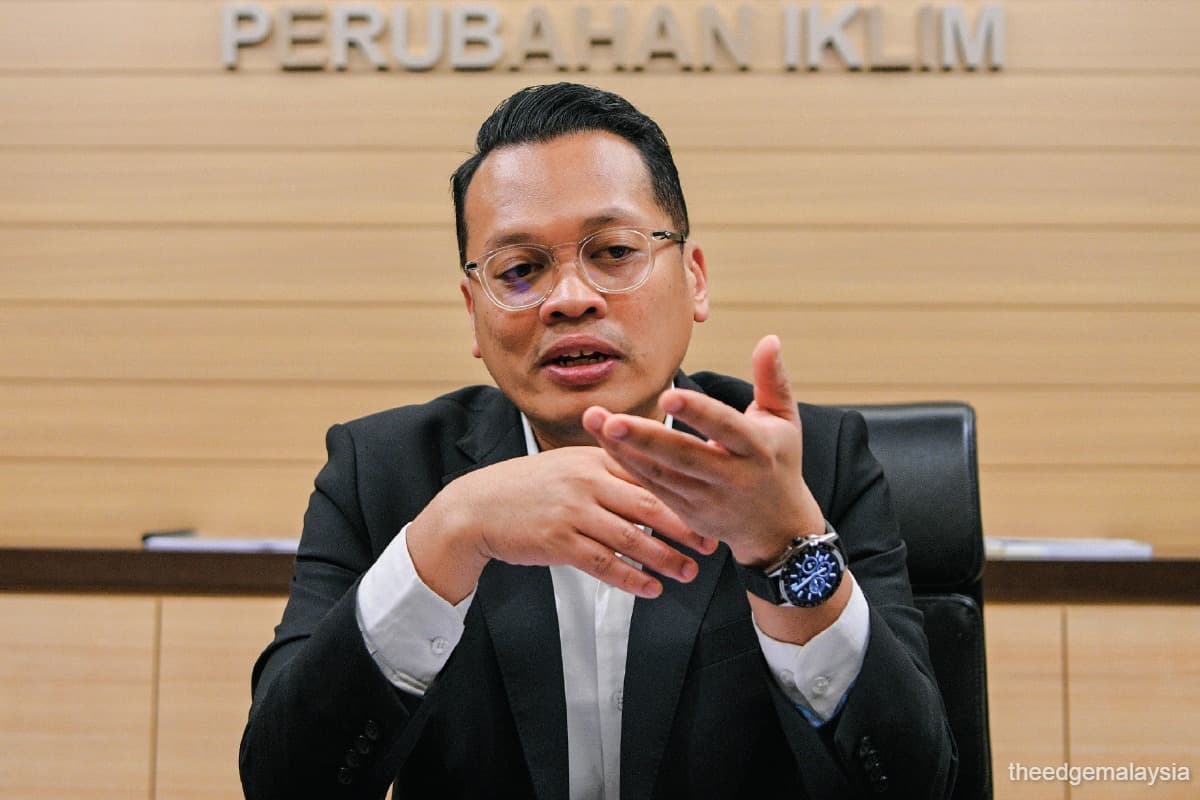
“I think our net zero target and the LT-LEDS are very ambitious, and we recognise that. But I think for us, [the high target] is to drive us to work on necessary policies,” says Minister of Natural Resources and Environmental Sustainability Nik Nazmi Nik Ahmad, in response to ESG’s question.
“Although we are still a developing and small country, and our contribution to [global] emissions in absolute terms is quite small, we believe that by showing high ambition, it can drive how we develop.”
Adopting sustainability practices could also protect Malaysian businesses from regulations by other countries, he adds, such as those that ban imports of deforestation-related commodities or products suspected of involving forced labour.
The LT-LEDS and NDC roadmap, he adds, are meant to be living documents.
“Obviously, there will be things we learn as time goes by … no one predicted that solar [energy] would be this cheap, and that prices for batteries would come down this quickly,” says Nik Nazmi, who adds that if the climate change bill is passed, a dedicated agency to tackle these issues will be established.
Could rare earth mining result in more deforestation?
A condition for Malaysia to achieve net zero by 2050 requires 52% of forest cover, via protection and afforestation, and restoration of 50,000ha of peatland. This can be challenging to do, as forests are a state matter, and activities such as logging are a source of revenue for states.
Yet, protecting forests in Malaysia is essential, since it absorbs almost half of the country’s total greenhouse gas emissions. Currently, Malaysia has 54% forest cover.
“We have a small room of 2% left, if we’re talking about 52% [forest cover]. That is the only amount we can ‘lose’, and that is not easy to achieve, as we are talking about [this happening] 25 years down the road,” says Nik Nazmi.
To maintain the forest cover, the federal government has been paying ecological fiscal transfers to state governments, and the amount allocated has been rising.
“We are also trying to allow some of the money to go straight to state government coffers, because for some, they are struggling to pay salaries,” he says.
The federal government is also looking at other methods of funding, such as blended finance and carbon credits.
A growing challenge to forest protection is the increasing interest of states in mining rare earth minerals, which are predominantly found in forest reserves.
Nik Nazmi says the Ministry of Natural Resources and Environmental Sustainability (NRES) is currently asking states to focus on rare earth mineral extraction outside of forest reserves, where mining is prohibited. It is conducting two studies in Johor and Perak in forested landscapes to ascertain if mining for these materials can be done sustainably.
“It is no longer about open cast mining, about digging a big hole and destroying everything. We are moving carefully, and we are doing two studies … we want to see whether claims that this can be done without major impact, and that this forest landscape can be restored as quickly as possible, are true,” says Nik Nazmi.
This is necessary, because buyers of these materials may reject minerals that are not mined responsibly.
“Even when I communicate with, say, Lynas (a refiner of rare earth minerals), they do not want to buy minerals that cannot be certified that they have been [mined] properly. We have learnt lessons from [the] palm oil [industry]. It has to be mined in a very responsible manner, so there is a market for it,” he says.
Will data centre investments hinder Malaysia’s progress to net zero?
The net zero by 2050 scenario provides limited details on how the industrial processes and product use sector should transition. It primarily emphasises that no new coal plants will be built and restricts the growth of brownfield facilities, such as steel plants that still rely on blast furnaces.
Green steel could be produced via green hydrogen, which requires the input of water and renewable energy (RE). Otherwise, electric arc furnaces can be used, but it must be powered by RE.
Therefore, alongside the electrification of the transport sector, energy demand is likely to increase significantly. To achieve net zero by 2050, NRES projects that 75% of the capacity mix must be RE, and up to 30% of energy generation via natural gas must be equipped with CCUS.
However, in recent years, Malaysia has been welcoming investments in energy-intensive data centres, which may further strain its resources.
This burden could be avoided, the minister says in response, as big data centre operators are willing to pay a premium for RE. “We have to appreciate that because it’s able to drive the premium demand [for RE] from utilities,” he says, adding that the Ministry of Energy Transition and Water Transformation, along with the Energy Commission, are evaluating whether a cap should be placed on the amount of energy reserved for data centres.
Can a carbon tax accelerate action?
Meanwhile, a carbon tax is expected to be imposed on the iron, steel and energy sectors by next year, which is meant to reduce emissions from the energy and manufacturing sectors. Few details are known about how it will be implemented at the moment.
Nik Nazmi says the tax should start at a relatively low level, and be adjusted accordingly over time, much like what Singapore has done.
“I think we need to be balanced in our approach. The fact that we will have a carbon tax is crucial and useful to drive behavioural [change] but we can start at a lower level first,” he says.
Regardless, the imposition of a carbon tax could result in higher prices of goods and services for consumers, as would the adoption of currently expensive solutions like green hydrogen and CCUS.
In response, Nik Nazmi says the policies will be practical, and the government has been increasing the consumption power of Malaysians by raising the minimum wage and transforming the economy from a low-wage model to one that is higher up the value chain.
Additionally, the carbon tax and requirements under the climate change bill will likely only affect big emitters, he says. “There is a threshold, just like we had with the energy efficiency legislation.”
On the other hand, there is a concern that if major emitters like the US continue to shirk their responsibilities in reducing emissions, whatever mitigation action taken by countries like Malaysia could go to waste.
In fact, climate change is expected to have a greater impact on Southeast Asian countries. Should Malaysia focus more on adaptation rather than mitigation?
“We need both. Adaptation will be a big part [of the plan],” says Nik Nazmi, who adds that part of the funds collected from the carbon tax, for instance, will be earmarked for adaptation. The National Adaptation Plan will be ready next year.
Nik Nazmi is optimistic that the global trend will still go in the direction of sustainability, even if the geopolitical situation is currently unstable.
“We appreciate that the European Union and East Asia, even China, have shown leadership [in this area] ... even the Middle East countries have been more proactive,” he says.
These uncertainties, nevertheless, pose a risk to Malaysia’s path forward. Still, he believes that being sustainable makes economic sense, partly due to the demand from the younger generation of consumers and workers.
“I’m not a crazy idealist who has all these goals. I know net zero by 2050 sounds very ambitious but how we implement it will be very practical. With the climate change legislation and thresholds, we will start with big emitters first, who probably can afford to have chief sustainability officers. We are very careful in terms of the impact to the economy. That is the balance we try to strike,” says Nik Nazmi.
Save by subscribing to us for your print and/or digital copy.
P/S: The Edge is also available on Apple's App Store and Android's Google Play.