

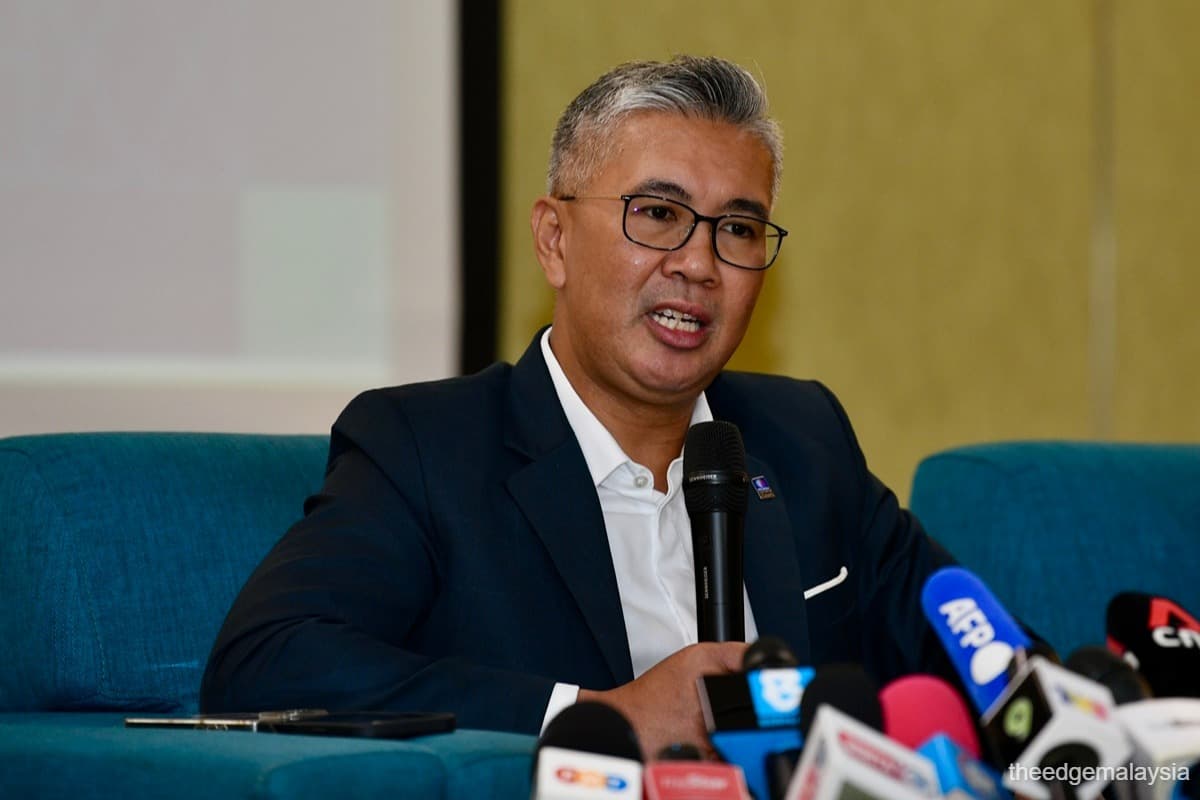
"We want to ensure that local exporters — especially those in sectors like furniture and palm oil — are taken into account during discussions.”
KUALA LUMPUR (June 12): Minister of Investment, Trade and Industry Tengku Datuk Seri Zafrul Abdul Aziz said his lead on another round of negotiations in Washington, US on June 18 is mainly to focus on reduction in US-imposed tariffs on Malaysian exports, particularly in sectors deemed strategic to both economies.
Speaking to reporters following the launch of the Asean Economic Community (AEC) Strategic Plan 2026–2030, Zafrul described the US-imposed tariff as “unfair and non-negotiable in appearance”, but maintained that Malaysia remains committed to engaging constructively with the US government.
“As you know, there is a flaw — they say it looks non-negotiable, especially the 10% threshold. Malaysia has been imposed with a 24% tariff (by the US). Of course, our first target is to reduce that,” he said.
“Our second target is to identify sectors where tariffs should be reduced even further — below 10%. These include sectors important to Malaysian exporters, and also sectors of strategic interest to the US economy.”
Zafrul acknowledged that the engagement would not be easy, but emphasised the need to present Malaysia as a complementary, rather than competing, trade and investment partner with the US.
The Malaysian government has been proactively engaging the US administration on the structural interlinkages between both economies, particularly in key sectors such as furniture and palm oil, where Malaysian exporters face higher exposure to tariffs.
“We want to ensure that local exporters — especially those in sectors like furniture and palm oil — are taken into account during discussions,” he said.
While the ministry has not specified which industries are considered strategic, it aims to include as many as possible on the list that may be eligible for tariff below 10%, Miti deputy secretary general Mastura Ahmad Mustafa later told The Edge.
Zafrul stressed that currently, Malaysia has made structural reforms to avoid being used as a transshipment route to circumvent US tariffs, including tightening oversight on certificates of origin and implementing stricter supply chain traceability.
The June 18 mission follows an earlier high-level visit by Zafrul on April 24, during which he held talks with US Secretary of Commerce Gina Raimondo and other senior US officials.
During that visit, Malaysia reiterated its readiness to work on four key trade issues: narrowing the bilateral trade deficit, reducing non-tariff barriers, enhancing technology protection and security, and exploring the viability of a formal bilateral trade agreement.
The US government in April announced new tariff measures affecting more than 60 countries — including Malaysia — which saw a 24% duty imposed on certain categories of goods. However, the implementation of these tariffs has since been temporarily suspended for 90 days, to allow for further negotiation.