

This article first appeared in The Edge Malaysia Weekly on June 9, 2025 - June 15, 2025
WHILE investors are still waiting for updates from discussions initiated in November between Bumi Armada Bhd (KL:ARMADA) and MISC Bhd (KL:MISC) to merge their offshore business, attention has now shifted to another floating asset operator, Yinson Holdings Bhd (KL:YINSON) amid its rumoured privatisation move.
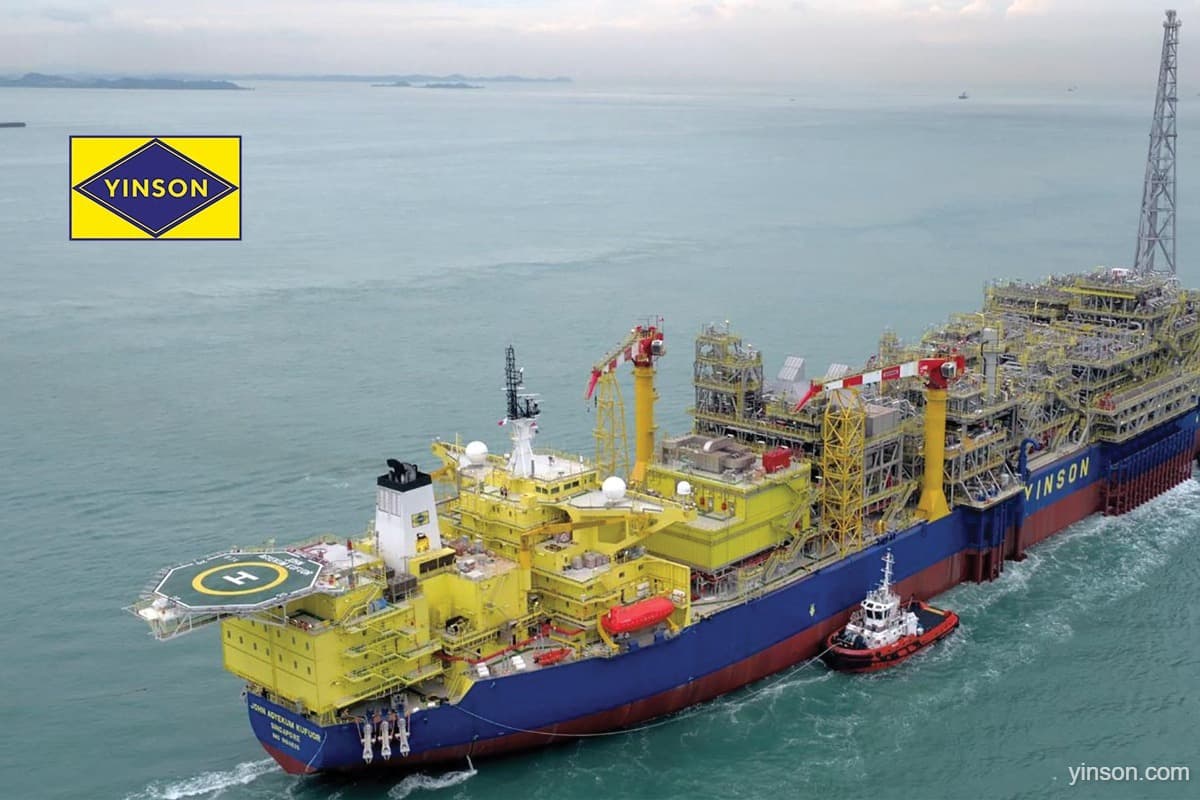
Yinson, with eight floating production storage and offloading (FPSO) vessels in operation and under construction, plus two floating storage and offloading (FSO) units, may be taken private by its 26.6% shareholder, the Lim family, together with New York-based Stonepeak Partners for as much as RM9 billion, or US$2.1 billion, Bloomberg reported on June 6.
The group, which until recently was on a tightrope, balancing between debts and future earnings growth, seems to be reaping the fruits of its hard work after managing to deliver the vessels on time and within budget. All of these are backed by long-term charter contracts that will bring in an estimated operating cash flow of US$850 million a year.
The share price of Yinson rose as much as 13.81% or 29 sen to a four-month high of RM2.39 after the news, valuing the group — which also owns a slew of renewable energy assets and green mobility business — at RM7.36 billion. Yinson declined to comment when contacted.
At RM9 billion, the proposal works out to between RM3.19 and RM3.23 per share (based on Yinson’s share base of 2.78 billion shares after deducting treasury shares).
This is at least 33% higher than Yinson’s current share price, but slightly lower than analysts’ consensus target price of RM3.54, based on TPs ranging from RM2.93 to RM4.33.
CIMB Securities, which has the lowest TP of RM2.93, values Yinson at RM8.87 billion using the discounted cash flow method — and including its three solar assets. RHB Research, with a TP of RM3.69, values the FPSO business at RM11.53 billion (or RM4.14 per share before adjustments), while Maybank Investment Bank with the highest TP of RM4.33 values it at RM13.49 billion (RM4.84).
While the yet-to-be-confirmed offer price is below the higher end of analysts’ TP, the “long earnings gestation” and the highly geared balance sheet makes it tough for shorter-view retail investors to be patient, says an analyst covering the stock.
At end-January, Yinson had total assets of RM25.5 billion against total liabilities of RM18.11 billion, of which RM16.05 billion were borrowings. It also had perpetual securities of RM1.94 billion. Retained earnings totalled RM2.83 billion.
“If that offer of over RM3 comes in, maybe [investors] should just accept it,” the analyst says. To be sure, shares of Yinson had hovered around RM2 to RM2.50 in the last five years, and touched its five-year low of RM1.76 just two months ago.
Another analyst, however, believes “there is still room to further unlock value”, and the privatisation is not the last corporate exercise involving the FPSO business for that reason.
Talk on unlocking value in Yinson revolves around potentially listing the FPSO business in other markets where investors value such capital-intensive, long-term business. The FPSO charter contracts will last until the 2040s for five of Yinson’s vessels, after including extension options.
Yinson had initiated a strategic review of its FPSO business back in 2022, which included a potential initial public offering (IPO) or strategic partnership opportunities “to maximise shareholder value and at the same time strengthen the FPSO business”. By 2025, CEO Lim Chern Yuan shared other options, including forming an infrastructure trust (bundling operational assets into a portfolio company) or even selling down its assets.
Stonepeak may be one such strategic partner. The fund, with US$73 billion worth of assets under management, describes itself as an alternative investment firm specialising in infrastructure, targeting assets “with strong macro tailwinds” and “exceptional growth prospects over the long term”.
It also has 2.7gw of renewable energy capacity in its portfolio, which includes interconnection and hyperscale platform Cologix, solar and battery firm Madison Energy, and TRAC Intermodal, which provides marine chassis to facilitate movements of shipping containers between vessels and onshore infrastructure.
It is not uncommon to see undervalued companies privatised and then relisted later with higher valuations after they are cleaned up away from the public eye, or through better prospects or market understanding of the business.
MMC Corp Bhd, for example, was privatised at RM6.08 billion, or RM2 per share, which was lower than the deal’s independent adviser’s valuation of at least RM3.32 per share. It was reported that its port unit alone is now eyeing a listing at over RM6 billion. MMC also owns shares in DRB-Hicom Bhd (KL:DRBHCOM) and power plant operator Malakoff Corp Bhd (KL:MALAKOF).
That said, Yinson is currently trading at about 15 times forward price-earnings ratio (PER) and about 17 times enterprise value to earnings before interest, taxes, depreciation and amortisation (EV/Ebitda) ratio, which is a metric used for capital-intensive companies as it ignores financial leverage.
This is higher than that of MISC (14.3 times forward PER), Bumi Armada (five times), Amsterdam-listed SBM Offshore NV (9.1 times) and Tokyo-listed Modec Inc (11.8 times).
Nonetheless, the action at Yinson would add to the series of corporate exercises involving the Lim family in recent years.
In 2024, Yinson chairman Lim Han Weng, who is Chern Yuan’s father, through Liannex Corp acquired a 50.2% stake in Icon Offshore Bhd from Ekuinas for RM172.2 million and, together with Yinson, went on to inject other marine vessels into the listed company now known as Lianson Fleet Group Bhd (KL:LFG) in exchange for more shares.
This year, the family listed HI Mobility Bhd (KL:HI), which operates a fleet of nearly 700 buses, in an exercise that valued the company at RM610 million. The family has a slightly over 60% stake in the company.
The elder Lim owns 1.59% direct and 25.05% indirect stakes in Yinson. Other shareholders include the Employees Provident Fund with 17.73% and Kumpulan Wang Persaraan (Diperbadankan) with combined direct and indirect stakes of 7.1%.
Save by subscribing to us for your print and/or digital copy.
P/S: The Edge is also available on Apple's App Store and Android's Google Play.