

This article first appeared in The Edge Malaysia Weekly on June 2, 2025 - June 8, 2025
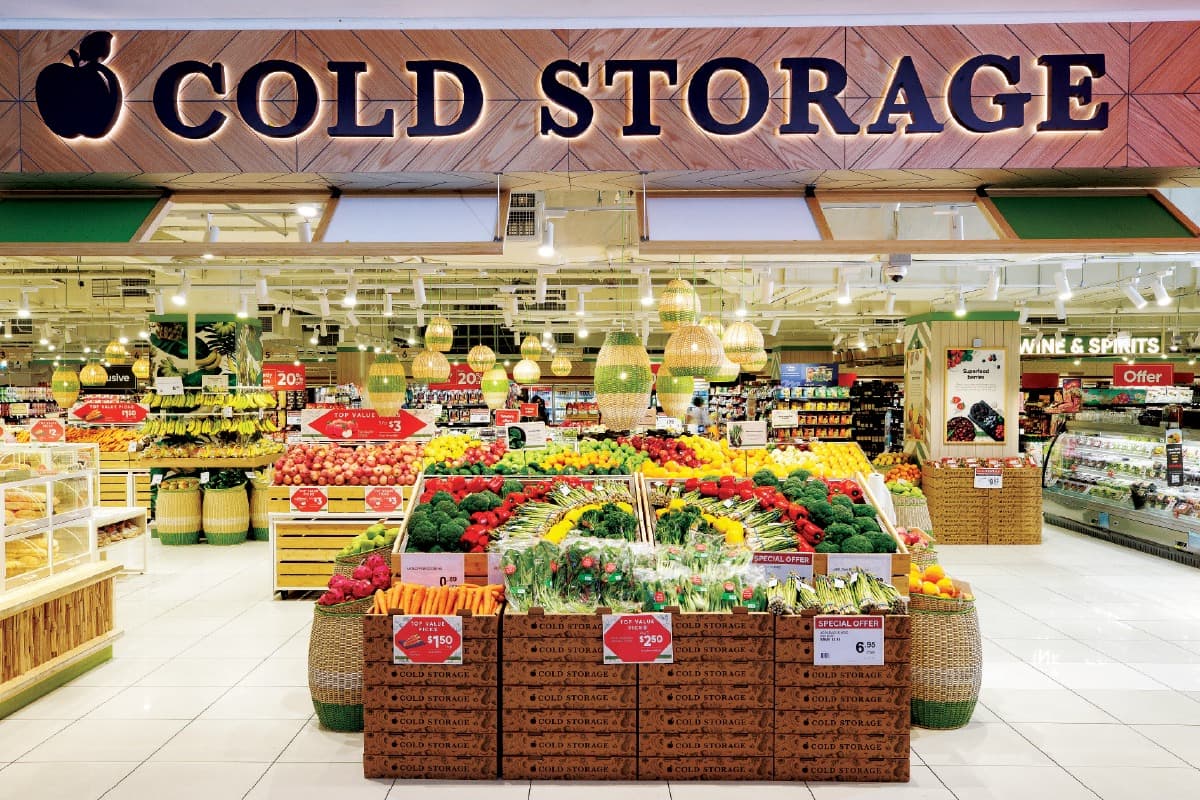
THE food and grocery business is an increasingly challenging one to be in, given rising food costs and inflationary pressures. Be that as it may, Malaysian retail group Macrovalue Sdn Bhd sees value in expanding into Singapore through its planned acquisition of all Cold Storage and Giant supermarkets in the island republic from the Singapore Exchange-listed DFI Retail Group.
Two years ago, Macrovalue acquired GCH Retail (Malaysia) Sdn Bhd —operator of Giant and Cold Storage outlets in Malaysia — from DFI for an undisclosed sum. That deal was completed in March 2023, after which Macrovalue embarked on a 12-month business transformation plan to attract more shopper traffic and set out to turn around the loss-making business within 24 months.
To its credit, Macrovalue managed to turn around the business ahead of that timeline.
“We turned the business around 18 months following the acquisition,” Datuk Andrew Lim Tatt Keong, co-owner of Macrovalue, tells The Edge in a joint interview with his business partner Datuk Gary Yap Keng Fatt. Lim and Yap, who is the managing director of GCH, have equal ownership of Macrovalue.
Lim shares that GCH made a net profit of RM4.4 million on the back of RM1.9 billion in revenue for the 18 months ended June 30, 2024. (The group had changed its financial year end to June 30 from Dec 31).
Prior to the takeover, GCH had reported a net loss of around RM100 million for the 12 months ended Dec 31, 2022, based on revenue of about RM2.2 billion, he says.

“When we took over, there were more than 50 large-format stores and 40 Giant Mini stores in Malaysia. Today, there are 54 large format stores — comprising 38 Giant, three TMC, two Cold Storage and 11 Mercato stores — and 36 Giant Minis,” says Lim.
Will Macrovalue have the same transformation success in the much more competitive Singapore market?
In Singapore, the Cold Storage and Giant businesses are already profitable. The Singapore supermarkets business had only just returned to profitability in the 2024 financial year after several years of losses.
Nevertheless, during the company’s results briefing, DFI CEO Scott Price had said that the supermarkets business was highly competitive and was expected to remain stable at best moving ahead, according to news reports.
Macrovalue, however, sees promising prospects for the business, citing the synergies it expects to reap from the operations in both countries. According to Yap, Macrovalue will integrate the Malaysia and Singapore operations, leveraging synergies in procurement, logistics and product mix. “The synergies will help us bring down the cost of operations and we can then pass on the benefit to consumers. We will probably be unifying the teams in Malaysia and Singapore, so that there will be one headquarters cost as opposed to two.”
Becoming a larger business will enable the group to enjoy better economies of scale.
“Food and groceries is a game of scale — the bigger you are, the more advantages you have. With the S$1 billion [RM3.3 billion] turnover now in Singapore and about RM2 billion turnover in Malaysia, that’s around RM5.3 billion combined. We [should be able to get] better trade discounts and bulk deals from suppliers,” Lim says.
In Singapore, NTUC FairPrice is the largest supermarket chain, commanding about 50% of the food and groceries market by revenue. Lim estimates that Sheng Siong is the next largest player with about 20% market share, followed by Cold Storage with about 18%, and another small player holding the rest.
“While they have similar market share, Cold Storage occupies the luxury [market] whereas Sheng Siong is more the mainstream market,” Lim says.
Expansion is first on the agenda

As at March 2025, there were 48 Cold Storage and 41 Giant stores in Singapore, for a total of 89 stores. According to Yap, the supermarkets business was making S$18 million in earnings before interest, taxes, depreciation, and amortisation (Ebitda) at the time of its proposed acquisition.
“The first thing on our agenda, post-acquisition, is expansion. We want to have more stores because Cold Storage is a household brand in Singapore. The first store opened in 1903 in Orchard Road. We want to bring the brand back to its glory days,” Yap says.
Unlike in Malaysia, the stores in Singapore are located in rented properties. “The biggest chunk of the store openings will be in HDB (Housing and Development Board) estates, hence it’s hard to say how many we can open by a certain time. If there are available sites, we definitely want to open, subject to appropriate rental rates and the availability of space,” he says.
The target is to add 10 CS Fresh — one of the Cold Storage brands in Singapore — stores, and a similar number of Giant stores, in “the next one or two years”, he adds.
Yap points out that in Malaysia, the Giant stores cater mainly to the B40 segment, whereas in Singapore, it is to a mix of the B40 and M40 segments. Patrons of Cold Storage stores (in both countries) and Mercato (in Malaysia), are mainly the T20 segment.
Under the deal, Macrovalue Six Sdn Bhd — wholly owned by GCH — will acquire 100% of Cold Storage Singapore (1983) Pte Ltd from DFI at a price of S$125 million, subject to adjustments.
Macrovalue Six will be taking on Cold Storage Singapore (1983)’s 48 Cold Storage stores (under the CS Fresh, CS Gold, Cold Storage and Jason’s Deli brands) as well as 41 Giant stores and two distribution centres. However, the 7-Eleven convenience stores and Guardian pharmacy businesses in the city state that are currently held by Cold Storage Singapore (1983) will be carved out of the deal, and will continue to be run by DFI.
The deal is expected to be completed in the second half of this year, possibly in September or October, Lim says.
“Given our history of having bought those businesses in Malaysia, it was only natural that DFI approached us to see if we were interested in acquiring the Singapore businesses. Yes, there were competing bids, but we are not privy to those,” Lim says.
Yap says one of the notable changes that consumers can expect following the acquisition is that there will be more variety of products in the stores in both markets. “We notice that many Singaporeans come to Johor to shop, so we will bring some of the value products to Singapore, and vice versa, we will bring some of the higher-end products from Singapore to Malaysia.”
Lim notes that following Macrovalue’s takeover of DFI’s businesses in Malaysia in 2023, among the key changes one can easily see now is that fresh produce is “fresher”, while there is also more variety in the merchandise mix. “We made a clear demarcation of our segments — Giant would be for the mainstream [market], while Mercato and Cold Storage would be aimed at the T20,” he says.
In Malaysia, Macrovalue will now be the third-largest supermarket operator after AEON and Lotus’s (formerly Tesco).
Penang-born Lim, whose other businesses include the Gama and Sogo departmental stores, and Yap are seasoned players in the industry. Yap is behind RDS Marketing Malaysia Sdn Bhd, which specialises in retail design and fitout.
Consumer demand and tariffs
Meanwhile, Lim says he does not expect any of Macrovalue’s businesses to be directly impacted by US-imposed tariffs. “In Malaysia, we don’t export products to the US, but we import some American products. Medjool dates, California grapes, Napa Valley wines — these are the three things that I can think of that we import from them. But these are all substitutable … we can buy them from anywhere else.
“So, basically, the tariffs will not affect the food and grocery business of Malaysia or Singapore, because we don’t sell to them much and they don’t sell to us much,” Lim says.
However, the tariffs may have an indirect impact on the businesses.
“If there is a global recession or slowdown, consumer sentiment could be affected, which would affect demand. But bear in mind, food and groceries are still essential things. So we don’t expect any big drop in demand,” he points out.
Thus far, however, the group has yet to see a slowdown in demand.
“We are watching consumer sentiment closely. Right now, there’s no feel-good factor, because everybody is worried about the tariffs and the trade war and how they might be affected in terms of their income,” Lim says.
All things considered, Lim and Yap are pleased with the transformation of the group’s supermarkets business in Malaysia. The business has done well despite the unexpected challenges that came following its acquisition of GCH from DFI in 2023, including the wars in Ukraine and in the Gaza strip and subsequent boycott of certain US-made products, and now the tariff turmoil.
“Apart from the boycott [of certain products], the rest of the challenges did not affect demand that much,” Yap says.
The owners acknowledge that profitability could have been better, though. “Profitability was reduced because of higher employment costs — for example, the minimum wage went up — and also higher inflationary pressures. Electricity rates, petrol prices and logistics costs went up, so that reduced profits. I had hoped profit would have been higher,” Lim says, adding that margins in the food and grocery business are generally thin.
He also wishes that store openings could be faster. In Malaysia, the group owns most of the properties that house its stores. GCH has signed up for another 11 sites to open stores, but sometimes faces challenges in that the property developers are unable to deliver the sites on time.
Next on the cards for the group is a listing. Macrovalue aims to undertake an initial public offering on Bursa Malaysia in two to three years. “That’s certainly something we are aiming for, but first, we will focus on building value,” Lim says.
He hopes to grow the combined revenue of Malaysia and Singapore to RM7 billion by the time of the listing. Macrovalue Six recently secured a RM500 million facility from Affin Bank Bhd (KL:AFFIN), which is to partly finance its acquisition in Singapore and for working capital too.
Save by subscribing to us for your print and/or digital copy.
P/S: The Edge is also available on Apple's App Store and Android's Google Play.