

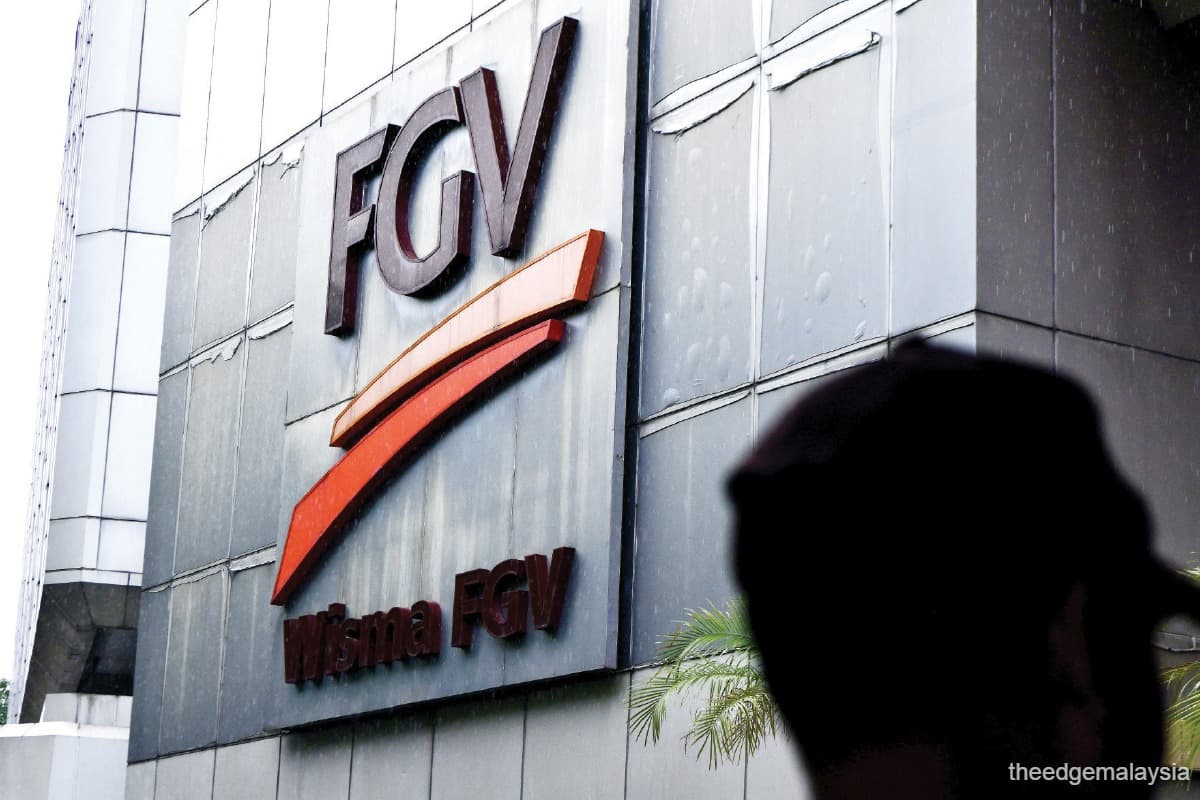
This article first appeared in The Edge Malaysia Weekly on June 2, 2025 - June 8, 2025
FIVE years after failing to privatise FGV Holdings Bhd (KL:FGV), the Federal Land Development Authority (FELDA) is back with another attempt.
Unfortunately for minorities who held out on the previous offer, the new offer is no sweeter, again set at RM1.30 per share. What is different this time, however, is the number of shares FELDA has accumulated since the previous attempt.
Currently sitting on 2.53 billion directly held shares or a 69.5% direct stake in FGV, together with persons acting in concert, FELDA now controls 86.93% or 3.17 billion shares in the plantations group. Persons acting in concert (PAC) include FELDA’s wholly-owned subsidiary, Felda Asset Holdings Co Sdn Bhd (12.42%) and the Pahang government (5%), according to FGV’s filing with Bursa Malaysia last week.
Other PACs include Koperasi Kakitangan Felda Malaysia Bhd, which owns 0.01% and whose board consists of Felda management, and Sulong Jamil Mohamed Shariff and his wife Salina Samsudin with a negligible number of shares.
Will it be second time lucky for FELDA?
The first threshold FELDA and the PACs would need to reach in order to advance in its attempt is to obtain at least 90% of the total shareholding of FGV. Once obtaining at least 90% of the shareholding of FGV, they would be able to apply to Bursa to suspend the stock.
Suspending the stock could put pressure on minority shareholders to give up their stake, especially those holding it on margin, as FELDA has said it does not intend to maintain the listing of FGV.
However, in order to trigger a compulsory share acquisition and take FGV private, the threshold is higher. It is worth noting that FGV has not met the public shareholding spread requirements since February 2021.
FELDA needs 429.21 million shares or 11.76% of the total shares it does not yet own in order to trigger the compulsory share acquisition. Calculated from the total shares outstanding point of view, FELDA would need 98.7% of FGV shares.
But, it is not too far from the 90% threshold that will enable it to apply to Bursa for a suspension from trading.
As at May 28, FELDA had managed to increase its stake by another 5.15 million shares or 0.28% from the open market, bringing its total to 87.21% — still a way to go to reach 98.7% of the total FGV shares.
Looking at FGV’s list of substantial shareholders in its 2024 annual report, key shareholders who would be crucial for the compulsory acquisition to happen include the state of Sabah via Chief Minister, State of Sabah, which controls 1.81%. Another Sabah entity is Ekuiti Yakinjaya Sdn Bhd, which is controlled by the sovereign wealth fund Sabah Development Bhd, with 0.572%.
Some have questioned why Sabah is not on the list of offerers for the deal, given that Pahang has jumped on board with the offer. In an earlier story (“FELDA revisits privatisation of FGV”, The Edge, May 5, Issue 1573), the publication had quoted a source who was aware of the privatisation explaining that both Pahang and Sabah had taken on debt to buy FGV shares and they had chosen to hold on to their stakes in the earlier privatisation attempt in 2020 because they could not afford to impair the losses.
“So what changed for Pahang? Is FELDA confident Sabah will accept the offer?” muses an observer.
Other noteworthy FGV shareholders include Yayasan Islam Terengganu with 0.45%; Datuk Freddy Lim Nyuk Sang of Kretam Holdings Bhd (KL:KRETAM) (0.39%); and Ku Tien Sek (0.19%).
In all likelihood, FELDA would need almost all the key shareholders to be agreeable for the privatisation to happen.
Notably, FELDA has not yet issued the offer document. Observers are waiting to see if FGV’s share price will inch up after the offer document is issued, a sign that minorities want more than the offer price.
FGV shares remained unchanged at RM1.30 after the announcement of the proposed privatisation.
The offer price of RM1.30 is 1.56% higher than FGV’s last price of RM1.28 on May 23, prior to the announcement on May 26 and 10% above the one-year average price of RM1.18. But it is at a 71.4% discount to its initial public offering price of RM4.55 per share back in 2012.
Amid the privatisation announcement, FGV reported its first-quarter earnings, which ended March 31, 2025, which saw it return to the black with a net profit of RM36.48 million compared to a net loss of RM13.49 million a year earlier. Revenue was 11% higher for the quarter at RM5.04 billion on account of higher palm oil prices.
FGV had said in its financial performance report that the plantation division average crude palm oil (CPO) price was 22% higher at RM4,784 per tonne while production of fresh fruit bunches (FFB) expanded 6%.
It is worth highlighting that the planter’s revenue and earnings have grown since its privatisation bid in 2020. In FY2024, net profit totalled RM274 million against revenue of RM22.15 billion. This compares with RM146 million of net profit in FY2020 while revenue stood at RM14.08 billion in the same year.
FGV has a total planted area of 335,420ha, of which 324,563ha are oil palm plantations. It has undertaken replanting programmes to help to improve the age profile of its oil palms. In FY2024, it reported that it had completed 89% of its replanting programme and the average oil palm age profile was 12.73 years. Its aim is to achieve a normalised average age profile of 12 years by 2026.
CPO production has improved slightly in the last five years, from 2.87 million tonnes in FY2020 to 2.92 million tonnes in FY2024. FFB yield also saw some improvement from 15.39 tonnes per hectare in FY2020 to 15.56 tonnes per hectare in FY2024.
Market observers question if minorities should get more from the offer. After all, five years have passed since its previous privatisation attempt. Over the period, the average CPO price has doubled from FY2020 of RM2,675 per tonne to RM4,784 per tonne in 1QFY2025.
Having said that, MIDF Research has recommended that investors accept the offer on the grounds that RM1.30 represents a 12% premium over its fair value of RM1.16 given the company’s mixed outlook.
“Currently, the stock is valued at 17 times the price-earnings ratio based on the forecast FY2025 earnings per share of 7.6 sen, 7.1% below the integrated plantation sector average PER of 18.3 times. If valuations were instead based on FY2024 earnings, the implied PER would be 17.2 times.
“Although the historical and forward implied PER are notably below FGV’s five-year average of 20.5 times and lag behind sector valuations, we view this as a fair benchmark given the company’s mixed outlook,” explains MIDF in a report.
Save by subscribing to us for your print and/or digital copy.
P/S: The Edge is also available on Apple's App Store and Android's Google Play.