

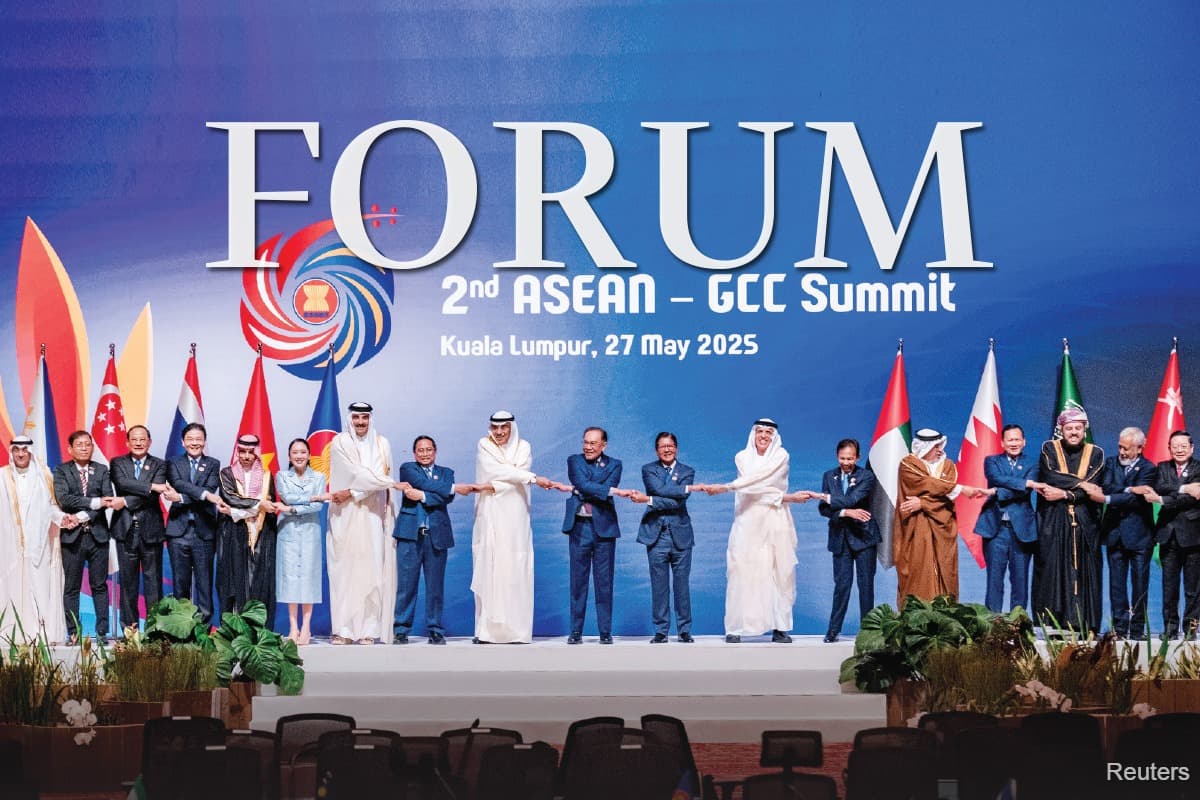
This article first appeared in Forum, The Edge Malaysia Weekly on June 2, 2025 - June 8, 2025
Posterity, I dare say, will regard the recently concluded Asean-Gulf Cooperation Council (GCC)-China Summit in Kuala Lumpur on May 27 as a historic turning point.
While the 46th Asean Summit and its related meetings, like the 2nd Asean-GCC Summit, were equally historic for their role in progressing Asean’s agenda, current trade wars and geopolitical fragmentation have somehow made many quarters perceive the inaugural Asean-GCC-China Summit as the game changer during the recent Asean gathering.
A potential “reconciler” to the fragmented world, Malaysia could stand proud not merely for arranging such a smoothly run summit, but also for the bridging together of minds that have arguably emerged as key voices of the newly resurgent Global South, particularly through the successful issuance of a Joint Statement — usually the most difficult feat in any multilateral meeting.
As part of their Joint Statement, the Asean-GCC-China leaders condemned the continued atrocities on the people of Gaza and called for a ceasefire, echoing the sentiments of all right-minded peoples across the world.
Beyond politics, a deeper trilateral economic integration makes perfect sense. For context, the combined numbers for Asean, GCC and China speak for themselves: 2.15 billion people (or just over a quarter of the world’s population), and a collective gross domestic product of almost US$25 trillion (RM106 trillion).
Figures for foreign direct investment inflows, too, stack up nicely: In 2024, Asean attracted US$235 billion in FDI inflows, representing about 17% of global FDI. China received US$114.76 billion, while the GCC secured US$70 billion. Collectively, these figures accounted for roughly 30% of global FDI inflows.
From such data alone, the significance of this combined economic might was clear to the leaders from China and the two economic blocs.
Asean can be a strategic gateway to the East Asian markets. Malaysia, in particular, with our well-established trade and industrial ecosystem, rule of law and ease of investor journey is also well-poised to facilitate such investments into the broader Asean and East Asian markets.
The GCC’s economic dynamism, strategic location connecting Europe, Asia and Africa, and its shared religious and cultural values with Malaysia as well as Asean make it an ideal partner for deeper economic integration. Indeed, in 2023, Asean’s trade with the GCC stood at US$130.7 billion and FDI inflows were US$390.2 million.
On a wider scale, China, as we know, was Asean’s largest trading partner with US$696.7 billion in trade and US$17.3 billion in FDI.
China and the GCC are, hence, crucial economic partners for Asean and for Malaysia. It is, therefore, completely appropriate for us to want to engage with them, both on a bilateral and trilateral format.
That is also why Malaysia will soon start negotiations for a free trade agreement (FTA) with the GCC, because there is so much potential to increase the current US$22 billion total trade between Malaysia and the GCC.
How Asean deals benefit its people
But I want to go a bit more granular and show how engaging on an Asean-GCC-China scale can benefit ordinary Malaysians, including the youth, women, and micro and small and medium enterprises (MSMEs). Through the 18 Priority Economic Deliverables under the Economic Pillar of Malaysia’s 2025 Asean chairmanship, the Ministry of Investment, Trade and Industry and other related ministries are working diligently to ensure substantial progress for these PEDs by year end.
Some of these are of course directly linked to the GCC and China. For instance, we have completed negotiations to not only upgrade the Asean Trade in Goods Agreement but also the Asean China Free Trade Area 3.0. Both of these will be signed this October, boosting both intra-Asean and Asean’s trade with China, which as we know will be key to tiding our region over during this period of geopolitical instability.
Separately, another of our PEDs, namely the Joint Declaration on Economic Cooperation Between the Asean and the Gulf Cooperation Council, was also completed in full. Through this, our two regions will explore new avenues of cooperation such as market integration, sustainability, decarbonisation, digital transformation and inclusion, including for MSMEs.
Sectorally, Asean’s PED on the Development of Policy Recommendations and Guidelines to Support Asean EV (electric vehicle) Implementation Road Map will benefit from China’s global leadership in EVs. Accounting for more than 70% of global electric car production in 2024, China has also produced more than 70% of all EV batteries ever manufactured.
Consider also the endorsement of the Asean Plan of Action for Energy Cooperation 2026-2030, which is clearly in alignment with the GCC’s ramping up of its efforts to diversify its economies and energy mix away from oil and gas in pursuit of renewable energy (RE). They have pledged a US$100 billion investment in RE by 2030 to transition to clean energy and reduce carbon emissions.
There are, indeed, many synergies for economic integration. Development of the Asean tourism outlook? China and GCC are key tourist markets for Asean.
An Asean Framework for Integrated Semiconductor Supply-Chain? China is both a major chip buyer and maker.
In conclusion, when Malaysia proposed the PEDs for its chairmanship year, we were clear on how we could boost Asean’s socioeconomic dynamism, and ergo, the Asean-GCC-China trilateral relationship can likewise contribute to this.
Furthermore, global demand for halal products is currently valued at over US$3 trillion and will grow to US$5 trillion by 2030. This is a market Asean, GCC and China can collaborate to tap, and even corner, together.
Also, as previously highlighted, as a combined market of more than two billion people, Asean, GCC and China should be regions where young Malaysian men and women, including those in small businesses, look for job or business opportunities. We are paving the way for all our Malaysian jaguh to enter wider markets for their goods and services, while ensuring that their interests will always be safeguarded through well-negotiated FTAs.
Deeper economic integration supports regional security
But one would argue that even spreading one’s wings to Asean really is just a way point for the truly ambitious. While other regions may draw inwards, our three are seeking even greater connectivity for our people and businesses.
The coming together of Asean-GCC-China’s leaders signals that we refuse to allow our horizons to be limited — by ourselves or others — to our own borders or backyards.
Indeed, deeper economic integration would do well to better support regional security, which feeds into Asean’s Political Security deliverables.
This is also why Asean — with its principles of centrality, neutrality, non-alignment — must matter to not only its member states, but also to partners like the GCC, China and, indeed, other dialogue partners, including Australia, Canada, the European Union, India, Japan, New Zealand, the Republic of Korea, Japan and New Zealand.
Truth be told, what we can achieve together through this nascent Asean-GCC-China trilateral configuration is only limited by our imaginations.
Tengku Datuk Seri Zafrul Abdul Aziz is Minister of Investment, Trade and Industry
Save by subscribing to us for your print and/or digital copy.
P/S: The Edge is also available on Apple's App Store and Android's Google Play.