

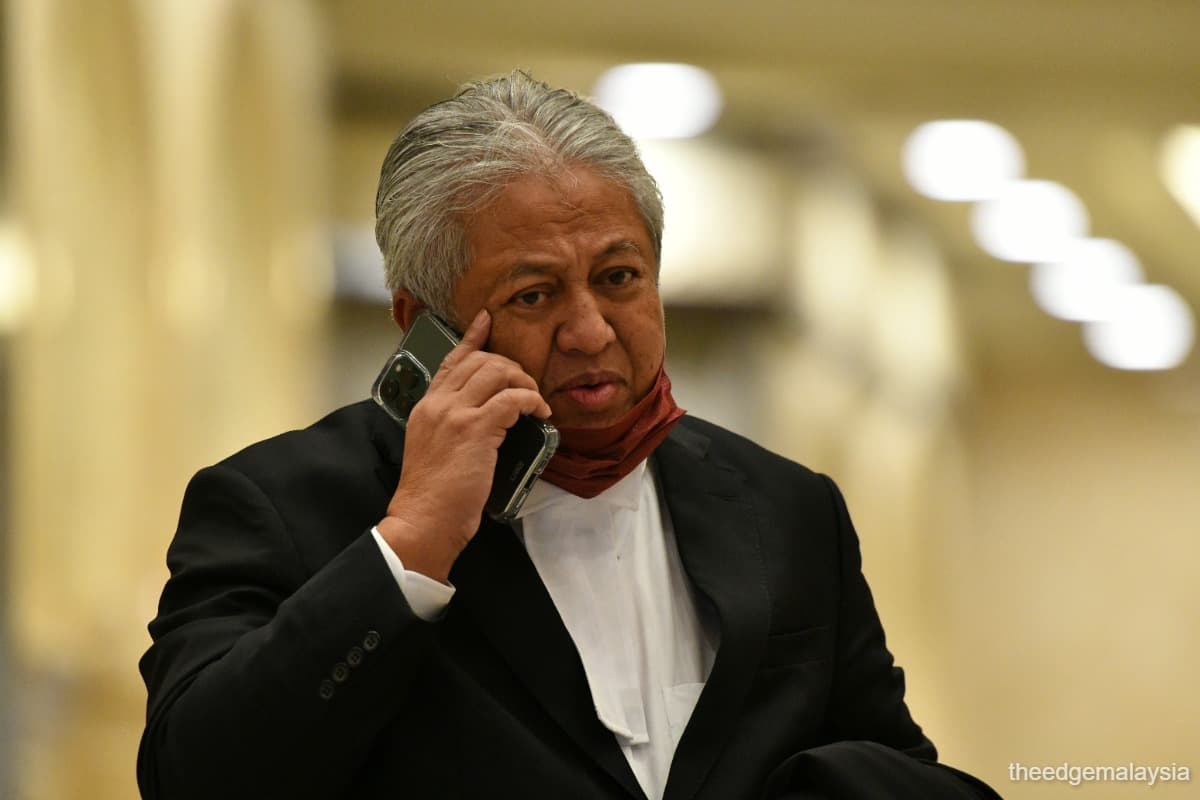
KUALA LUMPUR (May 29): The High Court has dismissed Datuk Zaid Ibrahim's defamation suit against the Malaysian Bar over a statement made three years ago regarding his law firm's conduct during former prime minister Datuk Seri Najib Razak's final appeal in the SRC International Sdn Bhd case.
High Court judge Roz Mawar Rozain found that Zaid, along with his firm Zaid Ibrahim Suflan T H Liew & Partners (ZIST)'s senior partners — Liew Teck Huat and Rueben Mathiavaranam — had failed to prove their claim of defamation, conspiracy to injury, and breach of statutory duty.
The High Court judge found that after due consideration, she did not find that the impugned statement further lowered the plaintiff's reputation in the eye of the public, which was already established in public due to events around Najib's appeal.
"The reputational impact of the plaintiffs’ conduct had already crystallised prior to the publication, owing to their own public statements and the unfolding events in the Federal Court [...]
"In the case, the plaintiffs themselves had, prior to the publication, made multiple public disclosures — admitting their lack of readiness, criticising prior counsel, and seeking adjournments which were ultimately refused by the Federal Court [...]”
Referring to case law, Roz Mawar observed that "not every criticism amounts to defamation".
The judge added that professional reputation is to be protected.
"However, the legal threshold for defamation is not met, where the sting of the statement does not materially add to a reputational damage already occasioned by events and disclosures independent of the impugned statements published," she said.
Lawyer Andrew Chiew, who appeared for the Bar and its then-president Karen Cheah, did not ask for cost, adding that hopefully this would be an olive branch to put the matter to rest.
The court commented that it was "rather magnanimous of Bar" and made no order as to cost.
The suit, filed in September 2022, revolved around Cheah's statement "Abuse of process brings disrepute to our justice system" amid Najib's final appeal in the SRC case at the apex court in August 2022.
The firm had taken over from Messrs Shafee & Co in Najib's final appeal. However on Aug 19, 2022, Najib discharged ZIST, and the statement by Cheah was issued after that.
Cheah, in her capacity as the Bar president, claimed that the change of lawyers — although it was Najib's prerogative — amounted to an abuse of the judicial process and that the lawyers indulging in such techniques had acted unprofessionally.
The plaintiffs claimed that the statement implied that as senior members of the Bar, they had deliberately acted unprofessionally by accepting the brief from Najib with an improper agenda to abuse the court process.
They said that the statement also implied that they had accepted the brief with an ulterior motive to undermine the justice system by resorting to unscrupulous strategies.
The plaintiffs claimed that despite "condemning" them of professional misconduct, the defendants failed to lodge a complaint to the Disciplinary Board under Section 99(1) of the Legal Profession Act (LPA) and had "taken it upon themselves" to determine that the lawyers were guilty of misconduct.
They also claimed that the defendants had breached their statutory duty by not referring them to the Disciplinary Board.
In their statement of defence filed last November, the defendants said that the statement was a fair comment in the matter of public interest.
They also claimed that they had a statutory duty to inform the public of Zaid and his lawyers' conduct during Najib's appeal.
They also argue that they are protected by qualified privilege as the statutory body’s purpose, among others, is to “maintain the standards of conduct of the legal profession in Malaysia and to express its view on matters affecting the administration and practice of the law in Malaysia”.
The defendants also claimed that they had not breached their statutory duty and that they had lodged a complaint with the Disciplinary Board on Oct 3, 2022, in line with Section 99(3) of the LPA.