

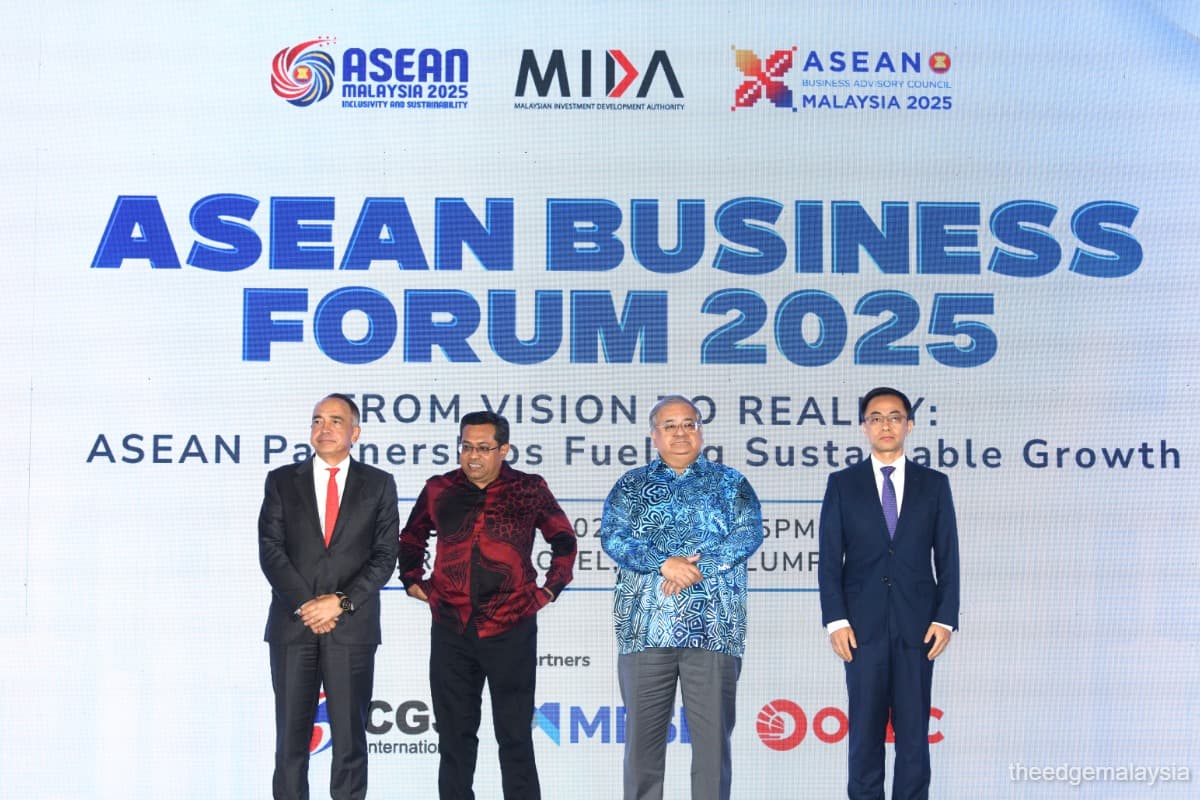
KUALA LUMPUR (May 29): A new private market association is expected to be set up by year end to advise Asean governments on policies that support the growth of the industry, said banker-turned-investor Tan Sri Nazir Razak.
A pro-tem committee — comprising members from Malaysia, Singapore, Thailand, and Indonesia — has already been formed and is working towards the formal establishment of the association by year end, said Nazir, who chairs the Asean Business Advisory Council (Asean-BAC) Malaysia.
Among the issues that can be discussed are market fragmentation, and rules on taxation and ownership for the growth of the private market industry, Nazir told reporters on the sidelines of the Asean Business Forum 2025 on Thursday.
The Asean-BAC was formed following the 7th Asean Summit with the mandate to provide private-sector feedback and guidance to boost efforts towards economic integration.
Accordingly, the Asean-BAC’s activities are primarily focused on reviewing and identifying issues to facilitate and promote economic cooperation and integration.
The private markets industry is "extremely important to the economy but remains too small”, contributing only 0.5% to gross domestic product compared to the global benchmark of 1.5%, Nazir said.
Asean may require up to US$60 billion (RM254.49 billion) in capital channelled to private equity and venture funds, according to Nazir.
“But certain reforms are needed in order for this to happen. We are going ahead with the process of setting up this Asean private market association to help drive industry development,” he added.
In his welcoming address at the forum earlier, Nazir also highlighted that intra-Asean trade and investment remain low, accounting for only 22.9% of the region’s total trade, stressing the urgent need to attract more investment into the region.
In Asean, “we have visions and master plans aplenty, but what we lack is execution at the speed and scale the world now demands”, Nazir said. “We are living through the exponential age, where climate, technology, geopolitics, and geoeconomics are evolving at a breathtaking pace.”
Further, the private sector has also fallen short, he said. “Are we doing the deals that we should be doing — in partnerships, mergers and acquisitions, supply chains and trade? I don't think so.”
On the part of the Asean-BAC, Nazir highlighted some of the association’s initiatives, including the proposal for an Asean initial public offering (IPO) prospectus — under which companies seeking a public listing in Asean markets will have the option to issue either a domestic or an Asean-wide prospectus.
Another proposal is the Asean Business Entity (ABE) status designed to support qualified companies within Asean, offering them a range of operational flexibilities.
Companies that qualify for ABE status could benefit from the free movement of outsourcing, capital, skilled labour, and higher maximum shareholding limits, providing them with greater control and expansion opportunities.
The proposals, he said, have been recommended to the government and are still work in progress.
Read also:
Non-tariff barriers still hinder intra-Asean trade, say economists
Bursa Malaysia in partnership to facilitate foreign-underlying ETF listings
Malaysia pushing for progress on South China Sea code of conduct, five-point consensus on Myanmar, says Zafrul
Asean green initiatives can generate additional US$300b by 2030, says Zafrul
Malaysia can drive deeper Asean economic integration, timing is right, says Nazir Razak