

This article first appeared in The Edge Malaysia Weekly on May 26, 2025 - June 1, 2025
ON March 5, the Malaysian government announced a US$250 million (RM1.1 billion) deal with UK-based chip architect Arm Holdings plc, which is owned by Japan’s SoftBank Group Corp. The decade-long agreement is to acquire semiconductor-related licences and technology to strengthen Malaysia’s chip industry.
The deal was announced at the launch of Malaysia’s Silicon Vision initiative at Shangri-La Kuala Lumpur, a high-profile event attended by Prime Minister Datuk Seri Anwar Ibrahim and Arm CEO Rene Haas. Both delivered speeches before officiating a signing ceremony.
Taking centre stage at the event was a showpiece Arm-powered central processing unit (CPU), made up of chipsets bearing the coat of arms of Malaysia and the Arm logo (see pic).
But what went largely unnoticed, even by many industry observers, were two other logos featured at the top of the CPU’s server unit — Kedah-based electronics manufacturing services (EMS) provider Aurelius Technologies Bhd (KL:ATECH) and its main operating subsidiary, BCM Electronics Corp Sdn Bhd.
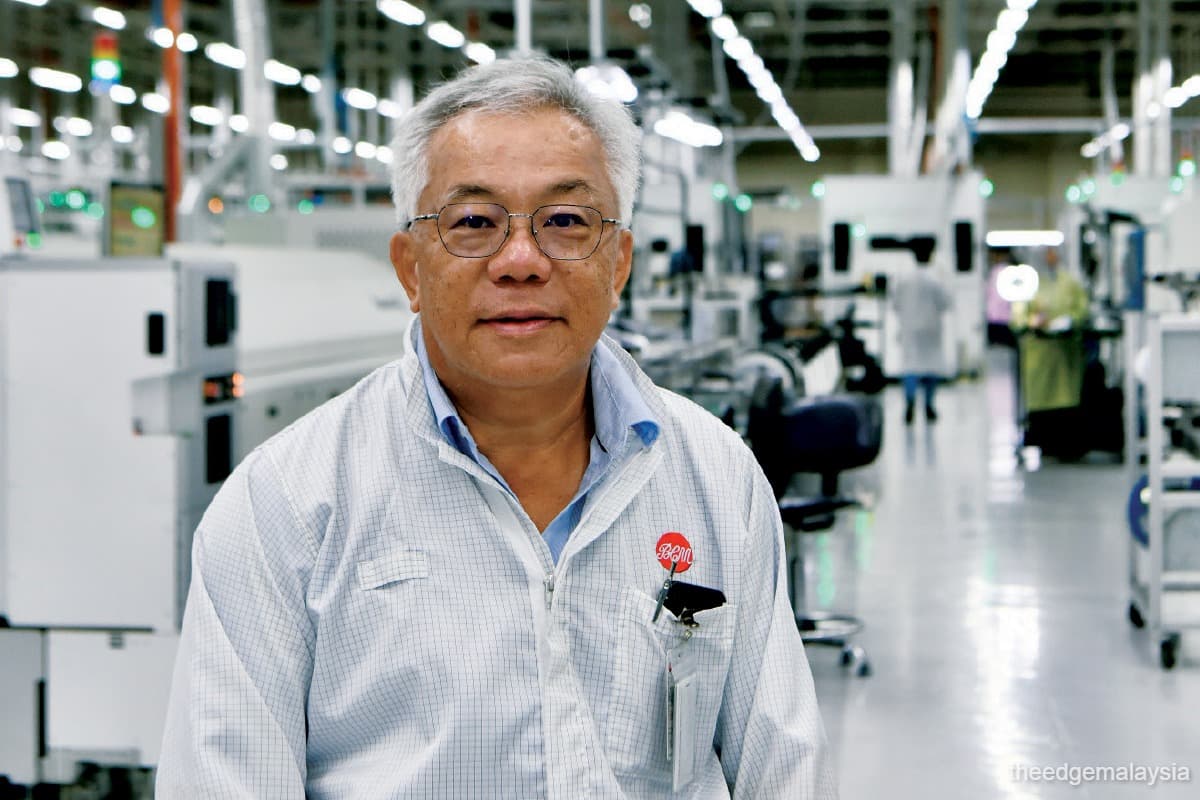
This inclusion was not a coincidence. ATech executive director and CEO Loh Hock Chiang — who runs an EMS outfit in Kulim — was one of the few selected participants in a panel session during the symposium.

Given that top Malaysian government officials and Arm’s senior executives dominated the spotlight that day, many may have missed the significance of Loh’s presence on stage as a panellist, instead of the expected line-up of chip experts or semiconductor industry leaders from Penang.
In a recent exclusive interview with The Edge at ATech’s headquarters in Kulim Hi-Tech Park, Loh remains tight-lipped on the group’s specific role during the Silicon Vision event.
He did, however, confirm that ATech is eager to play a meaningful part in Malaysia’s ambitious Arm project, whose main goal is to produce the country’s own chip within five to seven years, driven by the increasing global demand for artificial intelligence (AI) and data centres.
“It’s going to be a long process. It will probably take our country at least five years to develop ‘Made in Malaysia’ chips. We will have to see when this Arm project will really take off. But definitely, ATech is keen to participate in it,” says the 60-year-old, who is a major shareholder of the company.
ATech is an investment holding company whose subsidiary BCM Electronics is principally an EMS firm focused on industrial electronics products.
In 2019, ATech expanded into the manufacturing of semiconductor components in the form of multi-component integrated circuit (IC) for Internet of Things (IoT) applications. The group then commenced mass production of these semiconductor components about a year later.
Today, it is one of the first companies in Malaysia to manufacture fifth-generation (5G) communication modules and related applications for global clients, including a multinational telecommunications giant.
Notably, ATech is one of three main contract manufacturers in the world producing top-tier walkie-talkies used in critical public safety systems globally.
Nevertheless, Loh acknowledges that ATech, as an EMS firm, is at the lower end of the semiconductor supply chain.
“First, the chip design houses have to design the chipset. Next, they have to find the application for it. Then only EMS companies like us will come in to build the products.
“ATech is not involved in the design of chipset, but we might be involved in the application stage as an original design manufacturer (ODM), using these chipsets to design a new product,” he explains.
Loh goes on to say that as an EMS player, ATech ultimately views manufacturing as its end game — which is why securing first manufacturing rights, should the project proceed, is a key priority for the group.
“Right now, the Arm project is still at an early stage, and I foresee some challenges. Does Malaysia have sufficient capability and talent to design the chipsets? Do we have the deep pockets to do it? I am not complaining. But these are the questions that we have to ask ourselves,” he says.
Arm-designed chips are ubiquitous in the modern world, with the UK firm having shipped more than 300 billion chips. Today, 99% of smartphones run on Arm-based processors. Some 70% of the world’s population uses Arm-based products, while 50% of all chips with processors are Arm-based.
The Ministry of Economy had on May 6 revealed that Malaysia’s Arm initiative offers two access tiers: Arm Flexible Access (AFA), tailored for start-ups and smaller companies; and Arm Compute Subsystem (CSS), intended for larger, more established enterprises.
A total of 25 access tokens are allocated for AFA applicants, while seven are reserved for those applying through CSS. Applicants must submit a detailed product road map and provide proof of steady cash flow to the Economy Ministry, supported by audited financial statements from the past two to three years.
After a change in its financial year end from Jan 31 to Dec 31, ATech only had 11 months in its new financial year ended Dec 31, 2023 (FY2023). Over that period, the company made a profit of RM38.25 million on turnover of RM385.56 million.
FY2024 marked a record-breaking year for ATech, with revenue surpassing RM600 million and earnings reaching RM61 million, mainly attributed to larger customer base, new product lines and higher manufacturing capabilities.
Moreover, margin stability was also achieved through effective product mix optimisation, enabling efficient just-in-time deliveries aligned with customer demand.
ATech’s net profit margin improved from 6% in the financial year ended Jan 31, 2022, to 7.7% in the financial year ended Jan 31, 2023. It improved further to 9.9% in the financial year ended Dec 31, 2023, and to 10.2% in FY2024.
By comparison, the net margins of VS Industry Bhd (KL:VS) and SKP Resources Bhd (KL:SKPRES) were 5.79% and 4.91% respectively in their latest full financial year.
Meanwhile, Nationgate Holdings Bhd (KL:NATGATE) — the sole contract manufacturer of Nvidia Corp in Southeast Asia, specialising in assembling AI servers — only had a thin net margin of 3.04%.
Seeking strong partners
To seize the opportunity to participate in the Arm project, Loh says ATech will look for partners to make collaborative efforts.

“In my view, we have to find a very big guy, who is already established in the business, but still highly scaleable,” he adds.
However, if the potential partner is already a major player, ATech may encounter challenges, as such a company would likely have its own direct access to Arm, potentially reducing the need for collaboration.
“Why would they need us? Why would they need Malaysia? So, we have to find someone who is big enough, but still needs Malaysia,” he elaborates.
For Malaysian chip designers, says Loh, the focus needs to be on building for the future — not just current market needs. The real question is: What will the world demand in five years’ time?
“It’s not a simple game. But of course, if we could get it done, then we (Malaysia) will have the intellectual property (IP), and other people will come to buy from us, because they don’t have to reinvent the wheel,” he says.
Loh further says ATech is also aiming to position itself within the broader big data processing ecosystem.
“We want to bring server, storage, computing systems and connectivity into data centres. This is an area that we must go into. This is the future, and we cannot afford to miss this boat,” he says.
Loh is a chartered accountant with Chartered Accountants Australia and New Zealand, and has held various positions, including chief financial officer (CFO) and deputy CEO of Comintel Corp Bhd, where his last designation was executive director, before leaving in January 2018.
He assumed his current position of executive director of BCM in 2018 and was appointed group CFO of ATech in March 2021. Following the passing of ATech co-founder and former CEO Lee Chong Yeow in January 2022 — a month after the company was listed on Bursa Malaysia in December 2021 — Loh was made interim CEO before assuming the role of group CEO about seven months later in August.
As at April 3, Loh owned a direct stake of 7.05% in ATech. Together with the late Lee, he had held an indirect stake of 33.74% in the company through Main Stream Ltd (17.6%) and Main Stream Holdings Sdn Bhd (16.14%).
Lee’s daughter Jamie Lee Hwe Ping currently sits on the board of ATech as non-executive director. Hwe Ping’s younger brother Jonathan Lee Ming Chian, who serves as her alternate director, is the administrator of their father’s estate. They each have a direct stake of 1.76% in the company.
ATech executive director and CFO Tan Chong Hin is a substantial shareholder of the company with 5.38% equity interest via Pixel Advisers Pte Ltd.
The company’s latest annual report shows that its top 30 largest shareholders include the Employees Provident Fund (EPF), Aberdeen Group plc, Kenanga Investment Bank funds, AIA Bhd, Etiqa Life Insurance Bhd and Lembaga Tabung Angkatan Tentera (LTAT).
Two-for-one bonus issue
Closing at RM3.21 to give it a market capitalisation of RM1.4 billion on May 22, shares of Main Market-listed ATech is down 8.3% year-to-date but has gained 18.9% from its recent low of RM2.70 on April 15. The stock is currently trading at a historical price-earnings ratio (PER) of 21.2 times.
In mid-April, ATech had proposed a warrant-sweetened two-for-one bonus share issue. The proposed bonus issuances will involve up to 867.46 million new ATech shares, and up to 433.73 million free warrants.
To illustrate, based on the five-day volume weighted average market price of ATech shares of RM3.1571 on April 3, the theoretical ex-bonus share price will be about RM1.0524.
Meanwhile, the illustrative exercise price of warrants is assumed to be RM1.07 each, representing a premium of 1.68% to the theoretical ex-bonus price of RM1.0524. Based on this exercise price, and assuming full exercise, ATech expects to raise gross proceeds of RM463.87 million for working capital and future investments.
Save by subscribing to us for your print and/or digital copy.
P/S: The Edge is also available on Apple's App Store and Android's Google Play.