

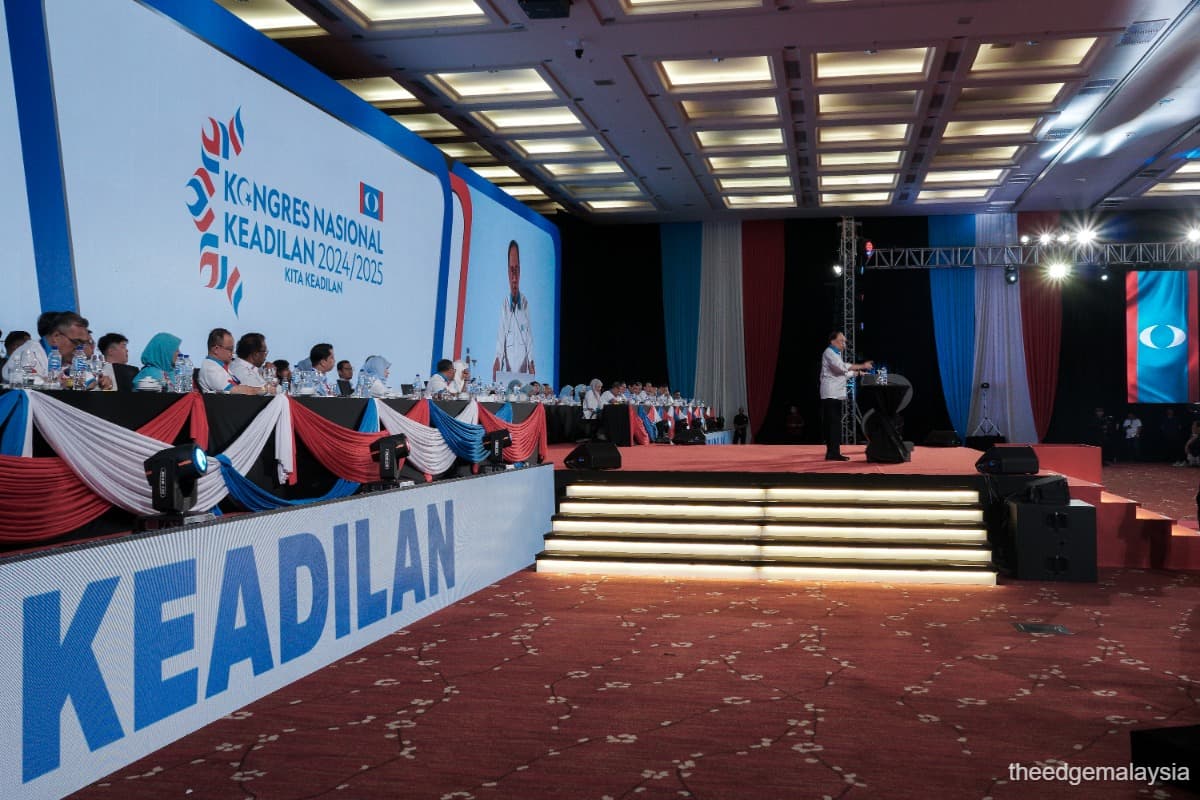
JOHOR BAHRU (May 24): The heated bout between Nurul Izzah Anwar and Datuk Seri Mohd Rafizi Ramli has ended, with the ‘Puteri Reformasi’ taking the deputy president mantle of PKR. The outcome was expected in the eyes of political analysts, who said it illustrates Prime Minister Datuk Seri Anwar Ibrahim’s continued overwhelming influence on the party.
According to official results, Nurul Izzah beat Rafizi by a wide margin of 5,937 votes.
The results represent the continuity of Anwar’s vision for PKR, particularly leadership succession for the party and government he leads, said Merdeka Center for Opinion Research co-founder and programmes director Ibrahim Suffian.
“While Anwar will lead the government, she (Nurul Izzah) will be strengthening the party in clear coordination with him. Despite the negativity that has transpired, the path of the party is now clear,” the analyst told The Edge when contacted.
The run-up to PKR’s central leadership elections led up with the party’s divisional elections, where a number of Rafizi’s allies failed to defend their seats.
These included Natural Resources and Environmental Sustainability Minister Nik Nazmi Nik Ahmad and Deputy Minister of Energy Transition and Public Utilities Akmal Nasrullah Mohd Nasir, and Deputy Youth and Sports Minister Adam Adli Abd Halim.
Looking at the Rafizi camp’s lost ground in the divisional elections, the economy minister's defeat at the central leadership level was expected, said Universiti Sains Malaysia (USM) political science professor Dr Ahmad Fauzi Abdul Hamid.
Anwar family factor
However, more crucially, Ahmad Fauzi said PKR’s leadership succession is now overshadowed by the “family factor”, where the party has opted to elect an unelected officer over an elected parliamentarian as its deputy president.
“Fence-sitters and PKR voters from among non-members would understandably deplore such backward slides towards non-democratic politics, what more with the bitter campaign that divides the party's rank and file,” he told The Edge.
“Allegations that the PKR president himself was behind this move to replace his deputy speaks volumes about his own tendencies to fall for undemocratic behaviour when his political interests matter more,” the analyst added.

At PKR's national congress, messages constantly echoed were that no individuals were bigger than the party, and that the party is in full support of pushing for another term for Anwar as the prime minister in the next general election.
However, before the general election, a potential Cabinet reshuffle is on the cards given Rafizi’s prior pledge to resign as the economy minister if he fails to retain the party’s number two post.
Analysts mixed on Cabinet reshuffle murmurs
Senior fellow of the Singapore Institute of International Affairs Dr Oh Ei Sun believes a Cabinet reshuffle is in order, suggesting that Nurul Izzah may be made a senator and appointed to a ministerial post.
As for Merdeka Center’s Ibrahim, he believes the same, but noted that it may be “too soon to tell”.
On the other side, Ahmad Fauzi said Rafizi’s defeat does not necessarily mean a Cabinet reshuffle is in order. “In Malaysia, we have begun to separate the government from the party, unlike during the days of Umno hegemony.
“Anwar as the prime minister and PKR president isn’t known to be a person loyal to party hierarchy anyway. He experienced a meteoric rise in Umno, and even dethroned a sitting deputy president and deputy prime minister, Abdul Ghafar Baba, in 1993.
“So, why must [Anwar] as the prime minister be too particular with his party hierarchy when considering appointments to the Cabinet?” the analyst quizzed.
Whether a Cabinet reshuffle will come, or how PKR members’ move to elect Nurul Izzah as the party's deputy president will truly impact its optics with the rest of Malaysia in the next general election, only time will tell.