

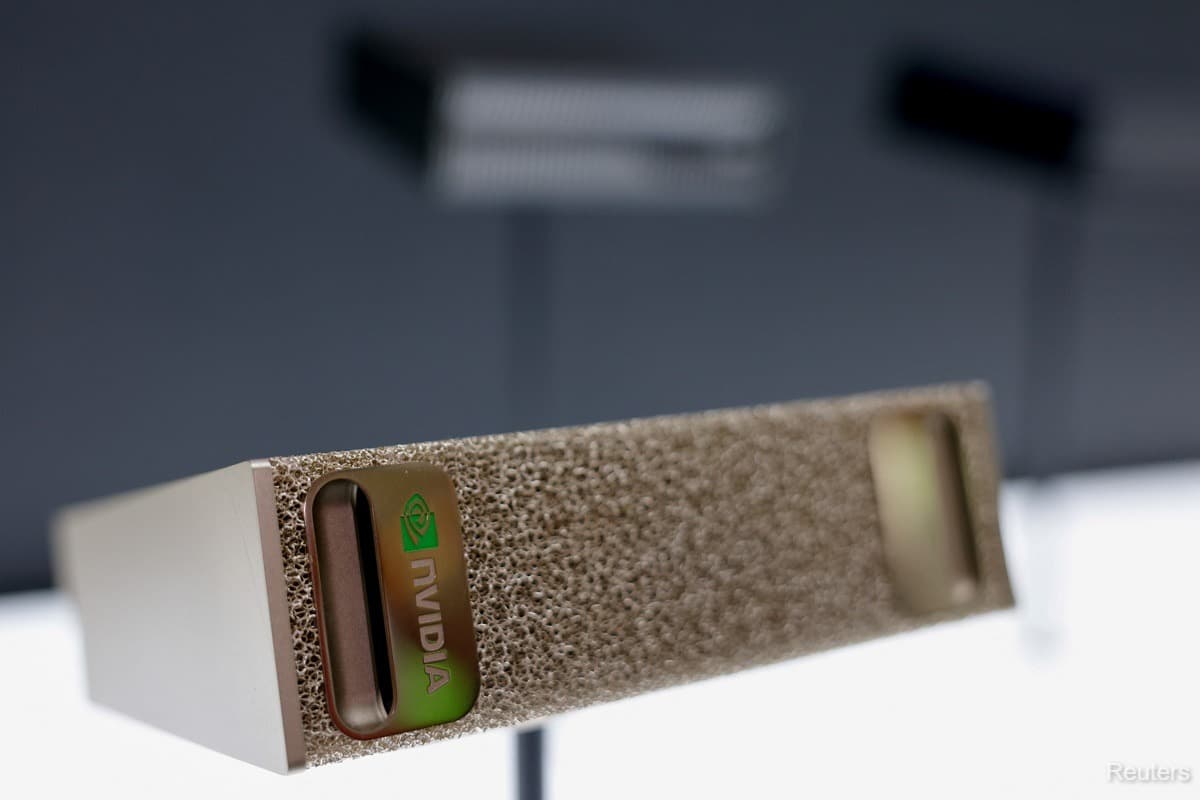
TAIPEI (May 21): YTL Power International Bhd’s (KL:YTLPOWR) first supercomputer in Malaysia, deploying the Nvidia GB200 Grace Blackwell Superchip on Nvidia DGX Cloud, is on track to go live by the third quarter of this year.
Alexis Bjorlin, vice-president and general manager of DGX Cloud at Nvidia Corp, confirmed that the rollout of the Nvidia Blackwell Ultra platform in Malaysia — which will be deployed from the 500MW YTL Green Data Centre Campus in Johor — is progressing “very well”.
“We will be hosting the DGX Cloud on (the infrastructure of) YTL, which is an Nvidia cloud partner (NCP). The development is going very well. Right now, we are very excited to bring out this cloud in the region.
"Everything is going according to plan. We are working closely with them. In fact, I work directly with (the people from) YTL,” she told The Edge at the sidelines of Nvidia GTC Taipei here on Wednesday.
Nvidia GTC, which stands for GPU Technology Conference, is a global artificial intelligence (AI) conference for developers, researchers and engineers.
Stable power, manufacturing capability deciding factors
According to Bjorlin, Malaysia’s stable power ecosystem and demonstrated manufacturing capabilities were critical factors in the decision.
“We are really excited about our investments in Malaysia. I had the opportunity to meet your prime minister (Datuk Seri Anwar Ibrahim). It’s very important that we come together and bring the technology and capability together between Nvidia and Malaysia.
"YTL, in particular, is our first partner in the region. This will bring tremendous benefits for us,” she said.
It was previously reported that the Nvidia Blackwell Ultra platform is set to use Nvidia's latest series of graphics processing units (GPUs), with shipments scheduled to begin in the second half of 2025.
In a statement in mid-March, YTL Power managing director Datuk Seri Yeoh Seok Hong said the group is poised to offer powerful AI cloud computing to the region “when our first Blackwell clusters come onstream, expected in July this year”.
YTL Power said its NCP subsidiary, YTL Cloud, will be an “early adopter” of the latest Nvidia Blackwell Ultra platform, making it one of the first cloud service providers in the Asia-Pacific to make this platform available.
Prior to Nvidia, Bjorlin was vice-president for infrastructure at Meta Platforms Inc, as well as senior vice-president and general manager of Broadcom Inc’s optical systems division.
She highlighted that DGX Cloud is a unified platform on cloud that offers high-performance, software, optimisations and AI expertise for evolving workloads. Basically, it allows organisations to bring AI workloads from development to deployment.
“We are not a cloud service provider. We are an AI platform that accelerates AI developers to be able to build AI workflows and access to all Nvidia technologies at speed of light. We operate ourselves on top of the cloud service providers, be they global players or NCP,” Bjorlin said.
A check on Nvidia’s website shows that DGX Cloud on the Oracle Cloud Infrastructure is enabling Deloitte to accelerate drug discovery in its Quartz Atlas AI solution with generative AI.
Meanwhile, AI technology firm Cerence Inc is training its automotive-specific large language model with DGX Cloud on Microsoft Azure.
“Our AI platform is very open. Some of our services are available for short-term use. We don’t just sign up people for long-term contracts. We may work with the cloud providers, and we bring our developers to the platform, they choose what the underlying cloud is.
They may say they have storage capability, and they want to operate on cloud service providers, but they want to keep going faster, so we are an accelerator,” she said.
Bjorlin went on to say that some enterprises' contracts with DGX Cloud could be short-term.
“We help them build their workflows, and they are free to take that and go and run those on the cloud platforms of their choice. There is nothing that keeps them on DGX Cloud.
“In fact, we want them to move out from DGX Cloud, because we have a small capacity, relative to the global cloud service providers. Our goal is to optimise the user's experience and workflows,” she reiterated.
Bjorlin further said the traditional cloud is operated at mass distribution, whereas the AI workload is “very fine-tuned”.
“You’re driving one workload across many computers at the same time. They have to be tightly-coupled and synchronised. All the GPUs are talking with each other to perform the AI task and to train the model,” she said.