

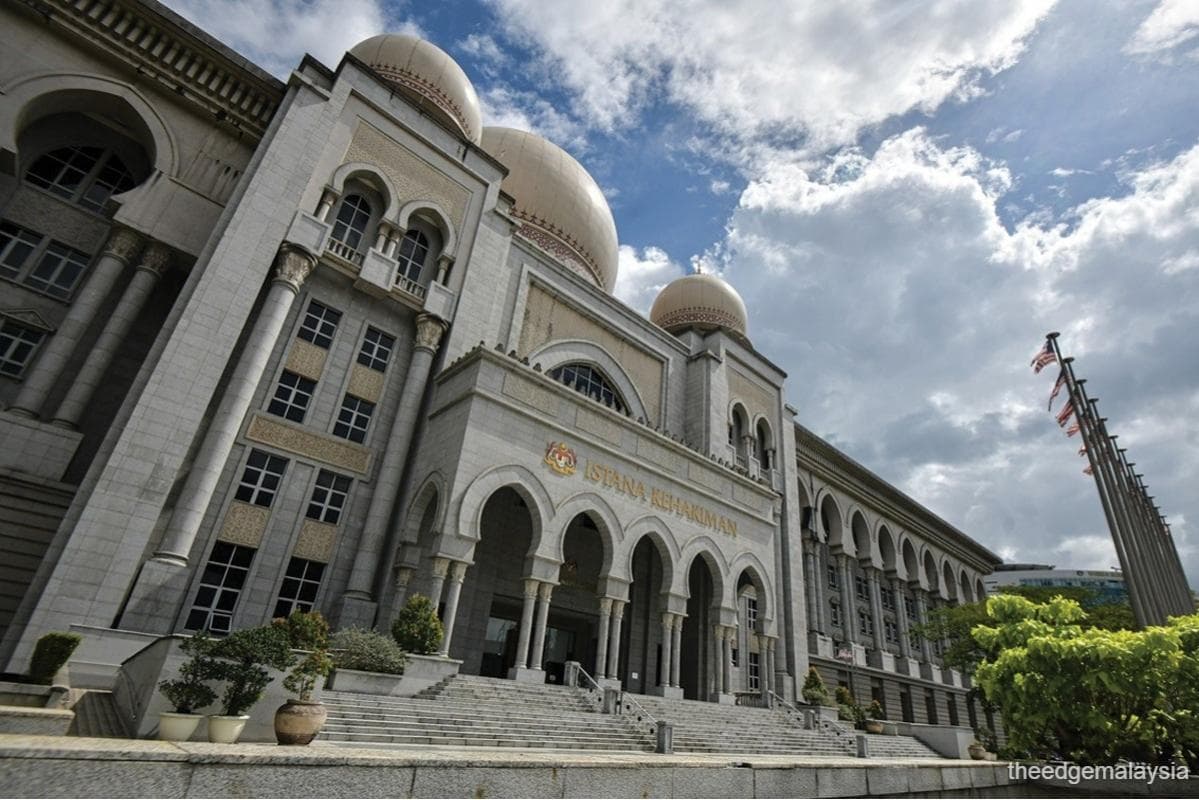
PUTRAJAYA (May 21): The Federal Court has fixed July 29 to hear the Malaysia Competition Commission’s (MyCC) leave application to appeal the Court of Appeal’s decision in March that upheld the High Court’s decision to quash the proposed fine of RM86.77 million MyCC had imposed on Grab Holdings Inc and two other subsidiaries.
The date was fixed following case management by the Federal Court deputy registrar Husna Dzulkifly on Wednesday.
MyCC filed a notice of appeal on April 17, citing that it is appealing the whole of the Court of Appeal’s decision, and the commission is posing eight questions of law to be decided by the apex court.
In the apex court, leave or permission has to be gained first before the full merits of an appeal are heard based on novel questions of law. This is to make sure that the appeal is not frivolous and vexatious.
It is understood that MyCC’s application for leave will be heard online. Grab and its two subsidiaries are opposing the leave application, claiming that the eight questions posed are not novel.
The law firm of Messrs Sitham & Associates has taken over from Messrs Tommy Thomas in handling MyCC’s final appeal.
On March 19, a three-member appellate bench decided that MyCC may have been “cavalier” when conducting the investigations on Grab and its two subsidiaries GrabCar Sdn Bhd and MyTeksi Sdn Bhd, in 2019.
Following this, the court found that there had been procedural impropriety and this warranted the judicial review sought by the three companies.
Judge Datuk Lim Chong Fong, who wrote the unanimous decision, said there should have been prior notification to the respondent (Grab and others) for request of information based on Section 18 of the Competitions Act 2010 (for power to require provision of information), as the investigation must be predicated by a third-party complaint.
The judge said this since the investigation had deprived the respondents of knowing the details of the complaint, resulting in the companies' request for the information.
Lim added that the appellate court also found the letter issued by MyCC to the respondents to be ambiguous.
“This court also found that Section 35 of the Competitions Act (with regards to interim measures) up to Section 40 (finding of an infringement) does not provide a mechanism to challenge a proposed decision.
“The court found there is no appeal process to the proposed decision made based on Sections 35 to 40, and the respondents (Grab and others) were right in filing the judicial remedy, as there is no internal remedy available for them to challenge the proposed decision (to impose the fine). Hence, this court finds the High Court judge did not make any appealable error that warrants appellate intervention,” Lim said, resulting in the appellate bench dismissing MyCC’s appeal.
Eight questions posed by MyCC
MyCC has posed eight questions of law to be decided by the apex court should it gain leave for the merits of the appeal to be heard. They are:
- Whether a proposed decision under Section 36 of the Competition Act is a ‘decision’ reviewable under Order 53 Rule 2(4) of the Rules of Court;
- The established principle of law, that investigative powers of the authorities are not susceptible to judicial review, applies to the investigative powers exercised by MyCC under the provisions of the Act, as the Court of Appeal has held otherwise:
- Whether the finding of the COA that the proposed decision under Section 36 of the Act is amenable to judicial review is against the legislative scheme of the Act;
- Whether an enterprise being investigated for an infringement of any prohibition under the Act should be afforded the right to be heard during the investigative process and before the delivery of the proposed decision;
- Whether the absence of the right to be heard during the investigative process conducted by MyCC in respect of an infringement by an enterprise of any prohibition under the Act is a denial of the right to be heard and therefore in breach of natural justice;
- Is the right to be heard by an enterprise being investigated for an infringement of any prohibition under the Act available before the proposed decision or after the proposed decision but before the final decision;
- Whether a challenge to the proposed decision delivered under Section 36 of the Act can amount to a challenge of the investigative process/powers of MyCC under the Act;
- Whether the CoA finding that the investigation by MyCC must be predicated on a third-party complaint is contrary to Section 14 (1) and or other provisions of the Act and/or common law.
The High Court on July 6, 2023, had allowed Grab’s judicial review when judge Datuk Wan Ahmad Farid Wan Salleh (now a COA judge) ruled that MyCC's decision in announcing the proposed fine was filled with procedural impropriety and had breached natural justice.
“Hence, this court is allowing the certiorari application [to quash] the proposed decision. However, the court is not awarding the damages, as there is no proof of mala fide [bad faith] by MyCC in making the proposed decision,” Wan Ahmad Farid had ruled.