

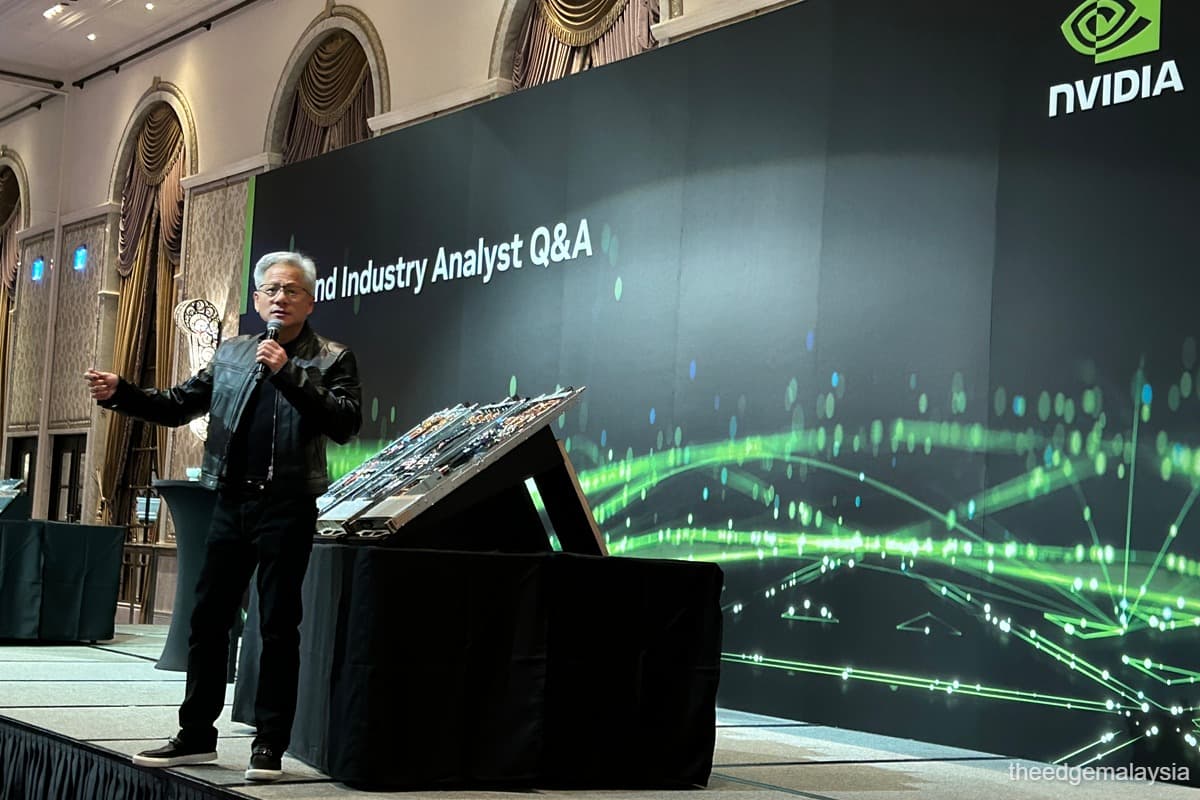
TAIPEI, Taiwan (May 21): Nvidia Corp chief executive officer Jensen Huang has openly questioned the effectiveness of former US president Joe Biden’s export controls on advanced artificial intelligence (AI) chips to China, highlighting that the policy has not only hurt Nvidia financially, but also accelerated China’s domestic AI development.
“I’m not upset about the policy. I just think that the policy is wrong. About four years ago, at the beginning of the Biden administration, Nvidia’s market share in China was nearly 95%. Today, it’s only 50%. The rest was built by Chinese technology,” he told the media during a question and answer session at the annual Computex event here on Wednesday.
“Not to mention that we had to sell less advanced chips to China, which means lower average selling price for Nvidia, and hence, lower tax revenues for the US,” he said.
The CEO, who has been nicknamed the “Godfather of AI”, pointed out that since the US chip export control was imposed by the Biden administration, “nothing has changed”.
“The Chinese AI researchers are still doing their work in China. They have unlocked their local technology. If they don’t have access to Nvidia, they will use their own [technology], or they will use the second best.

“The Chinese companies are very talented and determined. The export control gave them the spirit and energy, as well as the Chinese government’s support to accelerate their development. All in all, the export control is a failure, the fact would suggest it,” said Huang.
He also praised Chinese AI firm Hangzhou DeepSeek Artificial Intelligence Basic Technology Research Co Ltd, and Chinese technology giant Huawei Technologies Co Ltd.
“DeepSeek was built on Nvidia, that’s a gift to us. It’s also a gift to the world because it’s open source. Now, DeepSeek runs incredibly well everywhere.
“Again, the China market is so important to us because their AI researchers are so good. They are going to build amazing AI, no matter what. So, we want them to build on Nvidia technology, or at least US technology.”
Huang added that DeepSeek is “incredible for AI infrastructure”, as it is a reasoning model that could think fast.
“DeepSeek has opened the world’s first open-sourced reasoning model. Developers all over the world are using DeepSeek because it’s so good. It has the capability to read websites and PDF; then, it could think, reason, plan, and read some more,” he said, adding that DeepSeek actually increased the amount of computing needs by hundreds or thousands of times.
Huang also opined that one of the “largest and most formidable” technology companies in the world is Huawei. “They are innovating fast. The advantage that AI provides is that the data centre is large. It’s not like a cellphone, where everything has to fit into one chip. In AI, if one chip doesn’t work, then use two chips, or four chips.”
Given that China has plenty of energy and land to develop these AI infrastructure with less-advanced chips, Huang believed the US ban on Nvidia’s H20 in China is not effective for that reason.
“The Chinese would just buy more chips from Huawei and others, because we are not the only ones who could provide such technology. Many others are more than happy to do that.
“The US government now realises that. So, we hope that we can go back to China to win the market share as soon as possible,” he said.
Huang lauded US President Donald Trump’s decision to reverse Biden’s AI Diffusion Rule, claiming that the former president had wrongly assumed that the US was the only country that could provide AI technology.
“The goal of the old AI Diffusion Rule in the past was to limit AI diffusion, and President Trump realised this was a wrong goal, because the US is not the only provider of AI technology,” he said.
Huang is of the view that if the US wants to stay in the lead of the AI race, and if the US wants the rest of the world to build on American technology, the AI diffusion needs to be maximised.
“That’s where we are today. It’s really a great reversal of a wrong policy, and it’s just in time, but we need to move fast now,” he said.
Huang reiterated that Biden’s assumption that led to the AI Diffusion Rule at the beginning, has been “completely proven fundamentally flawed”.
“If the facts are flawed, the assumptions are flawed, then the outcomes will be flawed and the policies will have to be changed.
“That’s why Trump made it possible for us to extend our reach outside the US. He said publicly that he would like Nvidia to sell as many GPUs (graphics processing units) as possible around the world,” said Huang.
According to Forbes, Huang is the world’s 11th richest person, with a real-time net worth of US$117.3 billion at the time of writing.
China, which Huang consistently said is critical to Nvidia’s growth, contributed US$17 billion in revenue, or 13% of its total sales, in the financial year ended Jan 26, 2025.
The US has restricted exports of Nvidia’s most advanced chips to China since 2022.
As a result, the modified Hopper H20 chip was introduced, after Washington tightened export controls in October 2023.
Huang, however, reportedly said that after the H20, the next Nvidia chip for China will not be from the Hopper series, because “it’s not possible to modify Hopper anymore”.