

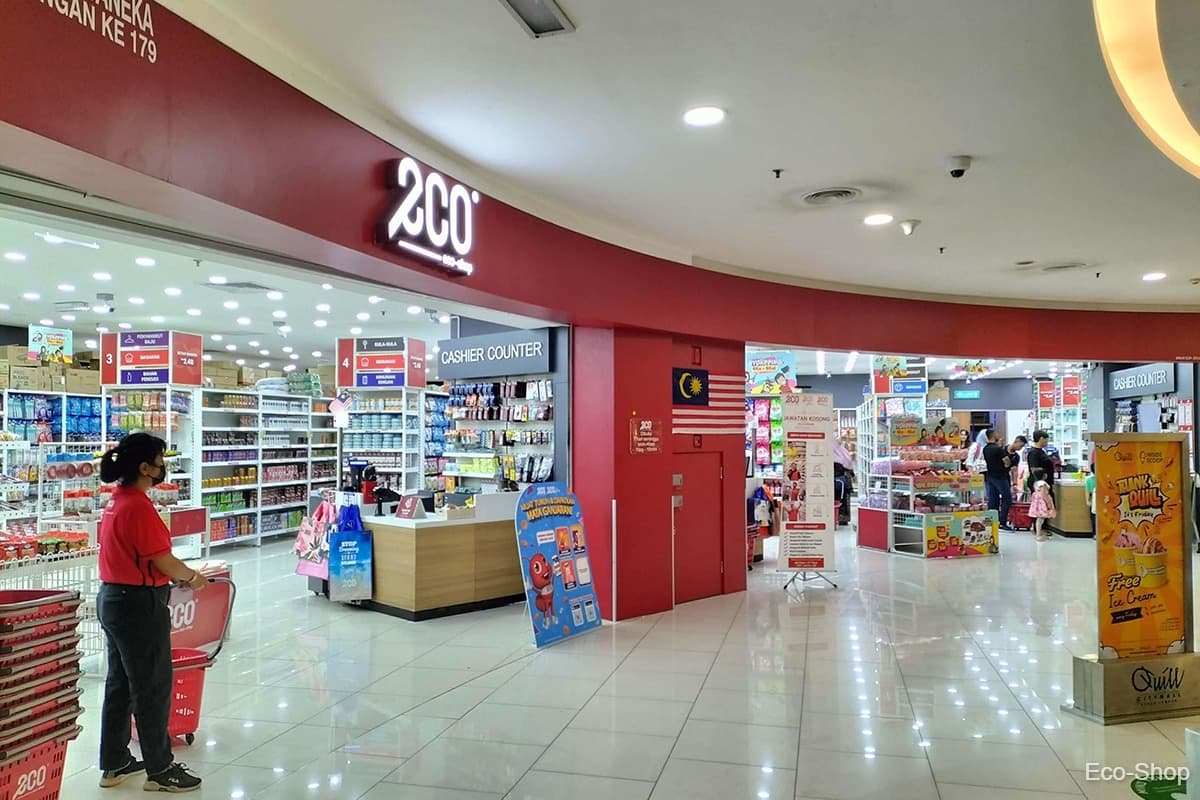
KUALA LUMPUR (May 22): Bursa Malaysia is set to welcome its third-largest retail chain listing in the past five years, with Creador-backed Eco-Shop Marketing Bhd (KL:ECOSHOP) slated to debut on May 23 with a market capitalisation of RM6.49 billion.
This follows two major billion-dollar retail chain listings: Mr DIY Group (M) Bhd (KL:MRDIY), which went public at RM10 billion on Oct 26, 2020, and 99 Speed Mart Retail Holdings Bhd (KL:99SMART), listed at RM13.9 billion on Sept 9, 2024.
Despite downsizing its IPO price by 6%, analysts remain divided on the valuation level ascribed to the company, which has carved out a dominant 68% share of the ultra-affordable fixed-price segment, operating 349 stores across Malaysia as of March 2025.
Eco-Shop's forward price-earnings ratio (PER) stands at 31 times based on its IPO price, compared with Mr DIY 's present forward PER of 23.1 times, as well as 99 Speed Mart’s 31.5 times, Bloomberg data showed.
The forward PER appears "at the higher end compared to its peers' average", said Apex Securities head of research Kenneth Leong. Similarly, its "PEG (price-earnings to growth) ratio is also elevated, suggesting potentially weaker earnings growth prospects relative to its competitors", he added.
He highlighted that Eco-Shop’s forward PER of 31 times, against a projected forward earnings growth of 13.2%, results in a PEG ratio of 2.4 times — higher than Mr DIY’s 1.9 times and 99 Speed Mart’s 1.7 times.

On the other hand, Vincent Lau, the head of equity sales at Rakuten Trade, viewed Eco-Shop’s IPO as fairly valued given the company’s significant long-term growth runway.
“With only about 350 outlets currently, there’s ample room to expand, especially when you compare it with Mr DIY and 99 Speed Mart, whose store counts are both in the thousands,” Lau said.
In terms of new store growth, Eco-Shop, aiming to open 70 new stores this year, is set to expand its store count by 19.6%, outpacing Mr DIY’s 12.9% and 99 Speed Mart’s 5.9%.
Lau also highlighted the recession-proof nature of Eco-Shop’s model, noting its appeal during periods of economic stress. “When consumers downgrade their spending habits, they tend to seek out value retailers like Eco-Shop. This is especially relevant for the bottom 40% income group, where demand remains resilient regardless of the economic cycle.”
Founded in 2003, Eco-Shop has built its brand around fixed pricing — RM2.60 in West Malaysia and RM2.80 in East Malaysia — for everyday items such as kitchenware, snacks, and household goods.
Its Eco-Plus concept, introduced in 2021, expanded the pricing ladder with RM6/RM6.60 and RM10/RM11 tiers, capturing a broader demographic and increasing basket sizes. Notably, approximately 75% of its offerings are house brands, accounting for 56% of sales, supporting margins and enhancing brand control.
Same-store sales growth above peers
Another indicator of Eco-Shop’s premium valuation is its projected dividend yield of 1.5%, which is lower than Mr DIY’s 3.2% and 99 Speed Mart’s 1.8%. Nonetheless, Eco-Shop remains committed to its dividend distribution policy of 40% to 60%, while Mr DIY and 99 Speed Mart hold a minimum payout of 50%.
Operationally, Eco-Shop stands out with the shortest cash conversion cycle among Malaysian dollar store operators at just 33 days, significantly outperforming Mr DIY’s 148 days. In short, the former cycles through its inventory more rapidly and recovers cash more efficiently.
One analyst attributed this advantage to Eco-Shop’s emphasis on fast-moving essentials, in contrast to Mr DIY’s focus on slower-moving items such as hardware and electrical goods.
99 Speed Mart, which offers a more limited range of stock-keeping units while prioritising daily necessities, maintains an even shorter cash conversion cycle of 14 days and a lower inventory turnover of 52 days.
With a lower store count, Eco-Shop records nearly twice the transaction volume per store compared to Mr DIY and 99 Speed Mart, while maintaining stronger same-store sales growth (SSSG).
However, the industry has seen some downward pressure on growth last year. Eco-Shop’s SSSG slowed to 2.9% in the second half of calendar year 2024, down from 11% in the financial year ending May 31, 2024. In comparison, Mr DIY reported a 1.9% decrease, while 99 Speed Mart recorded 1.4% growth for full calendar year 2024.
Mr DIY leads the trio in profitability, with an earnings before interest and taxes (Ebit) margin of approximately 18% and a net profit margin of 12%, outperforming Eco-Shop’s 11% and 8% respectively. This advantage is driven by Mr DIY’s scale and diverse product offerings, which include hardware, home improvement, and electrical items.
Mr DIY’s capex per store is also lower at RM540,000 compared to Eco-Shop’s RM800,000, thanks to better leasing terms and supply chain maturity. However, some pointed out that Mr DIY’s slower inventory turnover and recent SSSG softness suggest mounting saturation risks.
Eco-Shop’s IPO, Malaysia’s largest in nine months, is set to raise RM392.11 million at RM1.13 per share, having proposed to issue new shares at RM1.21 previously. Out of that, RM200 million (51%) is allocated for a semi-automated distribution centre in Klang, and RM56.3 million (14.4%) is designated for opening 70 new outlets annually.
Planned logistics hubs in Sarawak, Sabah, and Klang are expected to triple distribution capacity by 2027, reinforcing Eco-Shop’s strategy to sustain growth momentum through 2034.
In its third quarter ended Feb 28, 2025 (3QFY2025), Eco-Shop posted a 45% increase in its net profit to RM61.72 million driven by new store openings. Quarterly revenue rose 17.2% to RM736.35 million, compared to RM628.41 million in the previous year.
For the nine months ended Feb 28, 2025 (9MFY2025), Eco-Shop’s net profit increased 35.9% to RM154.91 million from RM114.02 million, while revenue rose 19% to RM2.098 billion from RM1.763 billion in 9MFY2024.