

This article first appeared in The Edge Malaysia Weekly on May 19, 2025 - May 25, 2025
MR DIY Group (M) Bhd (KL:MRDIY) — a barometer for consumer spending trends in Malaysia — has posted a new high in quarterly earnings in the first quarter ended March 31, 2025 (1QFY2025).
Apart from festive sales, which were boosted by the earlier timing of Hari Raya, its latest quarterly results were also driven by an increase in the number of stores, improved gross margins and a stronger ringgit.
The home improvement retailer, whose earnings have grown at strong double-digits for the last two consecutive quarters, is expected to wrap up the year with yet another record annual profit, according to consensus estimates.
The consensus full-year forecast of its net profit is RM634.40 million for the financial year ending Dec 31, 2025 (FY2025), 11.5% higher than in FY2024. That translates into earnings per share of 6.8 sen.
However, a slight blip is expected in the current quarter as Mr DIY may experience “seasonal weaker sales in 2QFY2025” following post-Hari Raya festivities, Maybank Investment Bank Bhd (Maybank IB) says in a note following Mr DIY’s recent results announcement.

“While we remain optimistic about the full-year outlook for FY2025, we anticipate some normalisation in 2QFY2025 due to the absence of major festivities,” Hong Leong Investment Bank (HLIB) Research analyst Syifaa’ Mahsuri Ismail tells The Edge.
Mr DIY’s net profit in 1QFY2025 rose 20.2% to RM174.15 million from RM144.88 million a year ago — the first three months making up 28% of the consensus full-year forecast. Quarterly revenue was up by 10.5% to RM1.26 billion, against RM1.14 billion in the previous corresponding period.
It is worth noting that Mr DIY — which sells everything from screwdrivers to instant noodles —had 1,471 stores in 1QFY2025 after adding 36 new outlets. There were 174 new stores in 2024, bringing the total number of stores to 1,429.
Mr DIY’s aggressive expansion, with no less than 140 stores a year since FY2020, has helped drive earnings growth. However, the retailer’s same-store sales (SSS) growth has been not that good. It recorded SSSG of 0.6% year on year in 1QFY2025 after seven consecutive quarters of contraction in SSS.
There were no new KKV openings, which generate three times the monthly revenue of a standard Mr DIY store, in 1QFY2025.
In May, 2024, Mr DIY bought a 49% stake in KKV Supplier Chain Sdn Bhd, which runs a lifestyle retail chain from China that sells personal care products aimed at the younger generation.
“However, management maintained its full-year target of 190 new outlets, including 160 Mr DIY stores and over 30 KKV and sub-brand stores,” Kenanga Investment Bank Bhd (Kenanga IB) says in a recent note.

Much of the rollout is expected to be in the second half of 2025, with more than 20 stores already in the pipeline for Sabah and Sarawak, adds Kenanga IB.
The group’s margin strength is also anticipated to continue into 2QFY2025 as the ringgit continues to appreciate against the renminbi, another fund manager projects.
“The ringgit has continued to rally against the [renminbi] from early April, which should further benefit Mr DIY’s cost of goods sold in the coming quarter, especially for inventories replenished during this period,” Khoo Zing Sheng, a fund manager at Pheim Asset Management, says.
Mr DIY’s gross margins improved by two percentage points to 47.8% in 1QFY2025, driven by lower average inventory costs.
While most businesses globally remain cautious of their outlook amid heftier tariffs proposed by US President Donald Trump, Mr DIY does not expect group performance to be impacted for the time being.
“Our financial position remains solid. At this time, we do not expect the current US tariffs to impact us,” Mr DIY CEO Adrian Ong says in a statement accompanying the company’s results announcement.
Maybank IB is of the view that Mr DIY could benefit further from trade tensions between the US and China, enabling more favourable sourcing terms for its China-based supply chain, which accounts for 70% of its stock keeping units.
Higher disposable incomes owing to rising wages and government assistance packages targeted at lower-income groups are also expected to benefit Mr DIY, RHB Investment Bank Bhd (RHB IB) says in a client note.
High inventory level seen as reasonable
For a retailer that doesn’t deal in high-value goods, Mr DIY’s billion-ringgit inventory might appear outsized, looking at its balance sheet.
As at March 31, 2025, Mr DIY held RM1.06 billion in inventories and RM1.32 billion in right-of-use assets under leasing contracts. The two items account for 64% of the group’s total assets of RM3.69 billion.
However, the inventory figure is scalable to the retailer’s store count and strong top line.
“The inventory level is deemed appropriate considering the company’s substantial quarterly revenue exceeding RM1 billion,” Pheim’s Khoo notes.
Mr DIY remains in a net cash position, with cash and bank balances at RM191.33 million, and borrowings of RM58.76 million as at end-March 2025.
The improved performance may have prompted a more generous dividend per share of 1.4 sen proposed for 1QFY2025 — a 40% jump from a DPS of one sen for the same quarter last year — translating into a payout ratio of 76% of profit, far exceeding its 50%-65% guidance.
In FY2024, Mr DIY declared its highest dividend payout so far, of five sen per share, amounting to RM472.9 million.
Mr DIY floated shares at an initial public offering (IPO) price of RM1.60 per share on the Main Market of Bursa Malaysia in October 2020.
The retailer’s share price has staged a rebound in recent weeks. It has surged more than 36% from this year’s low of RM1.28 in March after it dropped 42% from the RM2.20 level last November.
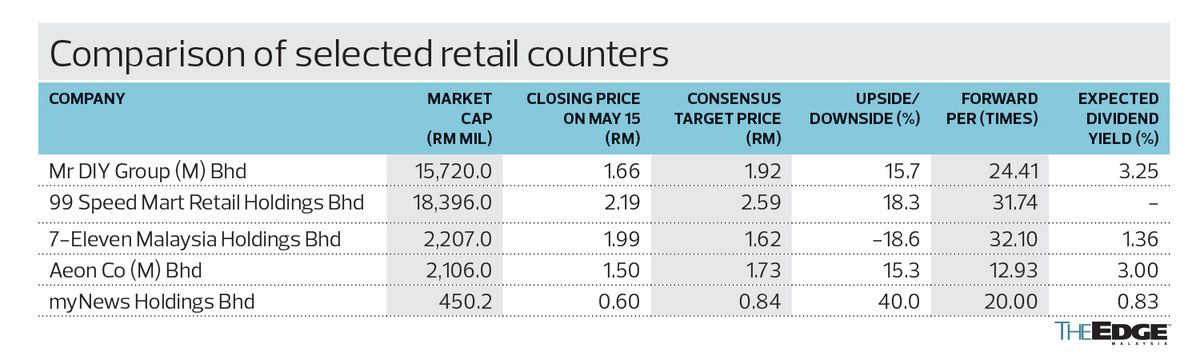
At last Thursday’s closing of RM1.66, the company is valued at RM15.72 billion. It is now trading at 26.22 times trailing price-earnings ratio compared with a PER of 31.6 times at its IPO five years ago.
In comparison, its peer in the consumer sector, 7-Eleven Malaysia Holdings Bhd (KL:SEM), was trading at 52.9 times PER, followed by 99 Speed Mart Retail Holdings Bhd (KL:99SMART) at 37.8 times, and myNEWS Holdings Bhd (KL:MYNEWS) at 37.5 times, according to Bloomberg data. At far cheaper valuations is Aeon Co (M) Bhd (KL:AEON) at 16.6 times.
Other retailers expected to benefit from festive season
Mr DIY Group’s robust earnings in 1QFY2025 have fuelled optimism that other consumer-related stocks may have also benefited from the same festive tailwinds.
“It is quite safe to say the other retailers will also benefit from the two festive seasons that we have this quarter,” Syifaa’ says, referring to Chinese New Year and Hari Raya, both falling in the first quarter.
These back-to-back festive holidays are likely to spur a surge in consumer spending across the grocery, fashion and household categories.
However, the currency tailwind enjoyed by Mr DIY may not translate equally into other retailers, especially those with less exposure to China-based sourcing, according to Khoo.
“Other retailers are expected to benefit from the earlier Raya in 2025. However, part of Mr DIY’s strong performance was also supported by the stronger ringgit against the [renminbi],” he notes.
Still, early signs point towards a sector-wide benefit from pent-up demand and festive shopping. Retailers like 99 Speed Mart and myNews, which focus more on everyday convenience and fast-moving consumer goods, could have seen similar sales upticks.
AEON, which operates both supermarkets and department stores, is expected to be a key beneficiary across both fronts. Its extensive footprint in urban and suburban areas makes it a proxy for household consumption trends during festive holidays.
Fashion and apparel players like Padini Holdings Bhd (KL:PADINI) would also have ridden the wave of seasonal purchases. Festive seasons have historically contributed significantly to Padini’s sales volume.
Save by subscribing to us for your print and/or digital copy.
P/S: The Edge is also available on Apple's App Store and Android's Google Play.