

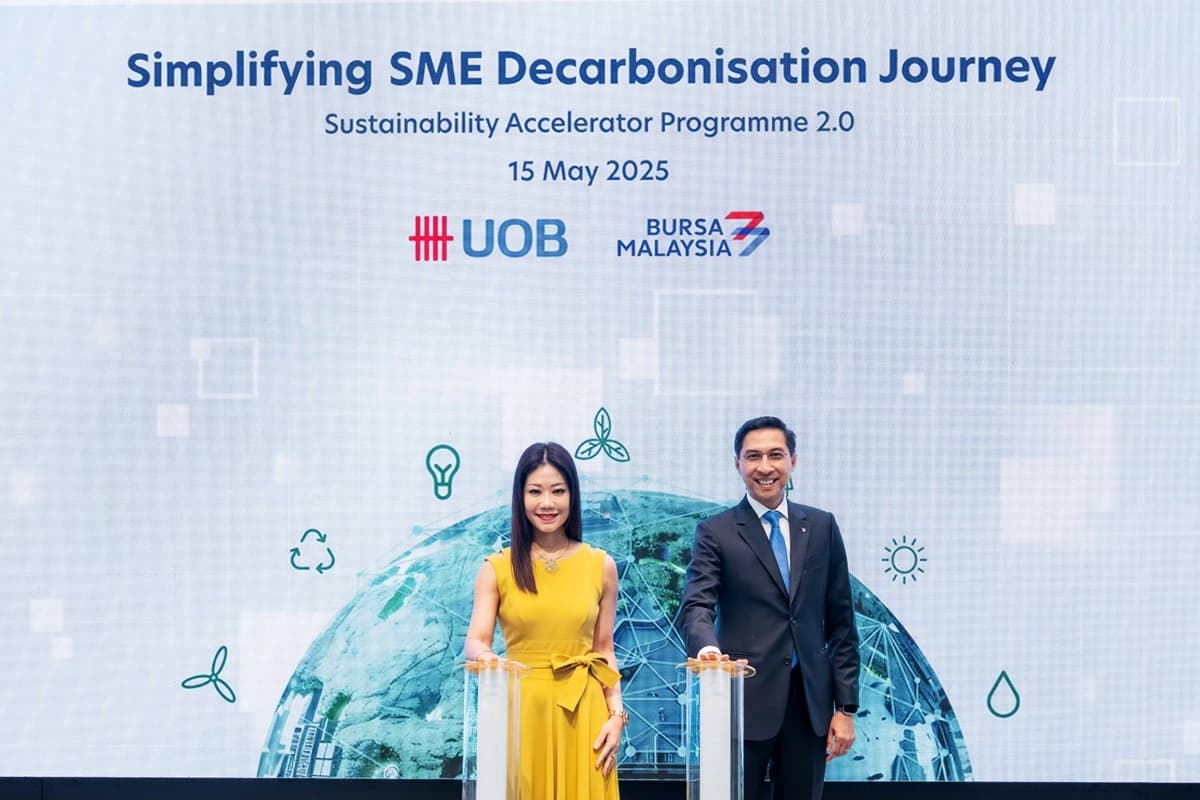
KUALA LUMPUR (May 15): In a move to support small and medium enterprises (SMEs) in their environmental, social and governance (ESG) journey, UOB Malaysia became the first bank to partner with Bursa Malaysia Bhd to provide its SME clients with free access to Bursa Malaysia’s Centralised Sustainability Intelligence (CSI) solutions on Thursday.
This partnership was announced with the launch of UOB’s Sustainability Accelerator Programme 2.0 (SAP 2.0), which facilitates the bank’s SME clients to adopt sustainability practices by offering the emissions tracker and reporting tool under the CSI by Bursa. Preferential rates are offered for access to assurance and green certification services by Control Union and green logistics services by DHL.
UOB Malaysia CEO Ng Wei Wei said banks play a vital role in helping SMEs embrace sustainability to stay relevant and competitive in an increasingly ESG-driven global supply chain.
“This is the silver lining amidst the global uncertainties, and I see a strategic opportunity for Malaysian SMEs to stay ahead of the curve by adopting sustainable practices early, they are in a better position to compete and to start diversifying into new markets and explore new avenues of growth,” said Ng.
“Under UOB’s SAP 2.0, in addition to our enhanced suites of SME-centric solutions, the bank will also fund Bursa’s CSI Solution’s subscription fees for our SME clients. Greenhouse gas (GHG) emissions reporting can be a daunting aspect of the decarbonisation journey, and by lowering this barrier and helping them calculate and report their GHG emissions more effectively, we hope to empower more SMEs to transition.”
Echoing a similar sentiment, Bursa Malaysia CEO Datuk Fad’l Mohamed said SMEs must adopt and comply with sustainability standards to attain long term competitiveness in the local and global value chain.
This is important because SMEs make up 97% of Malaysian businesses, provide over 48% of employment to the workforce and contribute 30% of the national gross domestic product (GDP).
However, he said a survey by the Small and Medium Enterprise Association of Malaysia revealed that only less than 12% of Malaysian SMEs are ready to implement ESG practices, even though more than two thirds of them recognise its influences.
“Just as we empower listed companies, we are now expanding the same support to SMEs so that they, too, have what is needed to advance their sustainability journey. We need more than just policies to govern exposure. Companies must have access to practical guidance, relevant tools and essential skills to effectively adopt the most important approach to integrating sustainability into their operations,” said Fad’l.
The CSI platform is a centralised repository for ESG disclosures that enables public-listed companies (PLCs) to consolidate and disclose ESG data in a standardised manner. Bursa has mandated PLCs to use the CSI for sustainability reporting, and the platform supports the ISSB IFRS S1 and S2 disclosure requirements adopted under the National Sustainability Reporting Framework.
Unlike PLCs, SMEs are not required to submit sustainability reports to regulators. However, SMEs in supply chains may be requested to disclose their ESG data by their suppliers or customers, especially if they are PLCs. Scope 3 emissions disclosure, which covers the supply chain, will commence in 2027.