

This article first appeared in The Edge Malaysia Weekly on May 19, 2025 - May 25, 2025
In January, during a routine firefly survey in Taman Persekutuan Bukit Kiara, Kuala Lumpur, Jack Tan, a research assistant and master’s student in environmental science at Monash University, unintentionally rediscovered a firefly species last seen a century ago in Malaysia. His find marks the ninth-known firefly species in the urban forest.
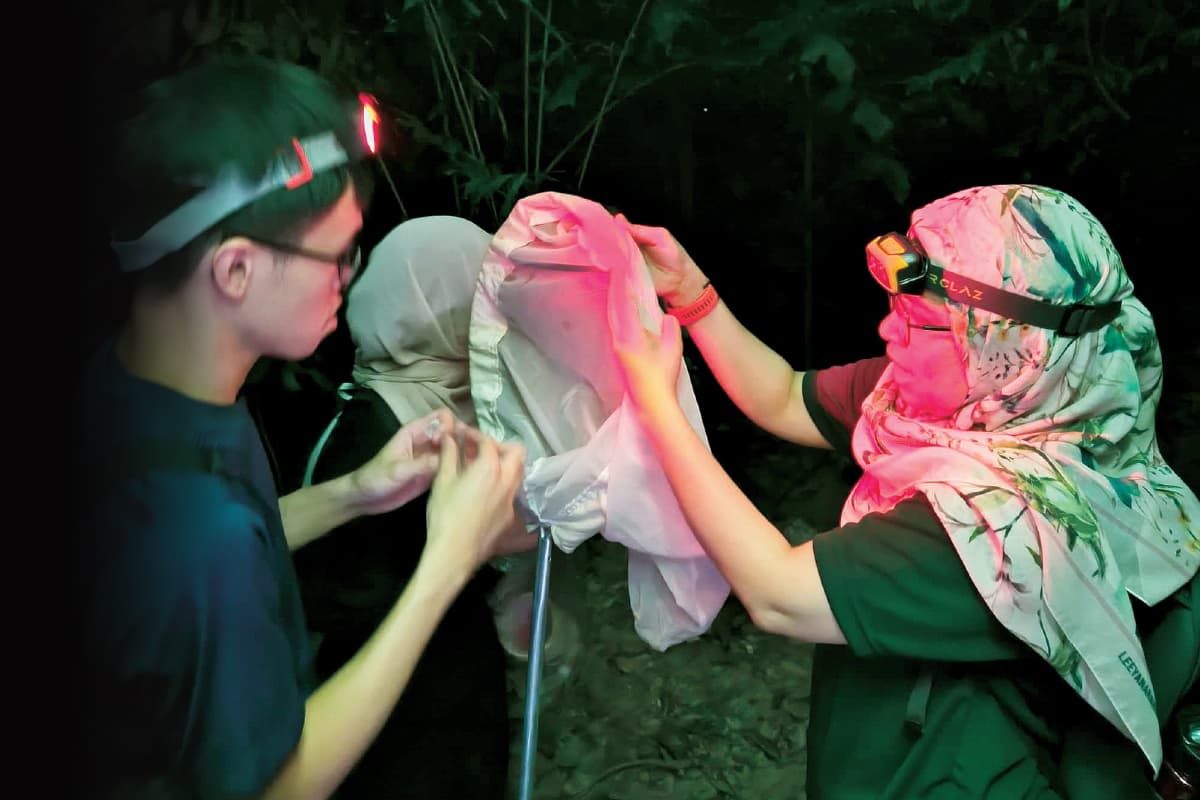
“Whenever we saw flashing lights, we would catch the fireflies, observe their features, record what species they were and then release them,” Tan tells ESG.
The species, Pteroptyx gombakia (P. gombakia), or the Gombak bent-winged firefly, was originally described in 2015 by entomologist Lesley Ballantyne at the Natural History Museum in London, based on a single specimen collected in 1921 in the Gombak Valley, Kuala Lumpur.
Tan’s sighting marks the first live observation in more than a century and outside its previously known mangrove habitat.
The find was also significant for the urban forest, whose community, led by non-governmental organisation Friends of Bukit Kiara (FoBK), has been organising various activities to protect the green space. Most recently, it called for a no-development buffer zone of at least 300m to 500m around the perimeter of the park to be included in the KL Local Plan 2040.

FoBK has also been trying to approach KLGCC Resort (part of Sime Darby Property Bhd), which is building a reservoir and high-rise residential buildings right by the park’s boundary, resulting in light pollution and changes in the natural environment that could threaten the survival of the fireflies.
While congregating fireflies in mangrove swamps are popular ecotourism attractions in Malaysia, there are also solitary fireflies in other types of forests. Bukit Kiara itself is home to eight known species, including Lamprigera, the world’s largest female firefly.
Tan initially mistook the newly discovered firefly for the Colophotia, a common species found in Bukit Kiara.
It was not until later, when he was reviewing the photos, that he noticed something unusual and sent the image to his academic supervisor Dr Wan Faridah Akmal Jusoh, a firefly taxonomist and senior lecturer in Biodiversity and Conservation at Monash University Malaysia.
“It is a common assumption because it’s an urban park. You do not think that you are going to get a new species or more species to date, especially if it is just like repeating the observation. [Tan] sent me the photo and said, ‘Dr Wan, I think we have a problem,’” says Wan Faridah.
The difference was spotted in the firefly’s light-producing organ called the “lantern”, and it is located in the insect’s abdomen.
“Both P. gombakia and Colophotia have bipartite light organs, which means their light-producing structure is divided into two distinct parts or sections. The P. gombakia lacks a median carina, however, which is a ridge that separates part of the body into two halves [in this case, the light organ],” says Wan Faridah.

Decline caused by urban development
Wan Faridah, who also serves as co-chair at the International Union for Conservation of Nature (IUCN) Species Survival Commission Firefly Specialist Group, notes that fireflies are sensitive to environmental changes.
A notice of their decline can serve as an indicator of broader environmental degradation in an ecosystem. The FoBK, which runs frequent citizen scientist surveys to track the firefly population, has already observed fewer firefly sightings in areas closest to the developments right next to the park.
Light pollution caused by urban development, says Wan Faridah, is an immediate threat to the survival of fireflies, alongside loss of habitat.
“The fireflies might suffer habitat loss due to urban development and the use of artificial light at night, which can interfere with the flashing signals the fireflies use to communicate,” says Wan Faridah.
Fireflies are part of the complex ecosystem, so a decline in their species would disrupt the food chain. For instance, firefly larvae feed on invertebrates such as snails, slugs and earthworms. Lower numbers of firefly larvae could be linked to reduced prey availability as a result of rapid changes in the environment.
To protect and conserve these insects, intervention to prevent habitat loss is needed. Long-term monitoring, data collection and public awareness must also be present. This is a challenge currently, as few scientists in Malaysia have been studying fireflies, particularly in urban forests.
“We want to say there is a decline but, again, [we cannot say for sure] because it needs long-term monitoring,” says Wan Faridah.
Another significant hurdle for firefly researchers in Malaysia is the lack of proper species inventory for our natural history collection, which could serve as an archive of the insects. In addition, because of colonial practices in the past, many specimens originally from Malaysia have been deposited in foreign institutions.
“That’s the saddest part about Malaysia. We do not have a [dedicated] museum and we do not have baseline information. There is also a lack of researchers and scientists that study entomology,” she says.
There is existing research, however, on congregating fireflies in mangrove forests. In 2017, a study by the Forest Research Institute Malaysia found a drastic decline of fireflies in the famous Kampung Kuantan in the last decade due to deforestation.
Last year, the IUCN Firefly Specialist Group, which Wan Faridah co-chairs, identified four congregating firefly species as “vulnerable”, using the IUCN Red List criteria. These firefly species were once abundant in mangrove forests in Southeast Asia.
Fireflies are icon species
P. gombakia belongs to the genus Pteroptyx. Certain species in the genus gather on mangrove trees and are known for their synchronous flashing displays in large congregations.
One group of Pteroptyx are known as bent-winged fireflies, and nine of the 14 species in this group are found in mangrove ecosystems. The habitats of the remaining are unclear because of insufficient ecological data, according to an article published by Tan and Wan Faridah in Oryx, the International Journal of Conservation.
This includes P. gombakia, which appears to be solitary and was discovered in a forested area, says Wan Faridah.
Malaysia is home to three types of fireflies: congregating; solitary; and diurnal, or daytime.
“Congregating fireflies are usually found in riverbank mangroves, appearing in large numbers with synchronised blinking. The firefly species in Bukit Kiara are typically solitary or diurnal,” she says.
Regardless of the species, the sight of fireflies illuminating the dark night with their warm light is often described as magical. The display of congregating fireflies flashing their lights in unison, in particular, is mesmerising, leading the IUCN to designate them as “icon species”.
A flagship or icon species is a species selected to act as an ambassador, icon or symbol for a defined habitat, issue, campaign or environmental cause.
“By focusing on the conservation of a species, the status of many other species that share its habitat or are vulnerable to the same threats may also be improved. This is why conservation is important,” says Wan Faridah.
Her introduction to fireflies had been serendipitous as well, as she had not planned on becoming an entomologist. During her undergraduate studies in environmental science at Universiti Putra Malaysia, she was introduced to fireflies while exploring mangrove swamps in Kampung Sepetang, Perak.
“This was when I heard the word kelip-kelip (the local name for fireflies) for the first time. That sparked my curiosity and I was very intrigued by their lights, their flashes. I told my supervisor that I wanted to study fireflies. My supervisor told me no one could teach me entomology but I could work on mapping fireflies for ecotourism instead. And that interest to study fireflies went from my master’s degree to my PhD,” says Wan Faridah.
Now, as a firefly taxonomist, her area of research focuses on biodiversity and the history of natural heritage, from studying fireflies to reconstructing timelines of how ecosystems have evolved.
She also aims to build an extensive species database and discover new species.
“That’s why we are working towards collecting species data. I’m currently involved in the virtual repatriation of type specimens [original reference specimen of a species]. So, we will try to ‘virtually’ repatriate the data that we have on some specimens collected in the past,” says Wan Faridah.
“I want to reconstruct the data so that we can have a full list of what we actually have here, particularly in Malaysia, and work towards building a species inventory.”
Save by subscribing to us for your print and/or digital copy.
P/S: The Edge is also available on Apple's App Store and Android's Google Play.