

This article first appeared in The Edge Malaysia Weekly on May 12, 2025 - May 18, 2025
After raising RM1.3 billion in debt in 2016, Maju Group’s MEX II now has just RM30 million left and an unfinished highway, leaving the government in a dilemma
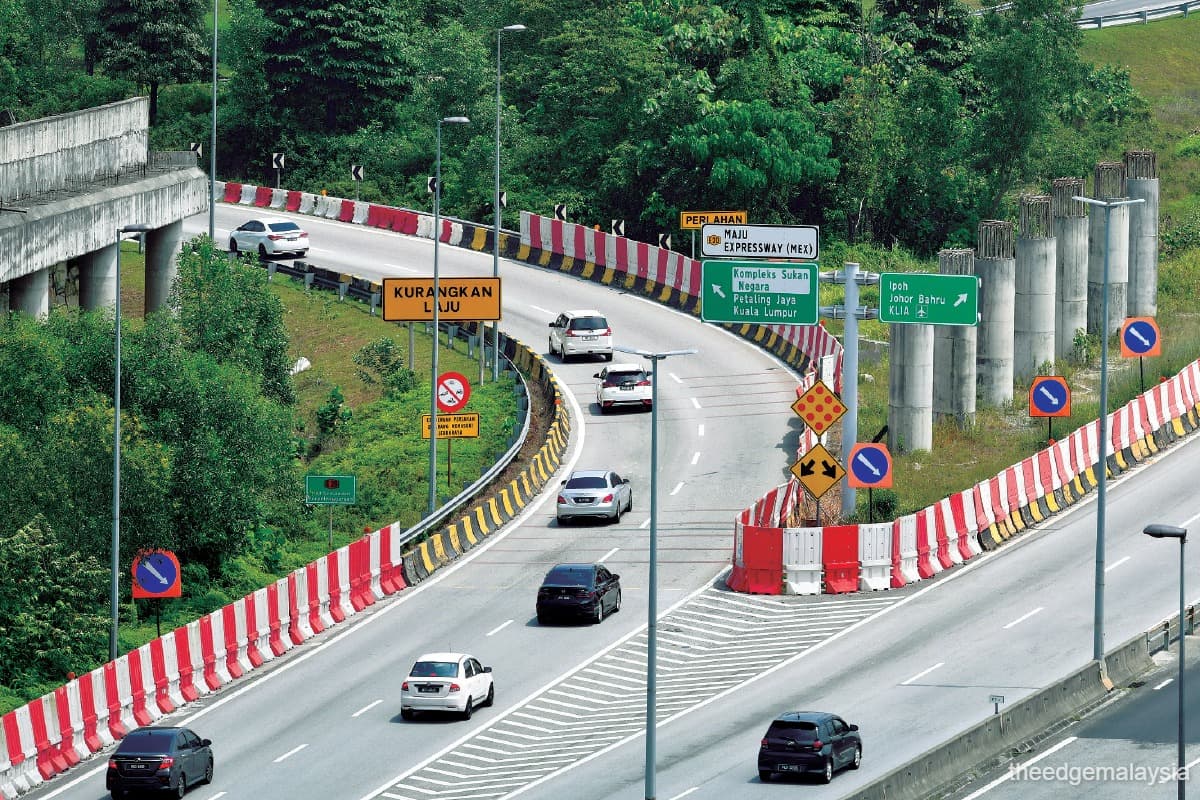
THE 26km Maju Expressway (MEX), which links Kuala Lumpur to Putrajaya, recorded a peak traffic volume of 172,433 vehicles in the first half of 2024. At this pace, it is fast approaching its daily capacity of around 200,000 vehicles.
Nearly 18 years after opening, MEX is finally fulfilling its role as the main artery connecting the city to the country’s administrative capital. It is the jewel in the crown for Tan Sri Abu Sahid Mohamed, 74, who owns the Maju Group.
Despite being well connected, Abu Sahid has fallen out of favour for his failure to complete the 16.8km extension of MEX, dubbed MEX II and which links Putrajaya to Kuala Lumpur International Airport (KLIA).
Maju Group subsidiary MEX II Sdn Bhd (MEX II), the concessionaire for the toll project, is currently under investigation by the Malaysian Anti-Corruption Commission (MACC) over alleged false claims totalling RM416 million. MEX II had raised RM1.3 billion by issuing bonds in 2016 to build the extension, which was supposed to be completed in 2019. Six years on, the MEX II highway is reported to be 89% complete — a figure that has yet to be verified.
Worse still, MEX II has only RM30 million left — with RM29 million already pledged to banks under a financing facility. An incomplete highway effectively leaves bondholders in limbo because their only source of repayment is through toll collection.
Says a consultant: “Bondholders can recover money only if the highway is completed. MEX II has been placed under receivers and managers (R&M) since May 2022, but so far there is no solution in sight.”

According to MEX II’s 2023 financial return, Abu Sahid is one of five directors in the company. The others are his son Mohd Faiq, Datin Paduka Alinah Ahmad, Dr Saravanan Sundramurthy and Datuk Mohamed Roslan Mohamed Shariff.
The MEX II highway was hit with a stop-work order in April 2019. Beyond that, MEX II has faced persistent cash-flow issues and has been unable to meet its bond obligations since late 2020.
The bondholders gave Maju Holdings Sdn Bhd, the ultimate holding company, several extensions to fulfil the obligations in 2021.
In May 2022, as the bondholders’ patience wore thin, they exercised their option to place MEX II under the supervision of R&M.
In the financial return for the period ended Dec 31, 2022, the external auditors raised a red flag, warning that the company lacked sufficient cash flow to complete the highway and meet its obligations to bondholders.
“MEX II has current liabilities of close to RM1.7 billion and the ability of the company as a going concern depends on its amicable settlement on its financial obligations by R&M,” the external auditor stated in its report.
MACC swings into action
The abandoned MEX II project had been on the government’s radar for more than a year. Several existing toll road concessionaires were approached to assess the incomplete project, with PLUS Malaysia Bhd believed to be among them. Sources indicate that PLUS was willing to take over MEX II, but only if bondholders agreed to a significant haircut.
“The offer on the table required bondholders to take a haircut of more than 50%. This did not go down well with the bondholders,” says a bondholder. “They felt that taking a ‘haircut’ on their debts would not solve the problems as long as there was no change in the people responsible for completing the highway. The bondholders turned the pressure on R&M to come up with a solution.”
Despite ongoing negotiations with bondholders and financial stress, MEX II remained largely under the public’s radar until last month, when MACC initiated an investigation into the company for alleged false claims totalling RM416 million.
The money, which is part of the RM1.3 billion that was raised to construct the highway, was allegedly withdrawn via false claims in 2016 and 2017.
According to reports, on or around May 1, MACC detained four individuals, including a woman, to assist with their investigation. The four were released a few days later. On May 3, MACC obtained a remand order for the former CEO of Maju Holdings to further aid in the investigation.
“Whether anything happens after the investigations remains to be seen. But after six years, there is a resolve to settle the issue at MEX II,” says the bondholder.

The principal proponent for the MEX II project is Maju Holdings and the consultant is HSS Engineering Bhd (KL:HSSEB). The lead arranger of the bonds was CIMB Banking Group and a large portion was subscribed by banks and government-linked institutions.
Sources say some bond subscribers were also invested in the debt issued by MEX 1 Capital Bhd. The bonds, amounting to RM1.13 billion, are secured against the cash flow from MEX.
“After a restructuring in 2022, the leakage of funds from MEX to Maju Holdings stopped. Within two years, the ratings improved,” says a source. “Bondholders believe a similar outcome is possible for MEX II — if there is firm resolve from Putrajaya.”
According to sources, investigators are tracing the money trail and focusing on how the drawdowns from the bond issuances were approved.
“The drawdowns on the MEX II project are linked to the project’s progress. On paper, the project is reported to be 89% complete, leaving 11% to be finished. However, the actual situation on the ground appears to tell a different story.
“The shortfall to complete the project could be around RM900 million, and there is virtually no money left in MEX II, which is why the government has stepped in,” says a source.
There have been two R&Ms between 2022 and 2024. The first was EY Insolvency Services PLT , which was appointed in May 2022. Roughly 10 months later, BDO Consulting Sdn Bhd took over the role. The reason for the change in R&M is unclear. R&M’s role is to identify a potential white knight to revive the project.
Government likely to call for RFP
It is learnt that the Works Ministry, Malaysian Highway Authority and the Ministry of Finance (MoF) met last week to resolve the problems with MEX II.
“The government is likely to issue a request for proposal (RFP) from bidders to take over the project from Maju Holdings. The tricky part, however, will be figuring out how to resolve the financial issues to ensure that MEX II can be completed while keeping the toll rates reasonable,” says a consultant.
He adds that MEX II has essentially exhausted the RM1.3 billion raised, yet there are still outstanding works needed to complete the highway.
“Assuming the remaining 11% of work costs RM150 million, and the alleged false claims total RM416 million, the cost to complete the project could conservatively be at least RM560 million. That is an optimistic view,” says the consultant.
“That means MEX II liabilities could easily breach RM2 billion. How much toll can any white knight charge motorists to recover the amount spent?”
A RM2 billion bond at a 7% coupon would easily cost RM140 million in coupon payments a year. Assuming that the traffic volume is 50,000 cars a day and the toll rate is RM10, revenue comes to about RM180 million a year.
“After deducting operational costs and maintenance, there won’t be enough left to cover even the coupon payments for the RM2 billion debt. And that’s assuming there are motorists willing to pay the RM10 toll,” says the consultant, noting that there are alternative highways to KLIA.
“The rule of thumb is less than 40 sen per kilometre. So, a toll rate of RM5 to RM6 will be reasonable.”
Moreover, if the toll rate becomes more expensive than other complementing highways, the expressway is likely to attract traffic only during peak periods.
A MEX II traffic consultant report projects traffic to exceed 70,000 cars a day after 2030. There is no certainty about these numbers, however, as even the busiest highways in the country currently do not exceed 120,000 cars a day.
Nevertheless, the MEX II highway will not be short of suitors. The real question lies in the pricing and whether it includes the completed MEX, where traffic volume is rising.
“MEX II cannot be a stand-alone entity. It has to come with MEX. Nobody in their right mind would consider MEX II without taking control of MEX because MEX II depends on the traffic flow from MEX,” says the highway consultant.
“If MEX fails to function for any reason, MEX II will not be able to attract the necessary traffic.”
It is learnt that, besides PLUS, other parties were interested in MEX II. The key question, however, is valuations and whether the MEX II highway comes with MEX.
In the past, Abu Sahid had announced plans to monetise the highway, either by floating shares on the stock exchange or through an asset injection into a public-listed company. Nothing materialised, partly because of valuations. This time, however, other factors will also play a role in any potential deal.
See also ‘Will Abu Sahid finally exit MEX?’

Save by subscribing to us for your print and/or digital copy.
P/S: The Edge is also available on Apple's App Store and Android's Google Play.