

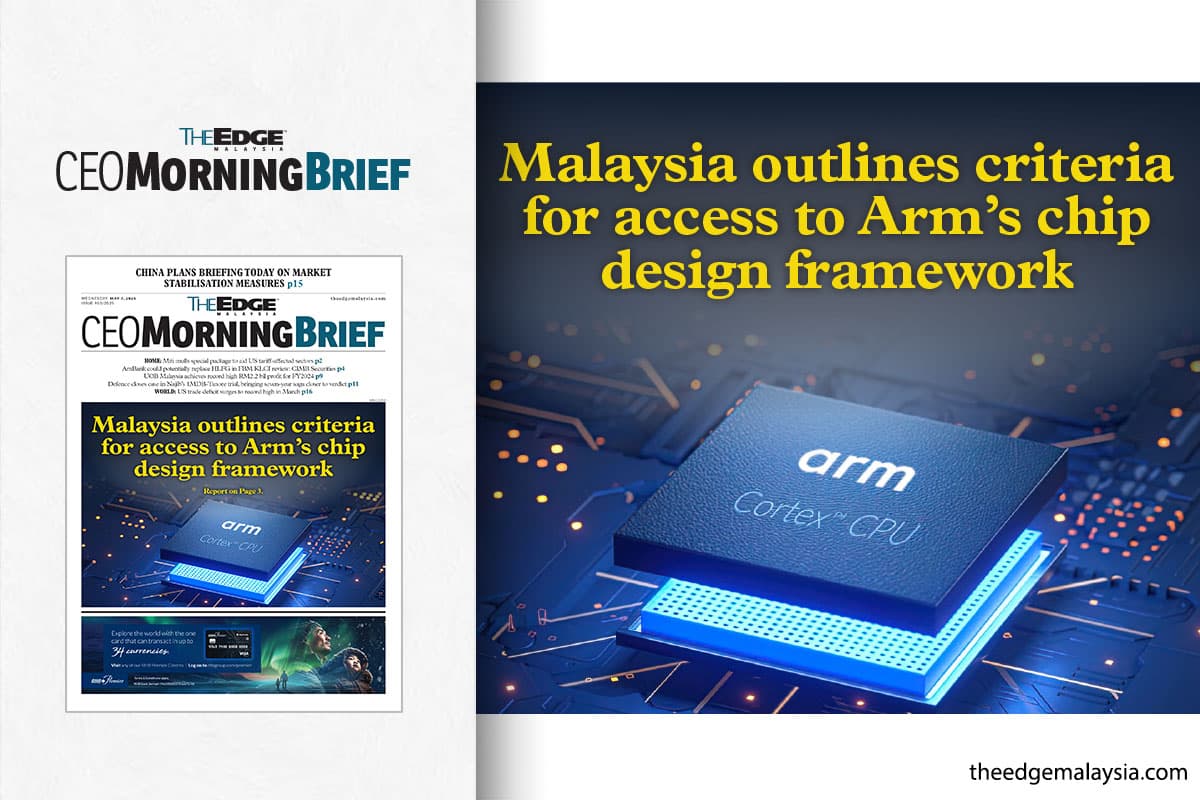
KUALA LUMPUR (May 6): Local semiconductor design companies who want to participate in the advanced chip design framework under Malaysia's collaboration with UK-based Arm Holdings plc must submit a detailed product roadmap and provide proof of steady cash flow to the Economy Ministry, supported by audited financial statements from the past two to three years.
These are among requirements outlined in the application process to access Arm's intellectual property, which includes the chip designs and technologies essential for semiconductor development, according to Economy Ministry's special officer (policy) James Chai.
In March, Malaysia signed a US$250 million (RM1.1 billion) agreement with Arm, spanning ten years, as part of the government’s strategy to bolster local semiconductor design capabilities and ultimately produce Malaysian-designed chips.
The target is to produce Malaysia's own graphics processing unit (GPU) chips within five to seven years, driven by the increasing global demand for artificial intelligence (AI) and data centres, Economy Minister Rafizi Ramli has been quoted as saying in news reports.
The initiative offers two access tiers: Arm Flexible Access (AFA), tailored for start-ups and smaller companies, and Arm Compute Subsystem (CSS), intended for larger, more established enterprises. A total of 25 access tokens are allocated for AFA applicants, while seven are reserved for those applying through CSS.

At an industry briefing and engagement session hosted by the Malaysia Semiconductor IC Design Park on Tuesday, Chai encouraged interested applicants to register their interest on the Silicon Valley website. The session detailed the application process and key qualifying criteria for companies looking to participate in the Malaysia-Arm collaboration.
To speed up the development of Malaysia’s front-end semiconductor value chain, Chai encouraged start-up companies to consider AFA as their entry point into chip design.
“I think most semiconductor design companies in Malaysia qualify for something like the AFA. It’s crucial to help them start designing their own products, which can then be sold to a broader market,” he said. “Many of them may be hesitant to jump straight into CSS because it’s more complex and costly.”
“We see AFA as a stepping stone,” Chai added. “More 'mature' companies can pursue CSS, while less mature ones can begin with AFA and transition upward over time. That’s the message we’re sending to local design companies, as we relaxed some conditions to better support the development of the local ecosystem."
“We’re now starting to move the ball. I hope many of you will seriously consider applying for the AFA,” he told industry players at the engagement session.
To receive CEO Morning Brief please click here.