

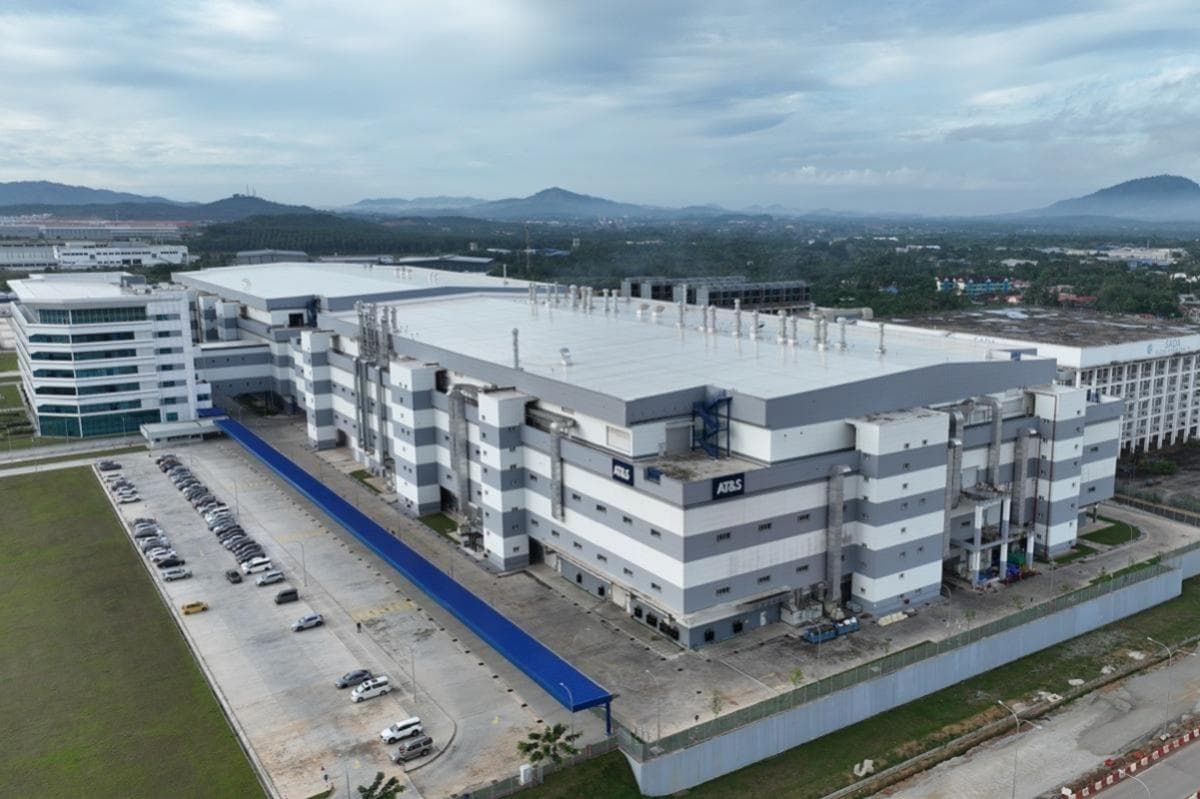
KULIM (May 5): Vienna-listed AT&S Austria Technologie & Systemtechnik AG says it is currently not impacted by the US tariffs announced on April 2, as its integrated circuit (IC) substrates made in Kulim are not classified as semiconductors and are shipped only to outsourced semiconductor assembly and test (OSAT) companies in Taiwan and Malaysia.
However, the Austrian firm is keeping a close watch on developments as geopolitical pressure — particularly from the US — pushes major players like Taiwan Semiconductor Manufacturing Co Ltd (TSMC) and Amkor Technology Inc to establish manufacturing bases in Arizona.
AT&S, TSMC and Amkor are part of the broader supply chain serving US chip giant Advanced Micro Devices Inc (AMD). This means AT&S may eventually be required to ship directly to the US, exposing it to potential tariff risks depending on future regulatory shifts.
“As it is, IC substrate is not itemised as semiconductor, and therefore, is exempted from the tariffs. We are, from today’s perspective, not affected. We are not making and supplying the finished products,” said Yap Suan See, senior vice-president and managing director of AT&S Austria Technologie & Systemtechnik (M) Sdn Bhd.
According to Yap, the sophisticated IC substrates that AT&S craft for AMD in Kulim will be sent to the OSAT providers in Taiwan and Malaysia for back-end activities.
“We do not ship directly to the US yet. But going forward, companies TSMC and Amkor are setting up operations in Arizona. So, AMD may require us to ship there in the future.
“There is a potential (that this could happen). With that, we will have to continue to monitor the situation,” she told the media in a press conference on Monday at the AT&S Campus, which houses the group’s manufacturing facility and office building in the Kulim Hi-Tech Park, Kedah.
AT&S’ manufacturing facility in Kulim had in March started high-volume manufacturing (HVM) of high-end IC substrates for AMD. The serial production of AT&S cutting-edge IC substrates caters almost exclusively to AMD for incorporation into its high-performance and energy-efficient data centre processors.
IC substrates provide connections between silicon dies and PCBs. They are composed of several layers and a supporting core in the middle, and contain drill holes and conductor paths that exceed the density of conventional PCBs. They are used for cloud edge computing, data centres and server farms as well as for consumer devices.
Kulim as main contributor to AT&S’ top three ambition
Founded in 1987, the Leoben-headquartered AT&S is the world’s sixth-largest high-end printed circuit board (PCB) producer and fifth-largest IC substrate manufacturer. It serves industries such as consumer electronics, computers, communications, semiconductors, automotive, aviation, industrial and medical.
Ingolf Schröder, executive vice-president of microelectronics business unit at AT&S, highlighted that the Kulim plant will be a main contributor to growth, helping the Austrian firm achieve its ambition of becoming one of the world’s top three IC substrate suppliers in the coming years.
“Our Kulim Campus will be looking at compound annual growth rate (CAGR) of 30% for its revenue between the financial year ending March 31, 2026 (FY2026) and FY2031,” he said.
Schröder further said the Kulim project will also contribute to customer and product diversification, as well as the capacity of AT&S’ tightly-integrated “substrate triangle”, with operations in Chongqing, China; Kulim, Malaysia; and Leoben, Austria.
“Our Kulim operations started with only one customer, namely AMD, but we hope to expand our clientele base to three customers by FY2026, and then, five customers by FY2027. These new potential customers could be chip designers or OSAT companies” he noted.
The planned investment under phase one of the Kulim project is €1.7 billion (over RM8 billion), and to date, AT&S has invested over €1 billion (about RM5 billion), including RM600 million for research and development (R&D). Meanwhile, it has purchased about 500 high-tech machines.
Notably, the Kulim plant is the group’s largest investment thus far in terms of initial investment for a single project. It is also the biggest single investment ever made by an Austrian company in Malaysia.
AT&S had in 2021 chosen Malaysia for the group’s first facility in Southeast Asia. Construction work on the plant started in November 2021, while commercial operations came onstream in between the first and second quarters of this year.
“The new AT&S Campus was built in just two years. One year later, we are ready to start high volume production. This is probably a new world record. Starting high volume production is not only a milestone for AT&S but also an important step for Malaysia,” says Schröder.
The first phase of the Kulim project is expected to create 6,000 jobs, including for 4,500 blue-collar workers. As of April 4, AT&S Malaysia employs 1,448 people, of which 883 are blue-collars.
Globally, AT&S, which operates six plants in Europe and Asia, currently has 13,000 employees. Year to date, shares of AT&S have gained by 12% to €14.78 at the time of writing on Monday, giving it a market capitalisation of €574.2 million.