

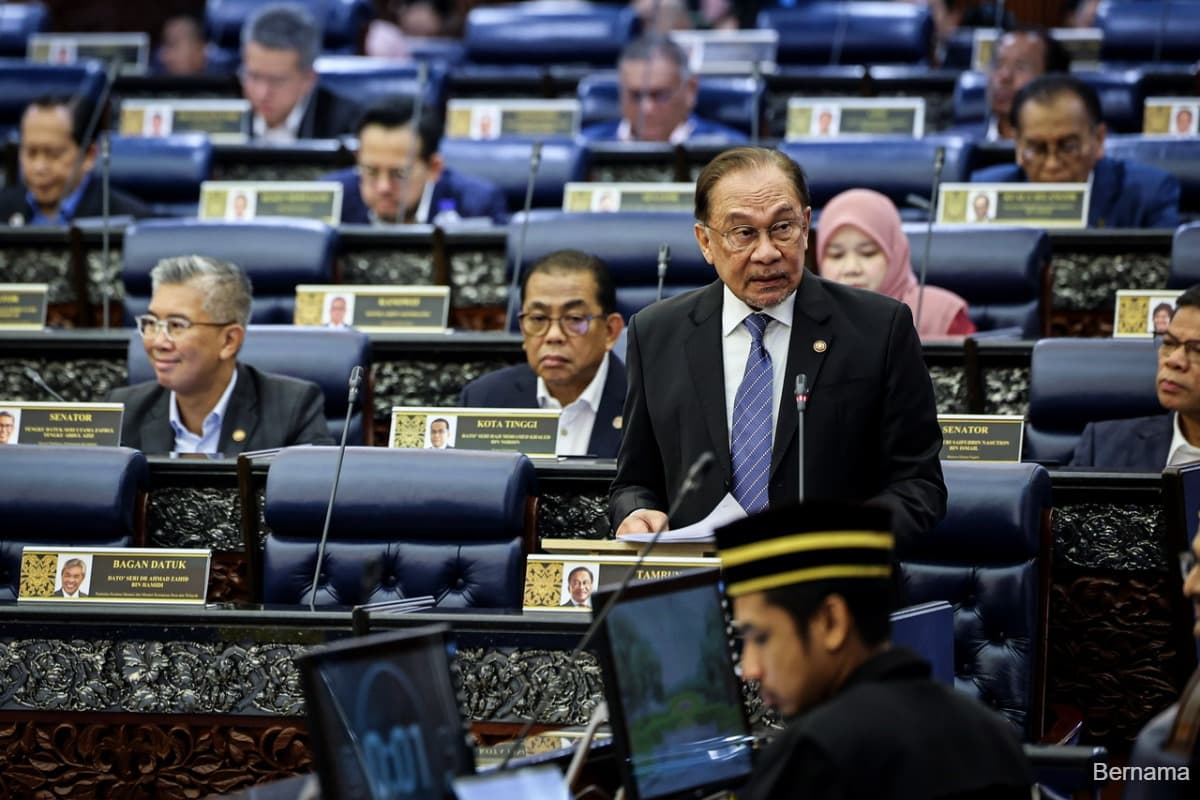
"Although this is still a preliminary discussion, I would like to emphasise that the United States government has agreed to continue further negotiations with Malaysia, and there is a possibility of reducing the imposed reciprocal tariffs."
KUALA LUMPUR (May 5): Prime Minister Datuk Seri Anwar Ibrahim indicated in Dewan Rakyat on Monday that the US has agreed to continue talks with Malaysia, with a chance of reducing tariffs. However, discussions are still at an early stage, and no deal has been made yet.
“Although this is still a preliminary discussion, I would like to emphasise that the United States government has agreed to continue further negotiations with Malaysia, and there is a possibility of reducing the imposed reciprocal tariffs,” he said in his speech during the special parliamentary session.
Anwar said that besides the steps already taken, the government plans to develop strategies to maintain economic stability and protect national interests in the short and medium term due to the current global situation.
These include support for exporters particularly small and medium enterprises, expediting the implementation of approved projects and economic reforms which strengthen the country’s resilience and competitiveness.
The US announced tariffs on April 2, including a 10% duty on imports from all countries and an additional 24% tariff specifically on Malaysian goods. This has raised concerns in Malaysia due to its heavy export reliance on the US.
Anwar also clarified that Malaysia does not impose a 47% tariff on US imports, as claimed by Washington.
“The actual average tariff on US imports into Malaysia is only 5.6%,” he said. “The claim that Malaysia imposes a 47% tariff is inaccurate and lacks sound economic reasoning. The calculation used to justify the 24% reciprocal tariff does not reflect the actual tariff rates and is not based on solid economic theory.”
On April 9, the US administration announced a 90-day delay in the implementation of the country-specific tariffs to allow for negotiations with more than 75 affected nations. However, the blanket 10% tariff remains in effect indefinitely.
Meanwhile, tariffs on Chinese goods have been sharply increased, with duties now reaching a cumulative rate of 145%.
Anwar also acknowledged that the imposition of US tariffs — if not resolved — could weigh on Malaysia’s economic growth this year, despite the ongoing diplomatic efforts.
“The situation remains dynamic. It is quite likely that we may not achieve the GDP growth projection of between 4.5% and 5.5% as outlined in Budget 2025,” he said.
He added that the Ministry of Finance and Bank Negara Malaysia are closely monitoring developments and will revise the country’s economic growth forecast once there is greater clarity on the final shape of the US tariff policy and the outcome of negotiations.
For more Parliament stories, click here.