

This article first appeared in The Edge Malaysia Weekly on April 28, 2025 - May 4, 2025
FOR a small domestic-focused bank, Alliance Bank Malaysia Bhd (KL:ABMB) has managed to rack up admirable growth in the last two years by playing to its strategy of doubling down on small and medium enterprises (SMEs) — its niche business — while firing up the consumer and corporate banking businesses that had been lagging.
Its loan growth rates are well above the industry average, and analysts believe Alliance Bank is on track to post yet another year of record earnings for the financial year ended March 31, 2025 (FY2025). The results will be out late next month.
As at 9MFY2025, loans grew by 14.2% year on year (y-o-y) — compared with the industry average of about 5.5% — while its net profit rose 7.9% to RM553.23 million. In FY2024, loans expanded by 13.6% (versus the industry’s 6%) while net profit grew 1.9% to an all-time high of RM690.5 million.
Across most measures, Alliance Bank — the smallest of the country’s eight banking groups by asset size, and the seventh largest by market capitalisation — is in a good place at the halfway point of its four-year Acceler8 2027 strategy, which culminates in FY2027.
But the macro landscape has changed in recent months, with global uncertainties over the US’ reciprocal tariffs and a trade war between the US and China threatening to slow down Malaysia’s economic growth. This gives rise to the question as to whether the lender will be able to keep up its strong growth momentum in the remaining two years of its strategic plan.

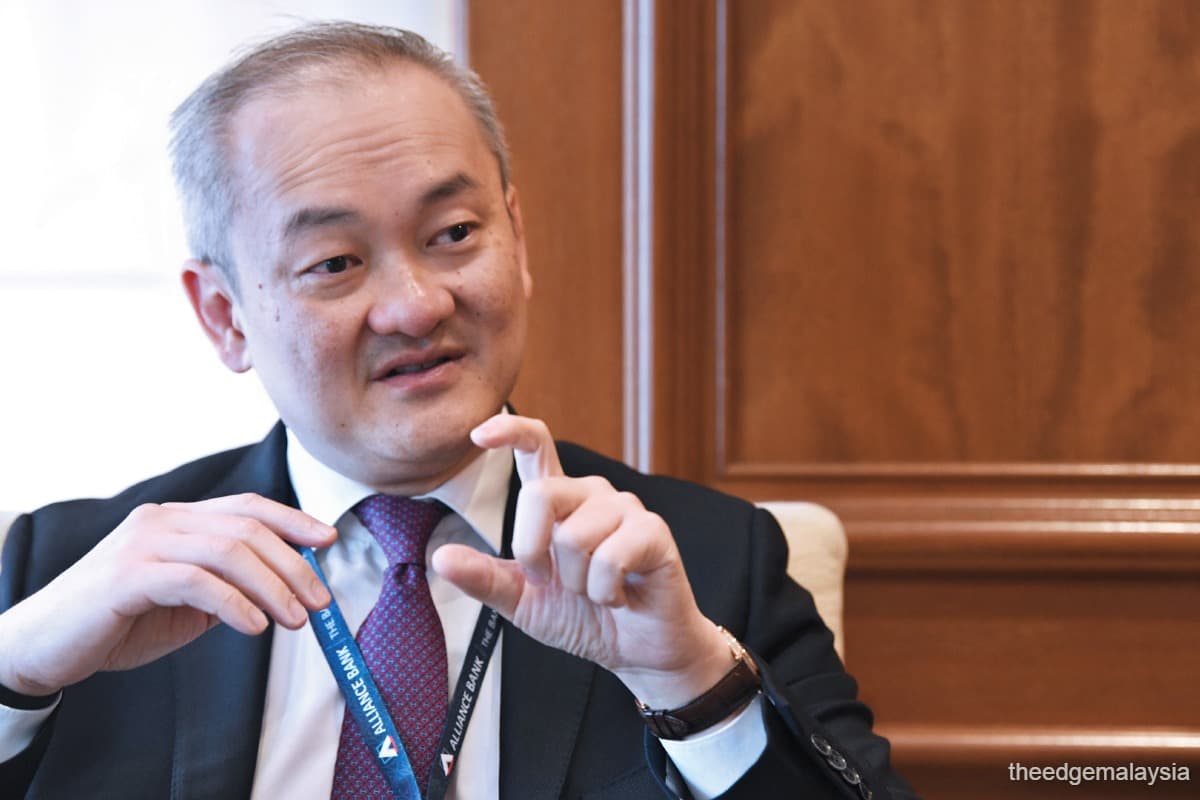
In an interview with The Edge, Alliance Bank group CEO Kellee Kam points out that although things are still fluid on the tariff front, Malaysia faces the challenge from a position of strength.
“Malaysia has a fair amount of both monetary and fiscal levers to be able to manage it, I believe. So, from a banking perspective, our view is that it is a still a conducive market for banking growth,” says Kam, who took the helm in September 2022.
“Even if there was a slowdown in gross domestic product growth [this year], we would still be in the mid-fours [in terms of GDP growth percentage] and that is still a pretty strong place to be, relative to where the region is,” he says.
Malaysia faces a 24% levy in July for goods that it exports to the US, unless it manages to negotiate a better deal before then.
Given Alliance Bank’s strong focus on SMEs, many wonder about the impact the tariffs may have on its business. According to Kam, the lender’s exposure to SME customers who are exporters is “not significant”.
“Our portfolio, interestingly enough, is largely domestic driven. Having said that, we’ve got to be conscious of the way supply chains work. [The customers] may not be exporters, but importers that import from someone else [that’s affected], or they may be selling [products] onshore for completion for export.
“We now have a separate team that we’ve formed that keeps an eye on the changing impacts on all our portfolios and our business, as things develop [on the tariff front],” he says.
Kam believes Alliance Bank can still manage higher-than-industry loan growth in FY2026. “I think you would probably see us at the 8% to 10% mark. We believe that is still going to be something that we can sustain,” he says. “We acknowledge that there are global [uncertainties], but there are a lot of domestic drivers that are still very positive to loan growth. And there are areas in which investments have already been committed. The data centre story is still relevant. The Johor-Singapore [Special Economic Zone] story, that’s still very relevant. And so is the government’s NETR (National Energy Transition Roadmap) programme investments. Those, I believe, will still be the drivers.”
Alliance Bank’s key targets that it aims to achieve by FY2027 under the Acceler8 plan are to be in the top quartile in terms of return on equity, which means an ROE of about 11%; a cost-to-income ratio (CIR) of about 45%; and sustaining above-industry loan growth of 8% to 10%. For now, Kam sees no need to revise these targets.
As at 9MFY2025, the group’s ROE stood at 10.2% on an annualised basis, while CIR was at 46.8%.

Kam is pleased that the group is on track with its plans. “It’s about doing simple things, but executed right. I think we’ve shown that we can execute well on growing across our portfolio.
“Prior to the Covid-19 pandemic, the three-year compound [annual] growth rate for our loans was only about 3%. We are now doing close to 10%. As at 9MFY2025, we were doing 14.2% y-o-y growth.
“Commercial and SME, which is our traditional stronghold, saw loans grow 15% y-o-y in the nine months. Consumer, which used to grow in the low single digits, did 14%. And corporate, which was losing market share over the last five or six years, grew close to 14%. They’re all showing double-digit growth,” he highlights.
This strong loan growth was achieved without the bank having to drop pricing or increasing its levels of risk, Kam says. Its net interest margin (NIM), a key measure of profitability that indicates what a bank earns in interest on loans against what it pays out to depositors, remains the highest among Malaysian lenders, at 2.46% as at 9MFY2025.
Its gross impaired loan (GIL) ratio — a measure of asset quality — improved to 1.97% as at end-December 2024 from 2.33% a year earlier.
Rights issue to fund growth while sun shines
The group’s recently proposed rights issue to raise fresh capital of RM600 million is to enable it to keep growing at the current pace without further running down its Common Equity Tier-1 (CET-1) ratio.
“We took a look at future growth and if we were to continue at this level, it would keep diluting our capital ratio,” Kam says. Its CET-1 ratio, a key measure of capital strength, at 12.4%, was already the lowest in the industry.

“We could slow down our growth, but we didn’t think it would be the right thing to do from a business or shareholder perspective. When conditions are right for you to grow, you should. To use farming analogy, when the sun is out in summer, you plant; you don’t plant during winter. We saw the country doing better, so slowing down was not the right thing to do.
“The other thing we could have done was a [private] placement of shares, right? But then, we asked ourselves, is it not right to give our existing shareholders who have supported us through the years the first shot at participating, at a discount? This is the first time ever in Alliance Bank’s history that it is [tapping shareholders] for capital.
“So, we went for the rights issue because we believe there’s a good balance to allow our shareholders to participate in the growth of the company. And we’ve already shown that we can grow the franchise,” Kam shares. The group has been paying dividends at a payout ratio of 50% in the three years since FY2022.
Be that as it may, Alliance Bank took many by surprise when it announced the planned cash call on March 21. The stock fell by 8.4% to close at RM4.66 the next trading day — its steepest decline in a single day since March 2020 — on concerns of dilution. It has since declined further, exacerbated by investor concerns about tariff uncertainties. It closed at RM4.36 last Friday (April 25) for a market value of RM6.75 billion.
Up until March 21 (the day it announced the rights issue), the stock had gained 44.6% over a one-year period. Its highest close in that period was RM5.38 on Feb 14.
Kam says the plan is to try to have the rights issuance process completed by July, subject to obtaining the necessary approvals.
Alliance Bank’s biggest shareholder Vertical Theme Sdn Bhd (VT), which has a 29.06% stake, has given an undertaking that it will subscribe in full for its entitlement under the exercise. The lender’s other key shareholder is the Employees Provident Fund, which had a 9.24% stake as at April 21.
Lee Thiam Wah, the founder of retail chain 99 Speedmart, holds a 4.98% stake through his investment vehicle Global Success Network Sdn Bhd.
With VT set to take up its portion of the rights issue, many are wondering whether Singapore-based hotel and property tycoon Ong Beng Seng will be allowed by Bank Negara Malaysia to remain a shareholder of the bank.
Ong — one of three individuals who own Langkah Bahagia Sdn Bhd, a 51% shareholder of VT — reportedly intends to plead guilty in a court case in Singapore linked to former transport minister S Iswaran’s corruption probe. Bank Negara has strict requirements for substantial and major shareholders of banks, including that they must not be the subject of any criminal proceedings or have been convicted of any offence involving dishonesty, fraud or other financial crimes.
“Honestly, I don’t know enough to comment, and that’s the truth,” Kam says when asked if Ong will remain a shareholder. Industry sources say the matter is one for VT and Bank Negara to resolve, and does not involve the bank.
Ong, 79, is set to step down as managing director of Hotel Properties Ltd to enable him to focus on his health.
‘No need for M&A’
Recent news reports state that Singapore’s biggest bank DBS Group Holding Ltd is keen on taking up VT’s 29.06% stake in Alliance Bank. Asked to comment, Kam says he is not in the know as that would be a shareholder matter. Both banks are backed by Singapore state investor Temasek Holdings Pte Ltd.
VT is 49%-held by Duxton Investments Pte Ltd, which is ultimately owned by Temasek. DBS is 31.91% owned by Temasek.
“We do talk to DBS on business transactions and so on, but at an arm’s length, as a partner bank [for potential cross-border business],” Kam says. But there has been no discussion with it on the matter of mergers and acquisitions (M&A), he adds.
According to a Bloomberg report on Jan 16, VT was planning to seek approval “in the coming weeks” from Bank Negara to start talks about selling its stake in Alliance Bank. The news wire, citing people familiar with the development, said VT was considering selling the roughly 29% stake to DBS.
It went on to say that if a deal goes through, DBS may consider raising its stake in the Malaysian bank to up to 49% via a voluntary partial general offer.
Meanwhile, Kam says Alliance Bank’s strong growth in recent years shows that it does not need to rely on M&A for growth.
“I’ve always said that we don’t need [it]. I think we’ve shown that it’s actually okay to continue as a standalone bank and drive our strategy the way it’s going. So, for us, internally, M&A is not something we consider,” he says.
Bloomberg data shows that of 16 analysts that track the stock, nine have a “hold” call on it while six have a “buy” and one, a “sell”.
“We initiate coverage of Alliance Bank with a ‘neutral’ rating as we believe that the positives such as the potential for faster-than-industry loan growth, attractive dividend yield, and the group’s SME strength are offset by near-term risks
arising from tariff-linked economic slowdown, upcoming dilution due to the rights issue, and NIM pressure from the consumer book,” Nomura Research says in an April 22 report.

Save by subscribing to us for your print and/or digital copy.
P/S: The Edge is also available on Apple's App Store and Android's Google Play.