

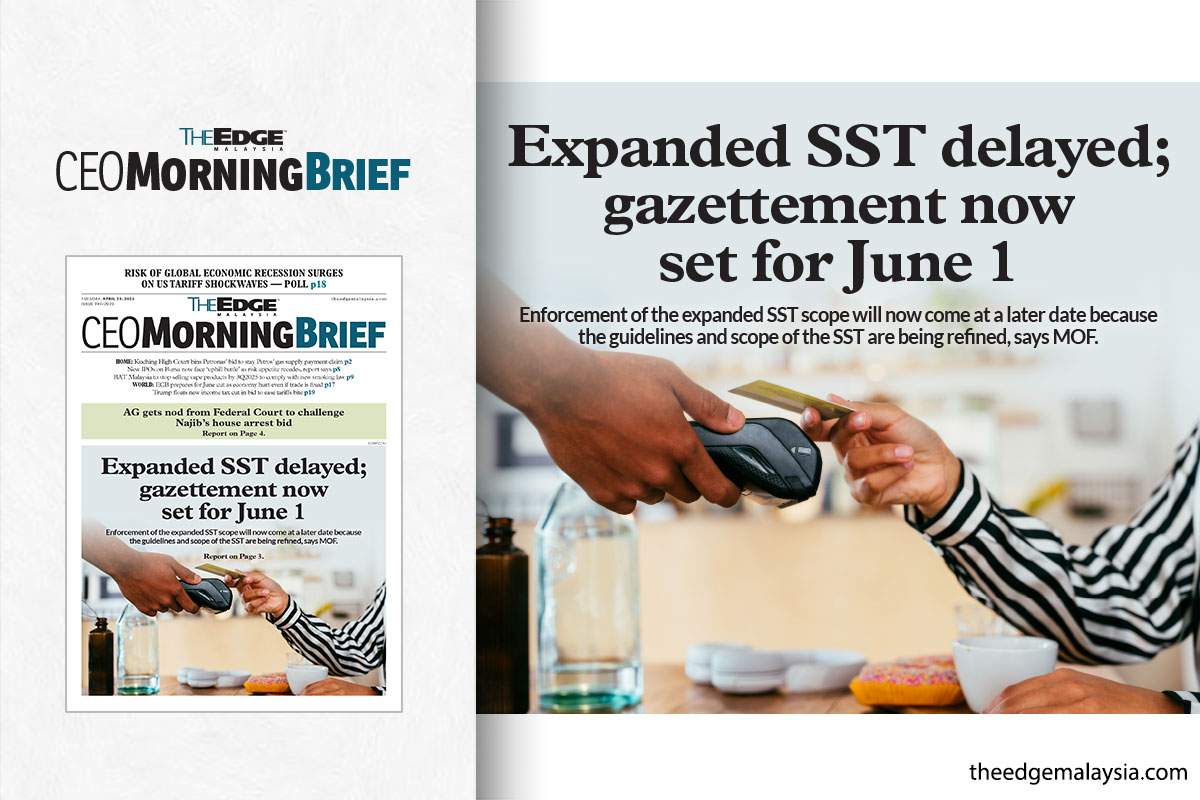
Gazettement of the new tax changes is now scheduled for June 1, according to Datuk Anis Rizana Mohd Zainudin, director general of the Royal Malaysian Customs Department. The gazettement was originally supposed to take place in the first quarter of this year.
KUALA LUMPUR (April 28): Enforcement of the expanded sales and service tax (SST), which was expected to take place on May 1, will be implemented at a later date, according to the Ministry of Finance (MOF).
This is because the guidelines and scope of the SST are being refined to ensure a smooth implementation, an MOF spokesperson told The Edge in response to questions about the expanded SST.
Hence, the SST scope expansion will be implemented at a later date even though nationwide engagements with industries to finalise the scope of the expansion and the applicable tax rates have been completed, the spokesperson said, without specifying when that will be.
Gazettement of the new tax changes is now scheduled for June 1, according to Datuk Anis Rizana Mohd Zainudin, director general of the Royal Malaysian Customs Department (JKDM). The gazettement was originally supposed to take place in the first quarter of this year.
"JKDM, in principle, has received instructions from the Ministry of Finance (MOF) to prepare draft legislation for the expansion of the SST scope, to be gazetted on June 1," Anis Rizana told The Edge in a brief text message. JKDM is the agency responsible for the execution and enforcement of SST in the country.
A gazettement is the official publication or announcement of a new law or government policy, or changes to existing ones. With the gazettement now delayed until June 1, the enforcement will only be possible after that date.
Prime Minister Datuk Seri Anwar Ibrahim announced during the tabling of Budget 2025 last year that the government intended to roll out the expanded SST scope on May 1, 2025.
Anwar, who is also the finance minister, did not provide specific details of the SST expansion then, saying only that the sales tax would be increased on non-essential items, including imported premium goods like salmon and avocado.
At the same time, the service tax will be expanded to include commercial service transactions between businesses that were previously exempted, especially fee-based services.
According to a parliamentary reply on Feb 6, the MOF stated that the finalised SST scope expansion and the review of SST rates would be gazetted through subsidiary legislation in the first quarter of 2025, after an engagement process with stakeholders and relevant industries is completed, to allow sufficient time for preparation before enforcement.
In a separate parliamentary reply on Feb 26, the MOF said it was exploring the feasibility of taxing high-value goods under the expanded scope of the SST.
Delay comes as Trump's tariffs rock global trades
The delay in enforcement of the expanded SST comes at a time when Malaysia is facing a 24% reciprocal tariff imposed by US President Donald Trump, who has announced unilateral tariffs on the US' trade partners.
Initially supposed to begin on April 9, the US tariffs have been suspended for 90 days — except for China — while a 10% blanket tariff takes its place to allow affected countries to negotiate a better rate with the US.
China, meanwhile, has had its reciprocal tariff raised from 34% to 125%, on top of a 20% fentanyl-related tariff that took effect in January this year. In response, China has slapped a 125% tariff on US goods.
Several business and trade groups have called on the government to postpone the implementation of the expanded SST scope, citing mounting economic challenges from the escalating trade tensions.
This includes Associated Chinese Chambers of Commerce and Industry of Malaysia president Datuk Ng Yih Pyng, who, in an engagement with the Customs Department last week, highlighted the increasing operational costs for businesses and the pressure on merchants.
Federation of Malaysian Manufacturers (FMM) president Tan Sri Soh Thian Lai also revealed that the FMM had sent a letter to the MOF requesting a deferment of the expanded SST. The federation had also called for a comprehensive impact study on how the expansion might affect inflation, business sustainability, and consumer affordability.
The postponement, however, will likely result in the government missing its target of collecting RM5 billion additional revenue this year from the SST expansion.