

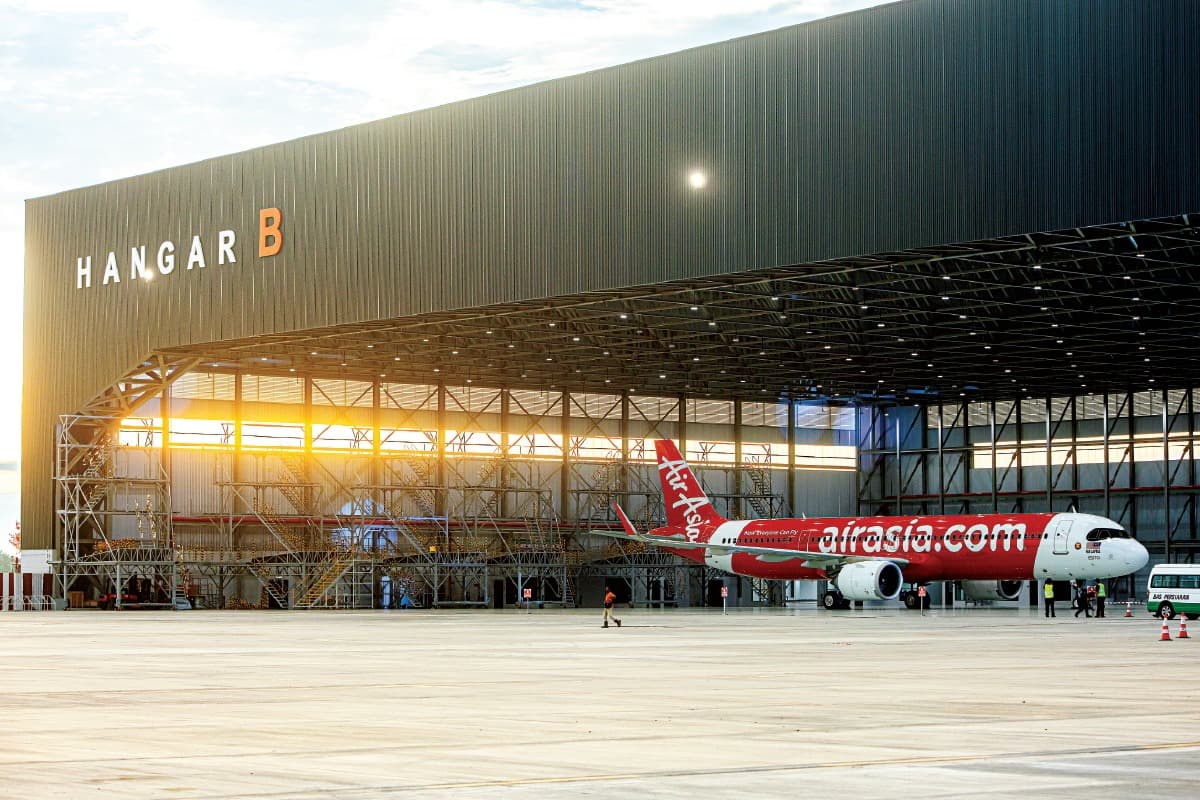
This article first appeared in The Edge Malaysia Weekly on April 28, 2025 - May 4, 2025
CAPITAL A Bhd’s (KL:CAPITALA) non-aviation assets are in focus as value unlocking is at play. The budget airline is selling its short-haul aviation business to medium-haul affiliate, AirAsia X Bhd (KL:AAX).
With the impending divestment of its aviation business, Capital A’s portfolio would be refocused to become a technology and logistics company. This move is part of the group’s restructuring plan, under which both the aviation and non-aviation businesses will benefit from a sharper focus. The disposal is expected to be completed in May.
The non-aviation businesses include Asia Digital Engineering Sdn Bhd (ADE), Teleport Commerce Malaysia Sdn Bhd, BigPay Malaysia Sdn Bhd, Santan, Move Digital Sdn Bhd (AirAsia Move) and branding unit Capital A International (CAPI).
Based on analyst estimates, the six non-aviation units have a combined value of between RM5 billion and RM6.5 billion. The disparity in the valuation underscores how differently the analysts value each of the businesses.
Nevertheless, there appears to be a consensus that ADE — Capital A’s maintenance, repair and overhaul (MRO) unit — and logistics arm Teleport are poised to be key growth drivers for the group. While Teleport was not profitable in the most recent financial period, analysts maintain that it has strong growth prospects.

ADE, along with Capital A’s online travel agent platform AirAsia Move, were the two non-aviation businesses that contributed the most to Capital A’s non-aviation profit after tax (PAT) of RM162 million for the financial year ended Dec 31, 2024 (FY2024).
Worth of non-aviation businesses
A sum-of-parts (SOP) valuation approach points to a significant increase in the value of these non-aviation segments, highlighting their importance to Capital A’s future growth trajectory.
Analysts put a valuation of between RM900 million and RM1 billion for ADE, which currently provides MRO services to 70% of AirAsia’s fleet and other airlines.
In a March 3 note to clients, Kenanga Research estimated ADE’s value at RM900 million, which implied a multiple of 10 times its FY2025 price-earnings ratio (PER) estimate.
A relevant peer comparison would be SIA Engineering Co Ltd — the MRO arm of Singapore Airlines Ltd — that currently trades at a PER of 16.8 times UOB KayHian’s projected earnings for its financial year ending March 31, 2026 (FY2026), UOB KayHian says in a report on Feb 17.
With the aviation industry gradually recovering and the demand for aircraft maintenance on the rise, ADE’s expertise and established infrastructure are expected to translate to significant revenue and profit growth, thereby bolstering its valuation.
For instance, despite being at the tail end of achieving full operational status for its new hangar lines, ADE still achieved a notable revenue growth of 27% in FY2024, analysts observe.
In contrast, AirAsia Move experienced a revenue decline of 19% year on year (y-o-y) in FY2024.
However, analysts note that AirAsia Move is developing new revenue streams such as duty-free offerings, and upgrading its technology to improve user experience — all of which may contribute positively to its future valuation.
Meanwhile, Kenanga Research provides a SOP valuation for Capital A’s digital assets, excluding ADE, at RM996.8 million. This is significantly lower than Maybank Investment Bank Research’s (Maybank IB Research) RM5.49 billion valuation.
Kenanga Research says its valuation is based on a 30% discount to Axiata Group Bhd’s (KL:AXIATA) Boost, considering their similarities as digital platforms in the same region. The research firm also acknowledges that AirAsia’s digital assets are not directly comparable to Boost and takes into account the decline in technology start-up valuations.
In a March 3 report, Maybank IB Research values Teleport at RM1.07 billion. Although still loss-making as of FY2024, Teleport narrowed its net loss to RM24 million, while its earnings before interest, taxes, depreciation and amortisation (Ebitda) soared 215% y-o-y to RM90 million.
Analysts foresee continued expansion in Teleport’s valuation, fuelled by rising shipment volumes and strategic partnerships. They note that Teleport has capitalised on the burgeoning e-commerce market and the increasing demand for efficient cargo and last-mile delivery services across Southeast Asia.

Kenanga Research says Teleport saw a fourfold increase in capacity utilisation from key aviation partners and improved service levels, significantly boosting Ebitda in FY2024.
Despite the promising growth of its non-aviation businesses, Capital A’s overall FY2024 performance has been affected by factors such as foreign exchange losses and lower-than-expected yields in the aviation segment. The group reported a net loss of RM475.11 million for FY2024 compared to a net profit of RM255.32 million in FY2023. This was despite the full-year revenue of continuing operations rising 17% to an all-time high of RM1.5 billion, compared with RM1.28 billion.
PN17 status casts shadow over airline’s ability to raise funds
Capital A’s Practice Note (PN) 17 status — a classification for financially distressed listed companies on Bursa Malaysia — casts a degree of uncertainty over the non-aviation expansion, particularly concerning fundraising.
Analysts acknowledge the significant weight PN17 carries on the ability of the group’s non-aviation businesses to secure funds through the capital markets, private placements or borrowings. The ability of these ventures to attract substantial funding for further expansion hinges significantly on Capital A’s success in demonstrating sustained profitability and ultimately exiting the PN17 classification.
However, ADE CEO Mahesh Kumar disagrees with this assessment.
“The banks right now are really interested [in offering us loans]. Of course, if Capital A is out of PN17, it helps. But on the MRO side, it doesn’t affect us,” he tells The Edge in an interview. Mahesh, 39, was appointed to his current role in September 2020.
“We need funding to expand our infrastructure, not for working capital. As long as the banks have good security on the facility, they shouldn’t be worried, and on top of that, demand far exceeds supply in the MRO industry,” he adds.
Still, Mahesh is careful to highlight the difference between the airline business and MRO.
“In the past, most bankers thought that if the airline industry was volatile, the MRO business would be too. That is not true.”
Capital A is aiming to complete the aviation business disposal and exit PN17 status by the second quarter of 2025.
On Feb 28, Capital A disclosed its internal targets for FY2025, with ambitious goals for both its aviation and non-aviation segments. It expects its non-aviation revenue to hit RM4 billion with an Ebitda of RM600 million, giving the group a 10% net operating profit margin.
Meanwhile, its aviation segment is targeted to achieve RM24 billion in revenue, an Ebitda of RM4.8 billion and a 5% net operating profit margin, assuming all aircraft are airworthy.
Still, until the group can consistently show positive financial performance, the PN17 label will likely remain a considerable hurdle in accessing capital markets and securing favourable borrowing terms, analysts say.
Save by subscribing to us for your print and/or digital copy.
P/S: The Edge is also available on Apple's App Store and Android's Google Play.