

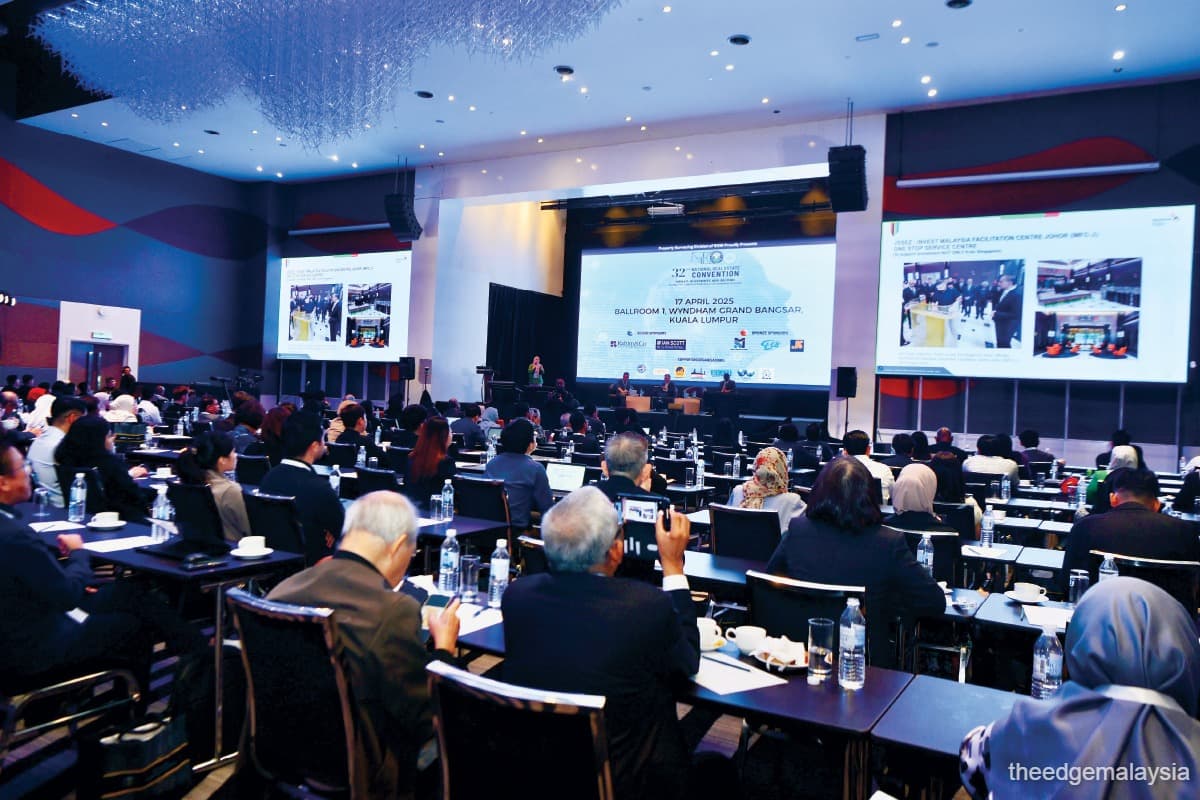
This article first appeared in City & Country, The Edge Malaysia Weekly on April 28, 2025 - May 4, 2025
As Malaysia’s real estate industry continues to evolve, staying ahead of emerging trends is crucial to driving growth and overcoming challenges. This was the main message delivered by speakers at the 32nd National Real Estate Convention (NREC 2025).
With the theme “Fostering Innovation for a Sustainable Future: Bricks, Blueprints and Beyond”, the convention gathered industry leaders, policymakers and academicians to explore transformative trends in real estate.
In his welcome address, Royal Institution of Surveyors Malaysia (RISM) president Ahmad Sanusi Che Cob said the theme for this year’s convention reflects the evolving landscape of Malaysia’s real estate sector.
“It goes beyond the tangible elements of buildings and infrastructure, and speaks to the innovations, resilience and visionary thinking that must guide our industry as we navigate towards a more sustainable and inclusive future. Today’s global environment is also about policy, technology, communities and purpose,” he added.
Kuala Lumpur Mayor Datuk Seri Maimunah Mohd Sharif, who officiated at the convention, said: “Kuala Lumpur’s journey is not just about what we build, but also about how we live. Building a smart, sustainable, liveable, lovable and resilient Kuala Lumpur is not merely a policy objective, it is a promise to create communities with a strong sense of belonging and a city that people love.”
Organised by the property surveying division of RISM, NREC 2025 took place on April 17 at the Wyndham Grand Bangsar in Kuala Lumpur. The full-day convention featured five main sessions, with each session comprising up to three individual paper presentations.

Catalytic projects
The first session, titled “Industry Game-Changers in Malaysia: SEZs, Mega Projects & Economic Growth Drivers”, was moderated by Universiti Technologi Malaysia associate professor of property finance Muhammad Najib Razali. It featured three paper presentations, namely “Malaysia’s Smart & Sustainable Financial District” by TRX City Sdn Bhd CEO Datuk Azmar Talib; “Johor-Singapore SEZ (JS-SEZ) — Strengthening Cross-Border Economics” by Iskandar Regional Development Authority (IRDA) director of strategic driver Maimunah Jaffar; and “ECRL: Transforming Connectivity & Regional Development” by East Coast Economic Region Development Council (ECERDC) chief operating officer Datuk Ragu Sampasivam.
The first project discussed was the Tun Razak Exchange (TRX) mixed-use development in Kuala Lumpur. Spanning 70 acres, TRX comprises a shopping mall, a hotel, office buildings, residential towers and a 10-acre public park. Azmar said in his presentation that TRX was designed not only for profitability but also to support Malaysia’s economic growth and elevate Kuala Lumpur as a global financial centre.
“The development has already attracted over RM8 billion in foreign direct investments (FDIs) and created more than 30,000 jobs, and expects to generate 80,000 knowledge-based employment opportunities. The development currently hosts about 50 multinational corporations,” he added.
On what is next for the project, Azmar revealed that the company has received approvals to begin construction of a new office tower that will house PricewaterhouseCoopers Malaysia Holdings Sdn Bhd (PwC Malaysia) as its anchor tenant.
Speaking about the highly anticipated initiatives of the JS-SEZ, Maimunah explained its relationship with Iskandar Malaysia and the Invest Malaysia Facilitation Centre-Johor (IMFC-J). She also outlined the key performance indicators and investment targets for the region.
“For investments, our 2025 target was RM383 billion. But we’ve already surpassed that, reaching RM453.3 billion this year. We’re aiming for RM636 billion by 2030,” she said.
On what makes the JS-SEZ different from Iskandar Malaysia, Maimunah elaborated, “Over the past 19 years [for Iskandar Malaysia], we’ve worked closely with Singapore, although not in a structured format at the government-to-government level. Previously, collaborations happened more at the agency level, between Iskandar Malaysia, IRDA and its counterparts like Enterprise Singapore or the Singapore Economic Development Board. This year [with JS-SEZ], we are moving towards a more structured collaboration.”
She highlighted several goals via the partnership, including improving cross-border mobility and connectivity for people and goods, as well as enhancing economic complexity.
The JS-SEZ is expected to generate 50 projects, 20,000 skilled job opportunities and 7% to 8% of gross domestic product growth in the next five years. Sectors that are expected to set up shop in the region include the artificial intelligence (AI) and quantum computing supply chain; medical devices and pharmaceuticals; aerospace manufacturing as well as maintenance, repair and overhaul (MRO) services; and integrated tourism projects.
Presenting the role of ECERDC in developing the east coast of Peninsular Malaysia, Ragu said, “The East Coast Economic Region (ECER) covers three states [Kelantan, Terengganu and Pahang] and two districts in Johor, which altogether make up about 15% of Malaysia. It has historically been considered a lagging region, but not anymore.”
The east coast, particularly the Kuantan area or Gebeng Industrial Area, is also known as the ECER special economic zone. Ragu said this area has had this designation since 2010.
“One of the key reasons is improved travel convenience. In addition, we now have the East Coast Rail Link (ECRL), which will start from the northern end, from Tumpat, passing through Kuala Terengganu, Kuantan, Bentong and Gombak, and finally down to Port Klang,” he added.
“Kuantan Port is strategically located to access markets in China and the Far East, including Japan and South Korea. So, for industries located in Kuala Lumpur or Selangor, Kuantan Port offers a viable option to export to those markets using rail and sea connectivity. Conversely, you can also bring investments into the ECER and access the Middle East and European markets via Port Klang, using the ECRL.”
Ragu also highlighted that within the ECER, there are several industrial parks developed and managed by the ECERDC, including the Pahang Technology Park, Gambang Halal Park and Kerteh Biopolymer Park.
To further drive tourism in the region, ECERDC is currently studying the viability of developing a recreational vehicle (RV) park in the ECER, he said. These parks will be located near beaches and national parks.

Policies to improve the industry
The second session, titled “Navigating New Legislations & Policies: Implications & Opportunities”, was moderated by Nawawi Tie Leung Property Consultants Sdn Bhd executive director Saleha Yusoff. It featured three paper presentations, namely “Real Property Development Act — Are you Ready for it?” by Ministry of Housing and Local Government (KPKT) director-general Datuk Jayaselan Navaratnam; “Urban Renewal Act: To Have or Not To Have” by Rahim & Co International Sdn Bhd director of research Sulaiman Saheh; and “Private Lease Scheme: Unlocking Ancestral and Wakaf Lands for Economic Development” by Datuk Pretam Singh Darshan Singh, co-founder and partner at Pretam Singh, Nor & Co.
Introducing the proposals under the Real Property Development Act (RPDA), Jayaselan began by discussing why a new law is needed when the industry already has the Housing Development Act (HDA). “While the HDA primarily governs residential housing, the RPDA is designed to be more comprehensive, covering residential, commercial and select industrial properties, and introducing consumer protection, transparency and accountability across the industry.”
He said the new legislation will mandate that all marketing materials, verbal promises and advertisements become legally binding, holding developers accountable for claims made during sales. There is also a proposal to empower the property tribunal to consider not just the sales and purchase agreement (SPA) but also promotional content and agent commitments.
Additionally, the proposed legislation may allow both buyers and developers to cancel the SPAs within a predetermined time frame. This is to reduce abandoned projects, he said.
There is also a proposal to extend the warranty beyond the standard defect liability period, depending on the manufacturer’s terms. Besides that, developers would be required to meet stricter delivery timelines, with allowances for resolving technical issues. Finally, the RPDA will introduce a self-managed digital platform enabling buyers to complete transactions independently, such as the signing of an SPA.
Another hot topic that has received mixed reactions from the public is the proposed Urban Renewal Act (URA).
Sulaiman is of the view that the legislation is necessary to revitalise dilapidated parts of the city, but is also concerned about gentrification. “Urban renewal is not only about physical transformation, but also about improving the physical environment to better support the non-physical functions, enhancing the liveability, usability and appropriateness of urban spaces for their intended users,” he said.
Highlighting the proposed URA’s potential to stimulate economic growth and revitalise urban centres, Sulaiman stressed the importance of open public discussions and protecting homeowners’ intentions, “especially for those who bought properties for long-term residence, not speculative gain”.
Speaking on private lease schemes, Pretam discussed the concept of privately owned land schemes, focusing on leases as an alternative to freehold ownership. He also explained how this system had been successfully implemented in some areas, particularly for ancestral and religious lands that cannot be sold outright.
“For example, the Khoo Kongsi is a respected Hokkien Association, established in the 19th century. Around 1920, they had a board of trustees and collectively purchased about 379 acres of land. Back then, if you bought land, you became a trustee. However, as a trustee, you couldn’t sell the land and this applies not just to temple land but also to church land in some cases.”
Since the freehold land could not be sold, a lease scheme was introduced instead, said Pretam. The freehold land remained under the ownership of the trustee, while long-term leases were offered to buyers.
“It is important to distinguish between a lease and a leasehold. A leasehold is issued by the government, whereas a lease is granted by the landowner. These leases are registrable under the National Land Code, making them a formal and enforceable tenure option within Malaysia’s land administration system,” he said.
The success story of the Khoo Kongsi case would be the Paya Terubong township in Penang, where the trustees of the Khoo Kongsi managed to develop the land under a lease scheme. Pretam said they managed to issue 11,153 strata titles under lease.
What are the key issues with lease schemes? “Sometimes people say it’s just a nominee structure. But even with leasehold, the state remains dominant. The state always retains the right to repossess land or revise lease terms and valuations upon renewal. This is standard practice, even in leasehold arrangements. Similar principles apply to lease schemes,” he explained.
He added that private scheme buyers will need to pay the lease consideration, which is the price of the property, and landowners may impose additional charges or taxes to ensure the property is returned in good condition at the end of the lease. Just like how the state imposes a premium to extend a leasehold, private lessors may do the same.
Wakaf land, on the other hand, is intended solely for the Muslim community, said Pretam. “The benefits should also return to the Muslim community because that is the purpose of wakaf land. I’m not suggesting that regular developers cannot be involved but rather, wakaf land can be developed to enhance its economic value in a way that aligns with the principle of equity for the Muslim community.”
The advent of AI and continued relevance of ESG
The third session explored the role of AI and the environmental, social and governance (ESG) agenda in the real estate industry. Titled “The Impact of AI & ESG: Transforming Valuation, Estate Agency and Property Management Practices for a Sustainable Future”, the session was moderated by Kamalahasan Achu, a senior lecturer at Universiti Teknologi Malaysia’s Faculty of Built Environment and Surveying.
It began with a presentation titled “AI & ESG in Property Valuation” by CBRE | WTW managing director (valuation and research) Ungku Mohd Iskandar Ungku Ismail. In his presentation, he outlined the growing advantages of AI in real estate, particularly in the field of property valuation.
“With AI, we now have tools such as automated valuation models (AVMs), which can analyse vast datasets to instantly generate property values and automate routine tasks such as data entry and report generation to reduce human error. AI also provides advanced data analysis and projections which offer property valuers insights across different asset classes. It improves consistency and accuracy and helps detect fraud by flagging suspicious transactions and fake listings,” he added.
Ungku Iskandar noted that data is already transforming how property valuers assess building assets. “In summary, data is changing the way we value our assets. The use of data and AI helps us gain deeper insights into the asset itself. Real-time data from Internet of Things (IoT) sensors, satellite imagery and public platforms can help us better understand market trends and monitor building performance.”
While AVMs are expected to become more reliable over time, he emphasised the need for a hybrid model that combines AVMs with human judgement to ensure proper market understanding and regulatory compliance.
Nevertheless, Ungku Iskandar cautioned that AI’s potential comes with its own set of challenges. These include the quality and availability of data, a lack of market understanding and judgement of specialised assets, the risk of market lag where valuers must stay constantly updated and an overreliance on AVMs where data integrity is critical.
Turning to ESG, he said, “ESG considerations are becoming more relevant today in determining both property value and marketability. Green certifications such as GBI, GreenRE and LEED are often associated with higher rental values and better occupancy rates.”
He concluded the session by saying that today’s stakeholders expect greater transparency on how data is used and disclosed in valuation reports, along with a growing expectation of ESG initiatives. In his view, the future of valuation will be data-driven, transparent and accountable.
The next session featured a presentation by Previndran Singhe, CEO of Zerin Properties Sdn Bhd, titled “The Evolving Role of Estate Agency in a Tech-Driven Market”. In his talk, he emphasised that AI has not threatened the role of estate agents, but instead redefined and enhanced it.
“Technology has not replaced agents — it has redefined us. It has sharpened our skills, not shrunk us. With AI and big data, clients can decode market patterns, predict property market behaviour, understand buyers’ behaviour and spot opportunities simply by analysing the volume of transactions that have taken place,” said Previndran.
He pointed out that estate agents remain essential to clients for their human judgement and real-world insights. “Clients still need us for the human stuff — understanding planning requirements, resolving title issues and interpreting the motivation behind a sale. Tech gives us data, but we give meaning to it. Developers are coming to us to turn data into stories that sell, whether it’s about green leases, IoT sensors or sustainable financing.”
Previndran reiterated that technology is not a threat, but an enabler. “For me, tech is not a big problem for estate agents — it’s an enabler. The evolution of the industry is being driven by shifting demographics, new economic models, lifestyle changes and regulatory reforms. We are no longer just salespeople. We are part adviser, part analyst and part storyteller, all working to get the deal done.”
Focusing on healthcare and senior living
The fourth session, “Healthcare, Wellness & Senior Living in Malaysia: Prospects & Market Trends”, brought up a discussion on the prospects and market trends in the healthcare, wellness and senior living sectors. The session was moderated by Ainoriza Mohd Aini, head of Universiti Malaya’s Department of Real Estate.
In KL Wellness City Sdn Bhd executive director Datuk Seri Vincent Tiew’s session titled “The Future of Healthcare and Wellness Real Estate,” he highlighted that the wellness real estate market is a large one globally. And as the growth gravitates towards Asia, Malaysia could take part in medical tourism by leveraging its four key strengths, which are affordable excellence, where medical procedures in Malaysia are up to 60% cheaper than in Western countries while maintaining a high standard of care at internationally accredited hospitals; multilingual healthcare professionals; cultural familiarity, where a shared cultural heritage enhances the patient experience; and post-treatment wellness, which gives patients the option to choose recovery in a tropical resort, luxury rehabilitation centre or wellness retreat.
He added that the country has been receiving a growing number of medical tourists. “In 2023, Malaysia attracted 1.22 million tourists to our private healthcare. In 2024, we successfully attracted 1.3 million healthcare patients/tourists. More than 60% of our 1.3 million visitors came from Indonesia, Singapore, China and Bangladesh.”
Teh Pei Lee, head of Monash University Malaysia’s School of Business and director of the Gerontechnology Lab, shared the innovations she had learnt from visiting senior living facilities Olivet Care in Australia, Felio Tenjin in Japan and the Hong Kong Lutheran Social Service in her session, “Getting Smart with Senior Living: Adapting Global Innovation for Malaysia’s Market”.
Following the many study tours, she started the Monash iHome project, an initiative aimed at delivering practical home modifications for individuals who need environmental adjustments to support their lifestyle and health changes as they age.
“We interviewed a 63-year-old man who was living alone and suffered from gout and diabetes. His house was cluttered and we [decided] to transform the spaces in his house to be a functional space and install aged-friendly facilities such as shower chairs and slip-stop tiles,” said Teh, adding that the renovation is targeted to commence in 3Q2025 and be completed by 4Q2025.
Green industrial park
The final session, “Reimagining Industrial Parks: The Future of Sustainable, Smart & Integrated Ecosystems”, was moderated by Siva Shanker, CEO of estate agency at Rahim & Co International Sdn Bhd.
The speakers were Selangor State Development Corporation (PKNS) general manager Hyril Azim Baharudin and the Ministry of Investment, Trade and Industry’s principal assistant director of the delivery management unit Md Zakuan Arief Md Alias, who talked about the state’s initiatives by tapping into industrial opportunities and the New Industrial Master Plan (NIMP) 2030.
Hyril said PKNS is embarking on the development of more than 200 acres of smart and green industrial parks. The core features of its green industrial parks will include circular economy practices, infrastructure and tenants that are ESG-aligned, integrated renewable energy and smart infrastructure.
The state development agency launched GRIP Kota Puteri Crown City, a green industrial park in Rawang, Selangor, last year. Hyril explained that this is to support the NIMP 2030, help exporters avoid EU carbon taxes and future-proof Malaysia’s industrial base to ensure long-term resilience of the industrial sector.
In concluding his presentation, Hyril opined that Malaysia can lead the region in ESG-based industrial ecosystems and that eco-industrial parks are essential to the sustainability of industrial growth.
Zakuan spoke about the various incentives implemented by the government to support the growth of industrial development to align with the objectives of NIMP 2030, including the Strategic Co-investment Fund (CoSIF) and NIMP Industrial Development Fund (NIDF). CoSIF is a funding initiative where the government co-invests with the private sector in NIMP-aligned projects, while NIDF provides funding to ministries and agencies for NIMP-aligned industrial development projects.
Save by subscribing to us for your print and/or digital copy.
P/S: The Edge is also available on Apple's App Store and Android's Google Play.