

This article first appeared in City & Country, The Edge Malaysia Weekly on April 28, 2025 - May 4, 2025
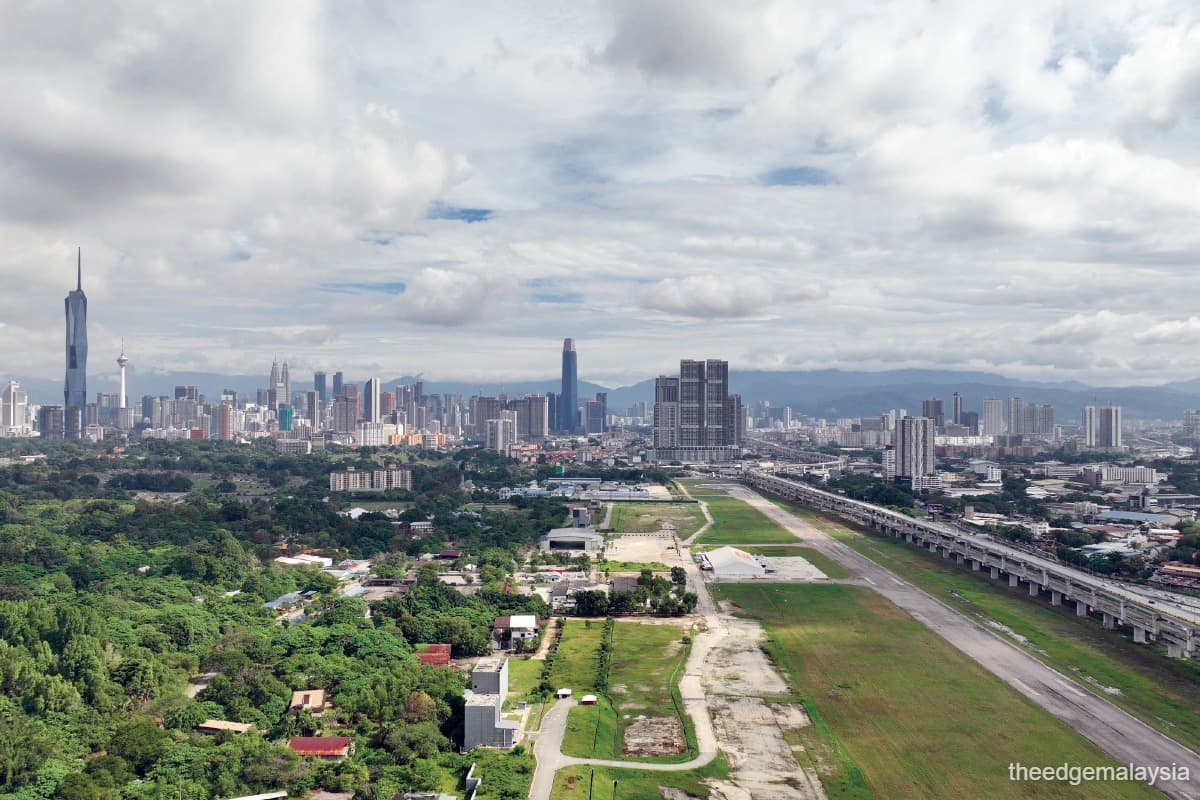
The view from Datuk Mohd Salem Kailany’s new office suite on Level 82 of the César Pelli-designed Petronas Twin Towers is quite spectacular. From the large glass window of the world’s tallest twin towers, Salem points to the site of the proposed Bandar Malaysia megaproject at a distance.
“We hope to be able to turn this project into the third icon of Malaysia, after KLCC and Putrajaya,” says the soft-spoken group CEO of KLCC (Holdings) Sdn Bhd (KLCCH), who took the reins of the company on Nov 1, 2024.
KLCCH owns 64.7% of shares in KLCCP Stapled Group (KL:KLCC) — the largest real estate investment trust and the only stapled security in the country — which comprises KLCC Property Holdings Bhd and KLCC Real Estate Investment Trust (KLCC REIT).
In the stapled security’s portfolio are prime office, retail and hotel assets including Petronas Twin Towers, Menara ExxonMobil and Menara 3 Petronas under KLCC REIT; and Suria KLCC, Mandarin Oriental, Menara Dayabumi, and a 33% stake in Menara Maxis under KLCC Property Holdings. These assets, with a total property value of RM16.2 billion, have a combined gross floor area of 12 million sq ft and, excluding Kompleks Dayabumi, are within the company’s 100-acre Kuala Lumpur City Centre (KLCC) development.
For its financial year 2024, the stapled group achieved a record RM1.7 billion in revenue — the highest since its listing in 2013 and a 5.7% year-on-year growth from RM1.6 billion, with profit before tax (PBT) of RM1.2 billion. The group recorded total assets of RM18.7 billion in the same period.

Apart from developing and managing real estate properties in KLCC and Putrajaya, KLCCH — the property arm of Petronas — will also develop the 486-acre Sungai Besi tract, earmarked for the Bandar Malaysia development, which it acquired last December. Previously the site of the Royal Malaysian Air Force base, the proposed development is estimated to take 50 years to complete.
Salem, 55, has big shoes to fill, but he is a seasoned industry professional with more than 30 years’ experience in real estate valuation, project advisory, property development, project management as well as mergers and acquisitions. He had previously held leadership positions such as president and CEO of UDA Holdings Bhd (2019), CEO of PNB Development Sdn Bhd (2016) and senior vice-president of Sime Darby Property Bhd (KL:SIMEPROP) (2007).
With a background in estate management, Salem is also a member of the Royal Institute of Surveyors Malaysia.
“While experience matters, especially in the context of a very dynamic property industry, two things are never the same. So, what’s more important is how I can bring value to this new entity.
“I believe in being customer-focused, attention to detail and perhaps taking some degree of risk, which I hope to be able to share here. Beyond that is really about the energy from the team, because for this to be a successful journey, the team needs to be excited about it as well. And I hope their excitement will continue to be carried through in our journey in bringing to market new projects, including Bandar Malaysia,” he adds.
.jpg)
Key developments
Bandar Malaysia — envisioned as an international business hub and a liveable, inclusive city — is one of the key developments that Salem will oversee. “This [project] will be the core [for the company]. As a developer, [KLCCH] have established its DNA from developing KLCC and Putrajaya. These are all iconic projects and we will be looking to bring a similar value proposition to the Bandar Malaysia development.”
Owing to the size of the development, Salem emphasises the importance of getting it right. “This project is going to be one of the bigger undertakings that the company has done before in terms of land size. This is a big opportunity for us so we need to do it right. We are currently looking at making sure the development master plan and the initial phase will be something the market is looking for.”
Details of the Bandar Malaysia development remain under wraps, but Salem hopes to unveil them by the end of the year. He added that there are no official plans for a name change. “We are still developing [the plans] and exploring options. We are looking at a self-sustaining development that provides job opportunities and a good living environment. We will be able to share more by year end.”
Salem’s experience in township development will surely come in handy, but he believes in embracing the company’s past experiences. “I have done many townships, so I would like to share some of these learnings with the team when we embark on the Bandar Malaysia development. Beyond that, we will leverage the learnings the organisation has already acquired through past developments, including KLCC and Putrajaya. These learnings are built into the organisation and we will continue to improve on them for our next development.”
Over at KLCC, specifically on Persiaran KLCC/Jalan Binjai and adjacent to the Persiaran KLCC MRT Station, the company is constructing a six-storey retail and lifestyle offering. Once completed, Ombak KLCC will contribute 420,000 sq ft in net lettable area and 1.3 million sq ft in gross floor area, expanding the retail space in the precinct.
Scheduled to open this year, the mall will have a rooftop park and 120 retail lots. Galeri Petronas will be the anchor tenant, alongside a marketplace and a curated blend of lifestyle, fashion and F&B offerings, according to Salem.
Despite Kuala Lumpur’s highly competitive retail market, he says, Ombak will have its own market segment because it is not a full-fledged offering like Suria KLCC. “It will cater for lifestyle retail, and the new Petronas gallery will be a key element that will offer immersive experiences. These are some of the new things we will be bringing to market,” he adds.
“Ombak is also connected to the Persiaran KLCC MRT Station, which makes it a new transit-oriented development (TOD). While Suria KLCC is served by the LRT Kelana Jaya Line, Ombak will be served by the MRT Putrajaya Line. And the covered walkway linking Ombak to Suria KLCC is under construction. We’re excited to bring Ombak to the market and we’re working towards an October opening.”
Preserving asset value
As for the existing assets under the listed entity, Salem will continue to drive asset enhancement initiatives, which have proven to yield favourable results for the group.
“KLCCP Stapled Group has been a listed entity for more than 10 years and we represent a big chunk — slightly over 30% — of the REIT market [by total assets and market capitalisation]. And from our historical performance, we have been able to deliver good dividends and steady returns to investors.
“We will continue to preserve the value of the assets to ensure they can generate the returns and command the right rental rates, which will eventually be translated into returns to investors and shareholders,” he says.
Its hotel segment was the group’s star performer in 2024, where revenue rose 13.7% y-o-y to RM239.8 million and PBT quadrupled to RM12.2 million from RM3 million. Its sole hotel asset, Mandarin Oriental Kuala Lumpur, achieved its highest room revenue of RM15.8 million in July 2024, and highest average room rate exceeding RM1,000. The hotel also recorded the highest revenue per available room (RevPAR) of RM610, and highest banquet revenue, which surpassed RM41.3 million, since the hotel opened in 1998.
“Mandarin Oriental, for example, is one of the assets that is undergoing upgrading works to offer upgraded ballrooms, hotel rooms and apartments,” says Salem. The group recently added two pickleball courts and an upgraded tennis court at the hotel to enhance its suite of leisure amenities. The five-star luxury hotel has 629 rooms, suites and executive apartments.
As for its retail segment, Suria KLCC and the retail podium of Menara 3 Petronas — with a total net lettable area of 1.1 million sq ft — contributed a steady 32.2% to the group’s total revenue last year, with revenue rising 6.8% y-o-y to RM551.2 million from RM516.1 million, and PBT rose by 9.2% y-o-y to RM429.1 million from RM392.9 million. This was primarily driven by an improved occupancy rate of 99%, from 96% in 2023, and higher rents.
In early 2024, the group assumed full control of Suria KLCC by acquiring the remaining 40% equity interest in Suria KLCC Sdn Bhd, which owns and manages the Suria KLCC mall — allowing the group to “move faster”, says Salem.
“That’s because it’s entirely on us now, in terms of asset rejuvenation and rearranging the tenant mix or lettable space. So, we will be putting in place things that we hope will give shareholders higher value.”
Last year, the group introduced 28 new retail and dining brands at Suria KLCC, including several first-to-market brands such as Fauré Le Page, Acqua Di Parma, Maison Francis Kurkdijan and Kyoto Katsu. It also more recently added new-to-market tenants Sushiro and Benihana to the mix this year. Existing tenants such as Marks & Spencer, Levi’s, Coach, YSL Beauty, Calvin Klein and Two Sons Bistro now feature expanded and revamped outlets.
“We will continue to refresh our retail offerings and bring in first-to-market brands because it is our role to listen to the customers and what they want, and then blend that with the group’s positioning,” says Salem.
Although the office segment was challenging last year, the group was supported by its triple net lease arrangements with Petronas for Petronas Twin Towers, Menara 3 Petronas and Menara Dayabumi, as well as its long-term lease in Menara ExxonMobil.
The office segment remained the group’s top revenue contributor last year, with revenue of RM583.4 million, comprising 34.1% of its total revenue. Petronas Twin Towers contributed 68.8%, or RM401.5 million, of total office revenue, followed by Menara 3 Petronas at 15.9%, or RM92.8 million. Menara ExxonMobil saw its revenue increase 1.3% last year, owing to higher rents.
The group’s management services segment, which includes facilities and car park management, generated a total revenue of RM336.5 million last year, marking an 8.7% increase from 2023 and contributing to 19.7% of the group’s total revenue.
While the property landscape may be filled with challenges, Salem is unfazed because he believes the group’s unique asset portfolio will be able to weather any storm. “For example, our triple net lease arrangements with Petronas give us security of revenue. Our mall has continued to attract footfalls and its tenants were able to generate enough revenue and [meet the rental obligations].
“If the ecosystem is good, then success will come naturally. We have very good ‘top of class’ ingredients to be successful. Take KLCC, for instance. It is a destination with the iconic twin towers that bring in the tourist market, both locally and internationally. Together with the 50-acre KLCC Park, all these key ingredients bring in traffic so that businesses can prosper,” he says, adding that upcoming events such as the Asean Summit 2025 and Visit Malaysia Year 2026 will also be a boon to KLCC.
“As a seasoned player in the market, the group has gone through many challenges and gets smarter over the years. So, challenges are plenty, but they are nothing peculiar. It’s about how we manage them.”
.jpg)
Turning Putrajaya into a preferred address
Salem has his sights set on making Putrajaya a destination via master developer Putrajaya Holdings Sdn Bhd (PJH), in which KLCCH is the majority shareholder with a 64.41% stake.
“Putrajaya is one of the best addresses in Malaysia because of the environment — it has very big lakes and parks, and efficient road systems. We feel Putrajaya has the opportunity to offer value-for-money offerings as well as for us to ‘premiumise’ some of the offerings.”
“In the context of the whole region, including Puchong, Cyberjaya and Serenia [City], Putrajaya is at the centre. Moreover, it is Malaysia’s administrative capital. So, when we look at its positioning, we see potential for Putrajaya to lead the market segment in terms of product offering, and I would like to see the team turn Putrajaya into the preferred residential address for that region,” he added.
The latest offering in Putrajaya is Terra — a RM900 million lakefront mixed-use development in Precinct 8 comprising two blocks of residential towers (Terra Residences), a hospitality component (15-storey Fraser Residence Putrajaya), retail (Plaza Terra) and an event hall (Terra Acara) on 11.5 acres of freehold land.
Terra Residences comprises 348 condominium units in total — Block B with 182 units and Block C with 166 units — with built-ups of 700 sq ft (studio), 904 sq ft (2 bedrooms, 2 bathrooms) and 1,184 sq ft (3 bedrooms, 3 bathrooms), and selling prices from RM485,000.
Block C was opened for sale in February and 82% of the 116 open market units (not including the 50 government special scheme units) has been sold. “We received very good response for Block C; more than 50% of the units were booked over the weekend launch,” says Salem. “We also only opened the units for sale when the project was close to completion; so, buyers can start moving in within this year itself.” Block B is targeted to be launched in 3Q2025.
Block C and Block B of Terra Residences will be completed this year in June and December respectively, while the other components (Fraser Residence Putrajaya, Plaza Terra and Terra Acara) will be ready by 1Q2026.
Fraser Residence Putrajaya will be operated by Singapore-based operator Frasers Hospitality and offer four-star serviced residences with meeting facilities.
Meanwhile, the developer is planning to launch a TOD project in Precinct 7 comprising a retail podium and Park & Ride facilities in 4Q2025; and it is working with the government to offer affordable housing schemes in Putrajaya, with plans to be unveiled later this year, says Salem.
“We are also looking to bring in elements that support the community such as schools and neighbourhood shops. And depending on the needs of the market, we also have plans to progressively offer commercial developments.”
Of the entire 12,184-acre Putrajaya master plan, PJH owns 1,239 acres, of which 560 acres, or 45%, have been developed.
Harnessing the science and art of real estate
In terms of property market outlook, Salem takes a positive view. “Based on the current market performance, there is already a marked improvement from pre-pandemic numbers. And from what I can see, the markets we are in, namely Kuala Lumpur and Putrajaya, are doing well.
“What we need is to be mindful of the changing trends in terms of what property buyers want. For example, a proper work space at home is one of the sought-after things after Covid. So, it’s really about understanding behavioural changes and translating that into the product,” he says.
“Similarly, for offices, it was common to have enclosed or private work spaces then. But, today, we can see a shift to open-plan layouts and new work styles, including hotdesking. It is important to be mindful of these changing trends to be able to cater for current needs.”
Salem believes the property market will continue to grow with “the right offerings”, as property is a basic need and people will still need to buy or rent. And getting it right, he says, is a blend of art and science.
“For example, there are certain things that you can assign value to, which is the science, and there are certain things that you cannot, which becomes subjective and is the art. And my role is to harness the science and the art, and turn it into a value proposition, something valuable and yet value-for-money.”
Salem completed his first 100 days as group CEO recently, and certainly has his work cut out for him.
Save by subscribing to us for your print and/or digital copy.
P/S: The Edge is also available on Apple's App Store and Android's Google Play.