

This article first appeared in The Edge Malaysia Weekly on April 21, 2025 - April 27, 2025
The decline of the Nissan marque, coupled with a regional expansion that has yet to bear fruit, has compounded the woes of the former automotive giant
SEGAMBUT was a sleepy backwater of Kuala Lumpur until Japanese cars began sweeping through Southeast Asia and Malaysia in the early 1970s — much like the wave of Chinese electric vehicles flooding the region today. Seizing the momentum, brothers Tan Yuet Foh and Tan Kim Hor, who had secured the rights to distribute Datsun (now Nissan) cars in the early 1960s, moved swiftly to list Tan Chong Motor Holdings Bhd (KL:TCHONG) in grand fashion in February 1974.
Using proceeds from the listing, the company built an assembly plant in Segambut in 1976. The quicker delivery of vehicles to the market helped propel Datsun to the top, overtaking Western brands such as Ford and Holden to become Malaysia’s best-selling car.
The assembly plant quickly turned Segambut into a mini automotive enclave as support services sprouted.
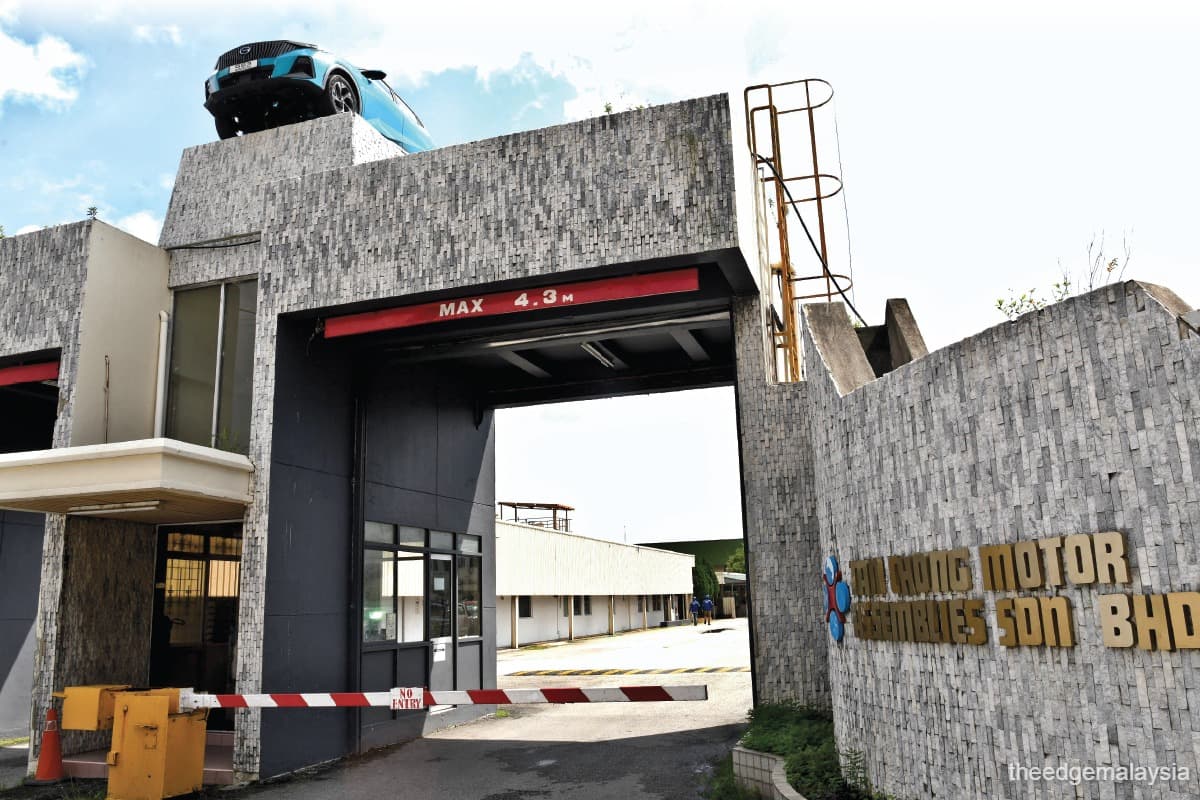
Although many of the auto-related businesses still operate there, the plant itself is relatively quiet as Nissan now has just a 1% market share. The sluggish state of its auto operations is underscored by the fact that the Segambut land, with a book value of RM515 million, is worth more than twice the company’s auto business — as reflected in its current market capitalisation of around RM200 million. At its peak in 2013, the company’s market cap exceeded RM3 billion.
Like most other distributors of mass-market foreign brands, Tan Chong’s dominance began to wane with the emergence of Malaysia’s own carmakers, Proton and Perodua, from the mid-1980s onwards.

But the decline became more pronounced in the past decade, which saw more bad years than good for the company.
In seven of the past 10 years, the group was in the red, owing largely to growing competition in the highly competitive car industry, a regional expansion that did not yield the desired results as well as foreign exchange losses.
Despite its choppy bottom line, however, Tan Chong as a group has always recorded a surplus in its earnings before interest, taxes, depreciation and amortisation (Ebitda), which reflects the cash that its operations generate. Effectively, this meant the company did not need to dig into its cash reserves to run its operations. Still, this is not sustainable in the long run unless the core business sees a significant turnaround.
Apart from its operations in Malaysia, Tan Chong operates assembly plants in Vietnam and Myanmar and holds the exclusive distributorship for Nissan cars and spare parts in Cambodia, Laos and Myanmar.
The bedrock of the group has traditionally been its Malaysian operations, especially the manufacturing and sales of auto parts done through its subsidiary, APM Automotive Holdings Bhd (KL:APM).
The Malaysian operations have always had a healthy Ebitda and been able to mitigate the losses of the regional operations and make up for the poor sales of Nissan cars.
Nevertheless, the group’s Ebitda has been declining in the last six years and finally fell into deficit in the latest unaudited results, which closed at end-December 2024 (see table). Tan Chong posted a loss of RM214.2 million — its biggest-ever — on revenue of RM2.1 billion. And for the first time in recent history, Tan Chong registered a deficit in its Ebitda: RM7 million at end-2024 compared to a surplus of RM86.7 million in 2023. The negative Ebitda came about from rising operational costs, foreign exchange losses, slower sales of Nissan models and continued losses at the group’s regional operations.

In relation to slower sales, even Nissan of Japan has experienced a drop in recent years because of less popular models and the advance of EVs. Nissan of Japan saw its sales fall from 5.5 million vehicles in 2018 to 3.3 million in 2024.
As for Tan Chong, its performance has been hampered by not only weak Nissan car sales but also losses at its regional operations — particularly in Vietnam — which continue to erode the group’s profitability.
According to unaudited accounts for the financial year ended Dec 31, 2024 (FY2024), Tan Chong’s Malaysian operations recorded an Ebitda of RM34.7 million on a turnover of RM1.9 billion. Turnover at the Vietnam operations was a measly RM37.9 million and Ebitda a negative RM42 million, indicating huge losses at the operations in that country.
According to an analyst, Tan Chong’s Vietnam operations incurred huge marketing costs related to the distribution of cars from GAC Motor of China.
A close look reveals that the Vietnam unit had posted negative Ebitda in seven of the past eight years. The exception was in 2018 when it recorded a positive Ebitda of RM12.4 million.
A year earlier in 2017, the Vietnam operations registered a negative Ebitda of RM36.1 million. The geographical segmental results of Tan Chong are not publicly available for the years before 2017.
Tan Chong started its regional expansion in 2010 to capitalise on Nissan’s global vision of selling 500,000 cars in Asean by 2016. In that period, Nissan was headed by the then CEO, Carlos Ghosn, who was also chairman of the Renault-Nissan Alliance.
Ghosn was unceremoniously relieved of his duties in 2018 and later did a dramatic escape from Japan to Lebanon to evade charges of financial fraud.
Tan Chong’s regional expansion was also aimed at reducing its reliance on the Malaysian market, where rising raw material and labour costs were affecting operations, while preserving its competitive edge built over a 60-year partnership with Nissan.
The national auto policy, in place since the mid-1980s and favouring national car models such as Proton and Perodua, has also worked against Tan Chong.
The group’s relationship with Nissan was the cornerstone of its rise as an auto giant in Malaysia. Prior to Proton’s entry in 1984, Nissan consistently led the market in car sales, followed by Toyota.
Regional expansion
Tan Chong’s regional expansion, aimed at mitigating its loss of market share in Malaysia, sought to leverage its longstanding relationship with Nissan and capitalise on the high-population, low-cost markets of Vietnam, Cambodia, Laos and Myanmar.
In 2010, Tan Chong formed a partnership with Nissan in Vietnam by acquiring a 74% stake in Nissan Vietnam Co Ltd from Denmark’s Kjaer Group A/S, with the remaining shares held by Nissan of Japan. Nissan Vietnam Co was the sole distributor of Nissan models in the country.

By the first quarter of 2017, Tan Chong had also begun operations at an assembly plant in Myanmar. That same year, regional sales accounted for 17% of the group’s total revenue.
In FY2018, Tan Chong’s regional expansion into Vietnam began to show positive results, generating an Ebitda of RM12.4 million — the first time its operations in the country became profitable.
In December 2018, however, Tan Chong’s Vietnam investment was dealt a big blow when Nissan of Japan decided to terminate the agreement granting sole distribution rights to Nissan Vietnam Co — in which Tan Chong held a majority stake — to take effect in mid-2019. This shift in Nissan’s global strategy also coincided with the ouster of Ghosn from Nissan.
Tan Chong’s regional expansion drive was further undermined by the 2021 military coup in Myanmar.
Despite these setbacks, Tan Chong remains confident. In response to questions from The Edge, the group emphasised that its investments in markets such as Vietnam and Myanmar were for the long term and strategic.
“The group continues to be the exclusive distributor of Nissan vehicles for Myanmar, Cambodia and Laos. Tan Chong remains active in the Vietnam auto market. With the encouraging economic growth in Vietnam, Tan Chong is well positioned to capitalise on the growth opportunities there,” it says.
Before Nissan’s termination of the Vietnam venture, Tan Chong’s operations in the country involved assembling popular Nissan models, including the X-Trail and Nissan Sunny. Now, the Vietnam plant produces, among others, TQ-branded light trucks and King Long buses. In addition, last year, TCMH Vietnam was appointed the exclusive agent for the import and distribution of GAC models, including its MPVs and SUVs. “The GAC models have been well received in Vietnam,” the company says.
According to analysts, Tan Chong is hoping to assemble GAC models in Vietnam in the future.
Of its Myanmar operations, which it wholly owns, Tan Chong says: “Over the years, we have sold many Nissan cars in Myanmar and, today, we continue to assemble and distribute Nissan vehicles in that market. As the official Nissan importer and distributor, we endeavour to provide sales and after-sales service support to all our customers in that country. Myanmar’s auto sector remains robust and we continue to see healthy demand for our products and services.”
To counter the reversal in profitability, Tan Chong is executing a strategic plan that includes launching new models in the coming quarters through its partnerships, while driving operational efficiencies and cost controls.
Tan Chong states that despite current competitive market conditions, it remains optimistic about its long-term prospects, citing strong fundamentals that position the group to stay resilient and capitalise on growth opportunities.

New models lack traction
Despite the confidence expressed by Tan Chong, the reality is that its share of the domestic market has declined over the years.
In 2015, Nissan’s market share in Malaysia was 7% of the total industry volume (TIV) of 666,674 vehicles. In 2024, its market share fell to a mere 1% of a TIV of 833,000 vehicles.
The lack of new models from Nissan and the entry of cheap EVs from China have affected Tan Chong, along with other non-national car companies in Malaysia.
Last December, Tan Chong launched the Nissan Kicks e-POWER, a compact SUV. Powered by Nissan’s e-POWER technology, it offers an EV-like driving experience without the need for external charging. The positive market response, according to the group, bodes well for the rollout of more e-POWER models.
Apart from the Nissan e-Power models, Tan Chong’s assembly plant in Serendah started production of the Nissan Serena MPV for export to Thailand.
“This marked an important milestone for the group,” the company says.
Analysts say the start of the export programme could pave the way for the group to explore further export opportunities in the region with Nissan.
“New export markets should increase the utilisation of the Serendah plant. In addition, the appreciation of the ringgit against the US dollar should help Tan Chong in the current year of operations,” says an analyst.
In Vietnam, another analyst notes, sales of Tan Chong’s GAC models have boosted operations, with sales volume doubling in the fourth quarter of last year on the back of strong market reception.
“Management expects favourable sales in 2025, potentially turning around the Vietnam operations. As higher volume takes place in 2025, management may explore completely knocked down (CKD) options with the GAC principal,” the analyst adds.
Tan Chong’s partnership with Nissan spanning more than six decades has been the backbone of the company’s position as an auto giant. But Nissan itself is struggling and a merger with its rival Honda cannot be discounted.
If the merger materialises, it could pose another challenge to Tan Chong’s regional expansion as the new management of the merged entity may pursue a different strategic direction.
Save by subscribing to us for your print and/or digital copy.
P/S: The Edge is also available on Apple's App Store and Android's Google Play.