

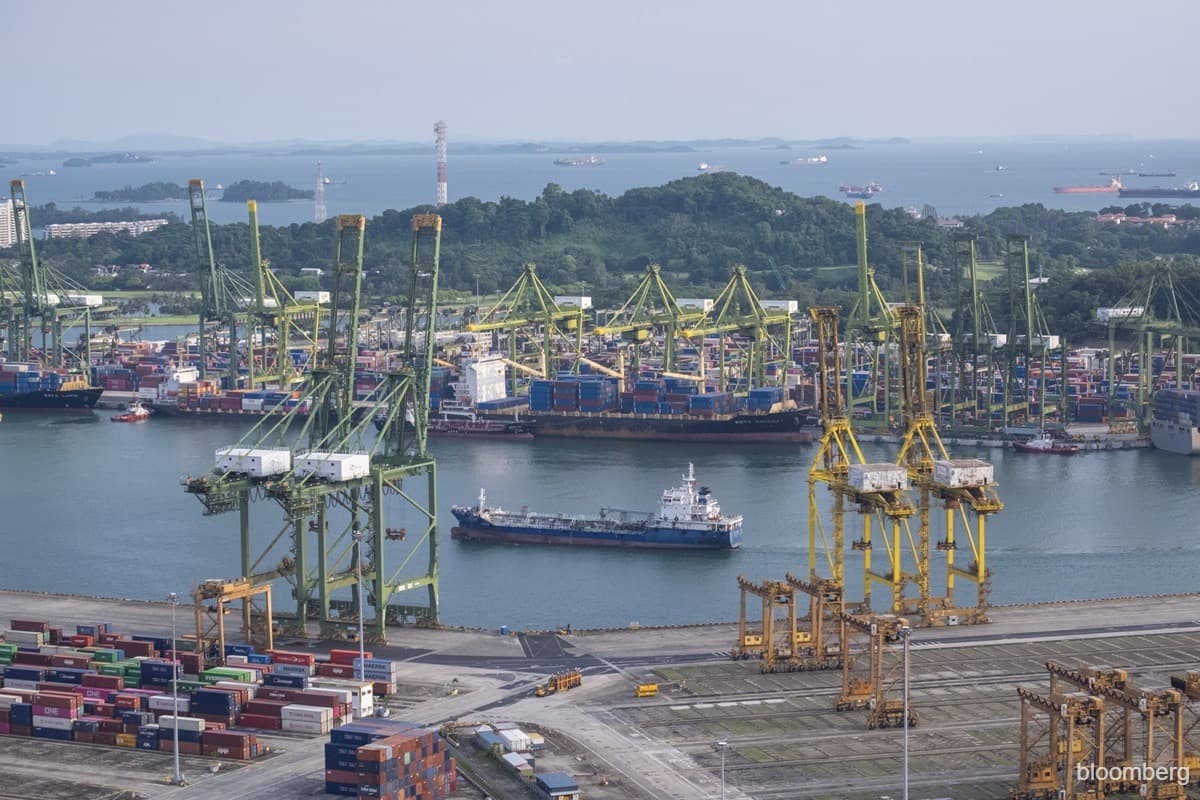
THE architecture of globalisation, once deemed irreversible and indomitable, is now showing signs of profound fragility. With US President Donald Trump’s administration unleashing on the global economy its harsh logic of punitive tariffs — then pausing them unilaterally, as if tossing the keys to a vault he himself had sealed — the very mechanics of global trade are now suspended in an eerie, uncertain vacuum. The global economic order, long governed by predictable flows of goods, capital, and services, is being unmade not by war, but by something far more insidious: capricious economic nationalism.
Trump’s new phase of “paused tariffs” on allies such as Japan, the European Union (EU), and Mexico — while sustaining or escalating duties on China up to a theoretical maximum of 245% — has created a condition not of decoupling alone, but of systemic ambiguity. The world no longer knows whether tariffs are a temporary leverage or permanent fixture. Such ambiguity casts a long shadow over the future of globalisation, threatening to render it not only uncertain, but reversible.
The damage is already quantifiable.
According to the Organization for Economic Co-operation and Development’s (OECD) March 2025 Economic Outlook, global gross domestic product (GDP) growth is expected to fall to 2.6%, a sharp drop from the 3.1% projected only six months prior. The reasons? A toxic mix of trade barriers, slowing investment, and falling consumer demand — all directly traceable to the ripple effects of the US-China trade dislocations. OECD secretary general Mathias Cormann warned that “uncertainty is the new tax,” where companies delay investment and innovation for fear of retaliatory sanctions or sudden tariff changes.
Similarly, the World Trade Organization (WTO) has projected global merchandise trade volume growth to stagnate at 0.8% for 2025, down from the already tepid 1.7% in 2024. The WTO attributes this contraction to persistent geopolitical tensions, supply chain restructuring, and what it diplomatically terms “policy-induced distortions” — a euphemism for America’s erratic trade strategy.
The International Monetary Fund (IMF), in its latest World Economic Outlook, estimates that continued tariff tensions between the US and China — combined with strategic export controls — could shave off 1.5 percentage points from global output by 2026. For the Asia-Pacific region, this is a near-catastrophic drag, with countries like Malaysia, Vietnam, and Thailand seeing their export-dependent sectors battered by both falling Chinese demand and diverted US sourcing strategies.
Credit rating agencies are equally alarmed. S&P Global Ratings warns of “systemic risk pricing” creeping into bond markets, especially in economies reliant on open trade. Moody’s Investors Service, in a recent bulletin, described Trump’s tariff pause as “the eye of the storm,” cautioning that financial markets should prepare for “recurring volatility” as tariff policy becomes a tool of presidential discretion, rather than institutional negotiation.
At the heart of this upheaval is the strategic globalisation of the US-China trade relationship. Once intertwined through complex supply chains and complementary consumption patterns, both countries are now deliberately disentangling. What started as “decoupling” has morphed into “deglobalisation” — a painful process by which redundancies are built into logistics, and new ideological litmus tests are introduced into what were once pure cost-benefit analyses.
Take semiconductors. As Taiwan Semiconductor Manufacturing Company (TSMC) builds a multi-billion-dollar foundry in Arizona, China accelerates its own chip independence drive with hundreds of billions of yuan in subsidies and measures to address industrial espionage risk. The race to “nationalise” strategic industries is fracturing what was once a global innovation ecosystem.
But this isn’t merely about technology. It’s about trust.
When Trump lifts tariffs for some and intensifies them for others, he doesn’t just challenge the principles of the WTO — he erodes the very idea of the rules-based order. Markets are no longer governed by comparative advantage, but by comparative alignment. Who aligns with Washington (or is perceived to) now determines tariff relief or punishment. In this new world, policy coherence is no longer a global public good. It is a transactional weapon.
For Asean, the implications are particularly stark. Despite efforts to build regional resilience through Regional Comprehensive Economic Partnership (RCEP), the Asean-EU Free Trade Agreement (FTA), and bilateral digital economy agreements, the region remains deeply vulnerable to external shocks. Malaysia, for instance, continues to trade more than 130% of its GDP, leaving it exposed to every twitch of Trump’s tariff pen. Thailand’s automotive supply chains are split between Japan and China. Vietnam’s export-led growth depends heavily on both US and Chinese markets. Decoupling for them is not a theory. It is an existential dilemma.
What then becomes of globalisation?
As the Hungarian sociologist Karl Polanyi once argued, markets are never self-regulating — they require the scaffolding of social norms, political will, and institutional trust. When these collapse, as they are doing now under the pressure of hyper-personalised trade wars, “all that is solid melts into air”. Even the ideological underpinning of globalisation — interdependence as a peace mechanism — is being questioned.
There is no going back to the 1990s-era euphoria of liberal trade. But there may still be a path forward, if regions like Asean and the EU act swiftly to conclude FTAs and deepen their internal integration. The EU-Asean FTA, still stuck in negotiation purgatory, must be completed not for symbolic gains but as a firewall against external shocks. Carbon Border Adjustment Mechanisms, digital economy pacts, and mutual recognition of standards must be approached not as bureaucratic checkboxes, but as strategic tools of survival.
Trump’s tariff pause is not a détente. It is a test — of whether the rest of the world can design a new global order, even as the old one is dismantled in real time.
To fail this test is to concede that the global economy is now held hostage, not by market forces or institutional reform, but by one man’s political mood.
And in such a world, nothing — not even globalisation — is too big to fail.
Dr Phar Kim Beng is professor of Asean Studies at the International Islamic University of Malaysia and senior research fellow at the Asia Europe Institute, University of Malaya.