

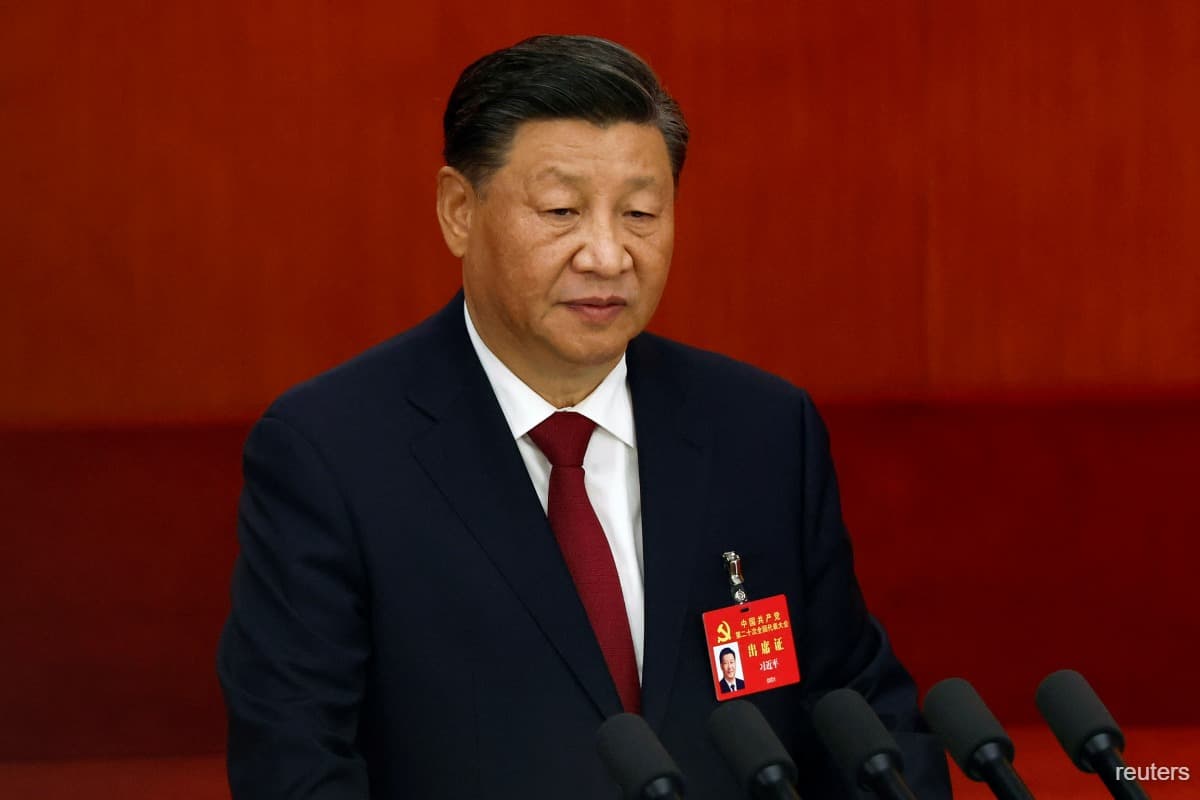
KUALA LUMPUR (April 15): CGS International anticipates Chinese President Xi Jinping’s visit to Malaysia could pave the way for potential developments beyond trade, particularly in key areas such as infrastructure, industrial parks, technology, and commodities.
The key areas include the Kuala Lumpur–Singapore High-Speed Rail (HSR), Malaysia-China Kuantan Industrial Park (MCKIP), Forest City, semiconductors, data centres, and palm oil.
CGS International, in a note on Tuesday, said the proposed revival of the HSR, likely to follow a design-finance-build-operate-transfer model, may attract Chinese participation and potentially bridge the funding element.
Additionally, potential collaboration or investments from China are anticipated in Malaysia’s semiconductor ecosystem and data centre sector.
The research house noted that there could be potential announcements of investments in the MCKIP and Johor's Forest City development.
While MIDF Research believes Xi’s visit is unlikely to have a significant impact on palm oil trade due to China’s persistently weak fundamentals amid escalating tariff tensions, CGS International sees the possibility of China — Malaysia’s second-largest palm oil buyer in 2024 — pledging to increase its purchases.
Xi’s visit expected to deepen Malaysia–China ties amid US tariffs
During this "critical time", Xi is set to begin a three-day visit to Malaysia starting on Tuesday, aimed at strengthening economic ties and addressing concerns over the impact of US-China trade tariffs on both nations, MIDF Research said.
"Overall, the Malaysia–China trade relationship remains resilient and is poised for further growth, underpinned by improving economic conditions and deepening bilateral cooperation," the research house said, adding that both countries are expected to expand bilateral trades as part of a diversification strategy amid US tariffs and a gradual shift away from reliance on the US market.
Separately, MIDF Research forecasts China’s economic growth to stay around 5% in 2025, despite the 145% US tariffs on Chinese goods, supported by robust domestic spending.
"The potential impact of a trade slowdown on China's economic growth is expected to be mitigated by its reduced reliance on external demand, with post-pandemic growth primarily driven by robust domestic consumption," the research house said.
"This strategic shift towards a more domestically driven growth model is intended to insulate China's economy from external uncertainties and the volatility of the global trade outlook," it added.
Several sectors are benefitting from the strengthening China–Malaysia ties, prompting MIDF Research to maintain a positive outlook on construction, property, real estate investment trusts and utilities.
While the technology sector is also expected to gain from closer bilateral relations — with China being the second-largest market for electronic devices after the US — MIDF Research maintains a neutral stance on the sector.
The research house also maintains a neutral outlook on the transportation sector, noting that it could gain confidence following Xi’s visit, driven by stronger travel ties and limited exposure to US–China trade tensions.
Similarly, MIDF Research retains a neutral view on the plantation sector, citing signs of weaker consumer sentiment and reduced market spending in China, which suggests a potential softening in demand.
China remains Malaysia’s second-largest trading partner, driving steady trade growth
China remained Malaysia’s second-largest trading partner in 2024, accounting for 17% of Malaysia's overall trade, playing a key role in the country's external trade landscape as Malaysia’s trade with China continued to grow steadily over the years, according to MIDF Research.
In a statement on Tuesday, the research house noted that Malaysia’s trade with China climbed to RM2.88 trillion in 2024, rising from RM1.88 trillion in 2018, despite a decline in 2020 due to the pandemic.
However, the trade deficit more than tripled over the same period, widening from RM35.8 billion to RM108.8 billion, as imports from China grew faster than exports. This rising imbalance highlights Malaysia’s growing reliance on Chinese goods, particularly in the manufacturing sector, said the research house.
Malaysia’s exports to China remain well diversified, with key products being electrical and electronic (E&E) products (36.3%), chemicals (9.7%), liquefied natural gas (8.2%), and metal products (7.1%), while the remainder comprises a wide range of other goods.
On the imports side, Malaysia is heavily dependent on Chinese manufactured goods, which made up 95.6% of total imports in 2024. The top categories were E&E products (40.3%), machinery and parts (12.5%), chemicals (8.1%), and metal products (6.3%), while the remaining 32.8% covered various other items.
"The high share of E&E imports supports Malaysia’s role in the global electronics supply chain, especially in packaging and testing. Despite the trade gap, Malaysia can benefit from global trade shifts, especially in backend E&E services, as trade tensions persist between major economies," the research house said.
It also highlighted that foreign direct investment from China is primarily fuelled by supply chain diversification, as multinational corporations look for alternatives amid US-China trade tensions, with Malaysia’s robust semiconductor and electronics sectors serving as key attractions.