

This article first appeared in Forum, The Edge Malaysia Weekly on April 14, 2025 - April 20, 2025
The first day of Hari Raya Aidil Fitri is often a hectic one for my wife and me as both our families live not far from each other. I live in Putra Heights, my in-laws in USJ Heights, both in Subang Jaya, while my late parents’ house is in Shah Alam.
So, there is no problem with having to balik kampung on alternate years during Raya, but this also means one has to spend the whole day and night visiting relatives.
Still feeling tired on the second day (April 1), after the fajr prayers, I decided to take a nap around eight in the morning, anticipating another busy day, despite hearing the irritating roar of a jet plane flying overhead.
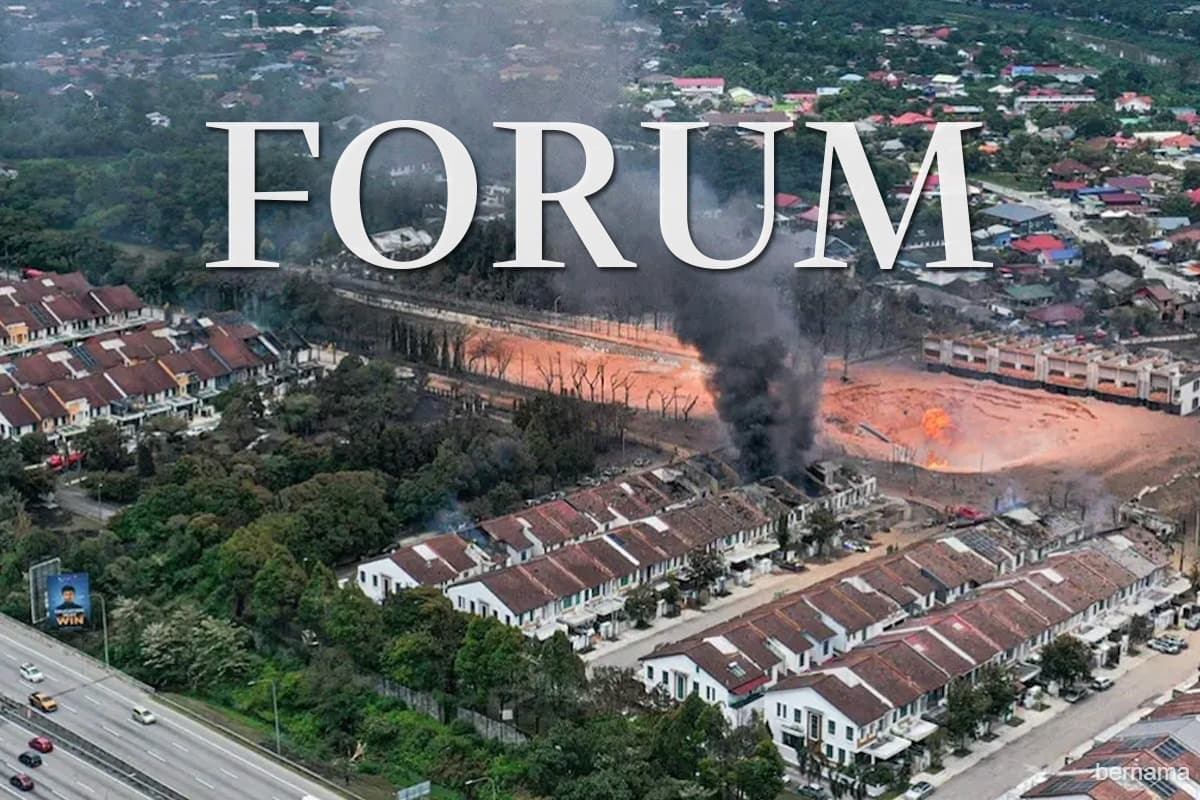
As I was about to doze off, my wife came running into the room, saying there was a huge fire nearby. We ran upstairs to my son’s room and from the balcony saw flames soaring high into the sky, reaching the height of the nearby Bukit Cermin.
The fire must have been about 3km to 4km away, but we could feel the intense heat (which was reported to reach over 1,000°C) and the glass sliding door was rattling.
“It must be the gas pipeline,” I told my wife and children. It’s the same kind of flame that I used to see flaring from refineries, offshore oil and gas (O&G) platforms and onshore plants, but this was hundreds and perhaps a thousand times larger.
The neighbours were panicking; some decided to leave the area but we stayed behind after checking with Petronas officials, who confirmed that the situation was under control. The valve was shut and the affected pipeline isolated. The flame would continue burning, though, until the remaining gas in the isolated pipeline burned itself out.
My familiarity with this gas pipeline, which is part of the 2,600km Trans Peninsular Gas Utilisation (PGU) project, stems from my experience covering the O&G sector as a journalist. From the mid-1980s to the early 1990s, during various site visits, I stayed on the offshore platform of Terengganu, saw the construction of the gas processing plants (GPPs) in Kertih and the laying of pipelines across Felda settlements in Pahang.
There were also briefings on the economic benefits of the PGU and safety measures as aspects of the whole system. I also visited the Petronas Supervisory Control and Data Acquisition (SCADA) facility in Segamat, Johor, which is the system used to monitor and control their pipeline operations, ensuring safety and reliability, and allowing for real-time data acquisition and analysis. If I recall correctly, the trans PGU pipeline system has a shelf life of between 40 and 50 years.
Following the explosion, many questions were raised about the safety and the integrity of the trans PGU project. There are many versions of how it could have happened but let’s wait for the full investigation, which requires engineering and forensic studies too. Finding the root cause of the problem — which is a must so that such incidents can be avoided — takes time.
For now, the area surrounding the explosion has been cordoned off, and a soil stability study needs to be completed before an in-depth investigation starts.
In the meantime, let us not speculate and play the blame game. Fortunately, there were no fatalities despite such a big explosion. What was reassuring was the quick safety and rescue response from the authorities.
There has been strong support from the community, non-governmental organisations and stakeholders as various forms of aid have been channelled to the victims, including medical help, cash assistance, transit house rental aid and free car rental. The restoration and reconstruction of some homes have already started. Politics, for once, has taken a back seat to Malaysia’s spirit of multiculturalism.
One question that I get asked quite often is why the gas pipeline was constructed near residential areas. The PGU project, which connects the whole of Peninsular Malaysia with gas resources from offshore Terengganu, started in 1984 and was completed in the 1990s. In places like Putra Heights, the pipeline was laid long before the township was completed by Sime Darby Property Bhd (KL:SIMEPROP). In many other areas, the pipeline came first, before there was commercial development.
Why the trans PGU was built
For a long time, the nation’s O&G resources were controlled by foreign multinationals under the concessionaire system. Prior to the enactment of the Petroleum Development Act (PDA), the concessionaires were the owners of the exploration and production (E&P) blocks, with the government getting little revenue in the form of taxes.
The PDA, which was passed by parliament (supported by members of parliament from Sarawak and Sabah too) in 1974, allowed for the establishment of the national oil corporation Petroliam Nasional Bhd, which became the sole owner of all hydrocarbon resources in the country. Petronas has exclusive rights, power, liberties and privileges to explore and develop these resources.
Overnight, from concession holders, the multinationals become mere production sharing contractors, which have to share revenue more fairly with the government. The multinationals then deemed the move as nationalisation but Malaysia — like many other developing countries that opted for production sharing contracts — saw it as a fairer system that would not result in them continuing to lose revenue from their own natural resources.
The PDA allows Petronas to open up the country’s offshore acreage, including those in the exclusive economic zone, to more multinationals to compete and look for hydrocarbon resources. It also participated in E&P through its subsidiary, Petronas Carigali Sdn Bhd.
As Malaysia discovered more hydrocarbon resources in the 1980s and 1990s, along with those discovered in the 1970s, it was found that the nation had about three times more natural gas resources than oil.
In the early days of the O&G industry, companies dreaded finding gas, as it was difficult to develop the fields, and find ways to transport and sell the product. To optimise returns, Malaysia opted for a two-pronged strategy.
One, where there is demand for energy like in Peninsular Malaysia, the gas would be piped from the offshore fields, processed via the GPPs in Kertih and transported through the PGU to be used by industries and power plants.
The PGU became even more relevant when Peninsular Malaysia was hit by a total blackout in the 1990s, paving the way for the entry of independent power producers (IPPs) to ensure there were enough supply and healthy reserve margins for the power and industrial sectors. Most of these fast-track IPPs used gas for electricity generation.
Gas also features prominently in the nation’s energy diversification programme, and it is viewed as the cleaner fuel, suitable to replace coal in power generation and for use in heavy industries.
Today, as gas fields off Terengganu are maturing, there is a possibility of linking gas resources from the seas of Vietnam and Indonesia to the GPPs. Alternatively, Malaysia is building more regassification terminals (RGTs) so it can land liquefied natural gas (LNG) tankers to feed gas to the PGU network. In Peninsular Malaysia, there are two RGTs, in Sungai Udang, Melaka, and Pengerang, Johor. A third is expected to be built in Lumut, Perak.
This means that the PGU system, which will be upgraded, can be used for many more years and remains key to powering the country’s industrial growth.
The second strategy was for places where there was not enough domestic demand, like in Sarawak and Sabah in the 1970s and 1980s. For Sarawak, the gas optimisation route was through the construction of an LNG plant in Bintulu.
Here, the processed gas is cooled to extremely low temperatures into a liquid state that can be stored and transported via LNG tankers to export markets in Japan, South Korea, Taiwan and China. Today, the Bintulu Malaysian LNG plant, with nine trains and a production capacity of 30 million tonnes per year, is among the largest in the world.
The PDA allows Petronas to develop the nation’s gas resources throughout the supply chain via the gas fields, GPPs, PGU, Malaysia LNG, floating LNG facilities, RGTs and LNG tankers. In the shipping company MISC Bhd (KL:MISC), Petronas has one of the largest LNG fleets in the world, behind the Canadians, Japanese and South Koreans.
These domestic linkages and experience have allowed Petronas to become an important global gas player too, with overseas gas assets in Canada, Australia, Egypt, Argentina, Iraq, Brazil, the UK, India, Pakistan, UAE and Turkmenistan.
Aftermath of explosion
The outcome of the investigation into the Putra Heights explosion will not be finalised soon but there are a lot of lessons to be learnt from the tragedy.
For Petronas, it might be the right time to revisit the history of the PGU and tell the story of its gas businesses and how it has and continues to benefit the nation. First and foremost, it needs to make sure the integrity of the PGU remains intact and determine what improvements can be made in terms of safety and surveillance. It has to keep its stakeholders updated, notably the communities residing in areas along the PGU network.
Local municipalities need to strengthen their monitoring systems and take strict action against those who are encroaching into the safety buffer zones. In USJ, not far from Putra Heights, there are already postings over social media on alleged farming activities in these buffer zones. In Malaysia, encroachment into the reserve land of the PGU, electricity company Tenaga Nasional Bhd (KL:TENAGA), railway operator Keretapi Tanah Melayu and water utilities has been a problem for many years.
If contractors or developers get the right of way to do work in the buffer zones, who will do the monitoring, alongside the local municipalities, to ensure that they follow the standard operating procedures and stop work if they are compromised?
For companies that want to develop areas near pipelines into commercial or residential properties, it would be better for them to extend the buffer zone further instead of just meeting the minimum distance requirement.
For those who live in Putra Heights and frequently use the road near the explosion site to reach Putra Avenue and Kampung Kuala Sungai Baru, many have questioned why Sime Darby Property, as the master developer, put that small plot of land at the explosion spot up for sale instead of just planting more trees there.
Many residents were surprised to see that the small plot could acccomodate a row of shophouses and ample parking space, raising the question if indeed the Petronas buffer zone had been encroached on during construction.
For property buyers who are likely to make the largest investment in their lifetime when purchasing a house, the lesson to be learnt is to be aware of the surrounding areas — if it is near a gas pipeline, a river or on a hill slope for that matter. I was surprised to hear that one of the residents, who has lived there for 15 years, was not aware of the gas pipeline and thought it was a water pipeline.
As for me, by the time this article is published, I would have attended the April 12 town hall meeting for residents of The Glades regarding the Gas Malaysia LPG reticulation system, which supplies piped gas to our homes.
Although it is not connected to the PGU pipeline and this is an enclosed LPG reticulation system, supplier Gas Malaysia had conducted a preliminary safety test following the April 1 explosion at Putra Heights. The test conducted on April 5 showed there was a pressure drop that could indicate there is a leak within the system.
I would not be surprised if residents vote for the LPG reticulation system to be shut down. Piping gas straight to the kitchen might be convenient and look good for a designer kitchen, but after the April 1 incident, many may just opt for the good old-fashioned LPG tank.
Azam Aris is an editor emeritus at The Edge
Save by subscribing to us for your print and/or digital copy.
P/S: The Edge is also available on Apple's App Store and Android's Google Play.