

This article first appeared in City & Country, The Edge Malaysia Weekly on April 14, 2025 - April 20, 2025
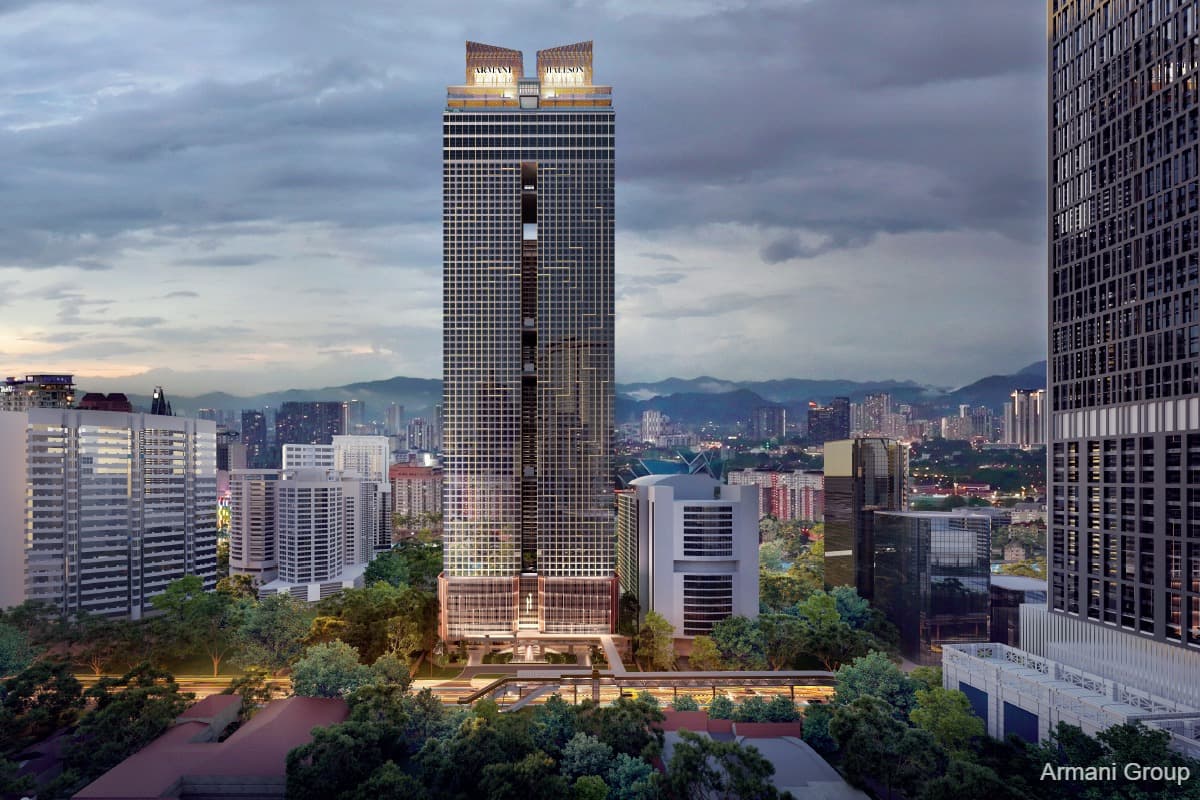
The 2.61-acre freehold land on Jalan Ampang, Kuala Lumpur, that was previously home to SJKC Lai Meng will be soon developed into a mixed-use project called Armani Hallson KLCC by the Armani Group.
Chris Yong, deputy CEO of the Armani Group, says the development consists of small office home office (SoHo) and small office versatile office (SoVo) units, and has an estimated gross development value (GDV) of RM3 billion.
“We are extremely excited about this project; it’s one of our most iconic to date,” he says in an interview with City & Country, adding that the targeted launch date is in May.
Armani Hallson KLCC will feature 775 SoHo units in one block (the 68-storey Block C) and 1,440 SoVo units in two blocks (the 78-storey Block A and B). The SoHo units range from 538 to 558 sq ft, while the SoVo units range from 406 to 1,182 sq ft. Prices start at RM1,600 psf.
The land was acquired by Magna Prima Bhd’s (KL:MAGNA) wholly-owned subsidiary Twinicon (M) Sdn Bhd from the Lai Meng Girls School Association in 2014 for RM148.15 million. In January last year, Magna Prima announced its collaboration with Golden Rainbow View Sdn Bhd — a subsidiary of Armani Group — to jointly develop the project.

Luxurious living
Maria Wan Malek, COO of Armani Group, says Armani Hallson KLCC is distinguished by its concept of luxurious living in a tropical resort setting. The development features ample facilities, including a 30,000 sq ft tropical garden on Level 10.
“We aim to introduce a new living concept for our residents. On Level 10, we have a tranquil lagoon, waterfall, floating steps, floating tea pavilion, zen garden, barbecue lounge, lawn, herb garden and more,” says Maria.
“The tropical garden is designed for the residents to avoid a claustrophobic feel, especially for [those in] units facing each other when they look down from their units. We’re the first to create this kind of urban living with a beautiful garden that features a waterfall and a glass-covered passage running through it. By offering these views, we want to create a sense of tranquillity.”
She adds that this is a departure from conventional offerings by other developers, as it ensures that no matter the direction or view from a unit, there is always something exciting to look at.
To further emphasise the luxury theme, Armani Hallson KLCC offers over 80 types of facilities on various levels, including an open terrace on SoHo block Level 33; swimming pool and Jacuzzi on SoHo block Level 67; gymnasium on SoHo block Level 68; swimming pool, Jacuzzi, onsen, hydro spa and heated pool on SoVo blocks Level 76; multipurpose hall and gymnasium on SoVo blocks Level 77; and viewing deck on SoVo block Level 78.

Maria highlights that the sky-level facilities in the SoVo blocks will provide breathtaking panoramic views of the Kuala Lumpur skyline, showcasing all four iconic skyscrapers — the Petronas Twin Towers, The Exchange 106, Merdeka 118 and KL Tower. The estimated maintenance fee, inclusive of the sinking fund, is 95 sen psf.
“SoHo residents can use the facilities in the SoVo blocks, but not the other way around,” she adds.
On the difference between SoHos and SoVos, Yong says the former fall under the Housing Development Act, making them suitable for residential living, while the latter do not. However, due to market demand, many people choose to live in SoVo units (judging from registrations).
“The Ministry of Housing and Local Government (KPKT) does not prohibit people from residing in SoVo units as long as the majority of the purchasers agree. We have voluntarily informed KPKT of our intention to allow buyers to live in the SoVos,” he says.
As a transit-oriented development, Armani Hallson KLCC will have covered walkways connecting it to the Bukit Nanas monorail station and the Petronas Twin Towers, which in turn offer access to the KLCC LRT station.
“We opened for registration in March, and the response was very positive. Our target market includes both local and international owner-occupiers and investors. Based on the response to our previous projects, we are confident in selling out this development,” says Yong.

Relationship with Magna Prima
Founded in 2010, the Ipoh-based Armani Group is led by Datuk Seri Bryan Wong Sze Chien and Datuk Seri Azlan Azmi. The company is involved in a diverse range of ventures in property development, construction, renewable energy, bakery, furniture and plantations.
The group also owns shares in several listed companies, such as Tafi Industries Bhd (KL:TAFI) and Scanwolf Corp Bhd (KL:SCNWOLF). Wong is also CEO of Tafi.
Yong says Armani Group’s relationship with Magna Prima began when it acquired land from the latter to develop the Armani Signature Residence at Sultan Abdul Aziz Shah Golf and Country Club in Shah Alam, Selangor.
“We launched that project in November 2023, and now the take-up rate is over 80%. This built our confidence with Magna Prima, leading them to open up their pot of gold, the Lai Meng school land, for us to develop. Magna Prima is the landowner, and we have the full development rights.”
Wong and his partner Seah Ley Hong have emerged as substantial shareholders of property developer Magna Prima through their private vehicle, Edxus Solutions Sdn Bhd.
On Sept 27 last year, Edxus Solutions acquired 95 million shares or a 23.91% stake in Magna Prima via a direct business transaction, its filings with the stock exchange showed. Following the acquisition, Edxus Solutions has become the largest shareholder with 26.93% interest in Magna Prima.

RM4 billion worth of launches in 2025
Maria says Armani Group has planned RM15 billion in launches over the next five years, of which RM4 billion will be launched this year.
Among the launches for 2025 are mixed-use development Armani Putra in Dengkil, Selangor (GDV: RM350 million, 5.07 acres); commercial office lot development Armani Perdana in Damansara Perdana, Selangor (GDV: RM150 million, 0.994 acres); shoplot development Pekan Perdana Commercial Centre in Pahang (GDV: RM40 million, 6.116 acres); mixed-use development Armani Cheras, Kuala Lumpur (GDV: RM200 million, 0.59 acres); residential development Armani Avani in Sungai Long, Selangor (GDV: RM180 million, 4.096 acres); mixed-use development Setia Alam phase 2, Selangor (GDV: RM600 million, 4.98 acres); industrial development in Klang, Selangor (GDV: RM500 million, 9.32 acres) and Armani Hallson Bukit Bintang (GDV: RM2 billion, 1.69 acres).
“We don’t keep land for too long. That’s why we have plans for the next five years. Holding land for extended period strains cash flow,” says Maria.
The group has had numerous successful joint ventures, and Yong attributes these to a market-driven planning approach. “Before any land purchase, we engage with key stakeholders, such as bankers, valuers and marketing partners, to understand the area’s needs. Whether buyers want larger units with ample parking or easy access to public transport, understanding demographics is key to project success.”
“This disciplined approach leads to tangible results, with most recent launches achieving over 80% take-up rates, and some even reaching 90% within the first year,” Maria says.
Yong adds that this strategy allows Armani Group to manage the ongoing challenge of rising construction costs, ensuring efficient partnerships and cash flow management.
“We’re fortunate to have Vestland Bhd (KL:VLB) as our main contractor. Their design-and-build model allows us to keep costs under control while managing project cash flow. This synergy is crucial as construction costs rise.”
Wong also owns a 0.74% stake in Vestland.
Another challenge lies in the increasingly stringent compliance requirements from local councils and regulatory bodies. While the group respects these regulations, Yong emphasises that they contribute to higher development costs. To address this, Armani Group stays actively engaged with local authorities to ensure policies remain practical and implementable.
Yong also points out that barriers to entry are growing more significant, increasingly turning the industry into a game dictated by economies of scale.
“The ability to control costs comes from volume and established relationships. Over the years, we’ve built strong partnerships with bankers, contractors and suppliers. These relationships are difficult for new players to replicate.”

An optimistic outlook
Yong is optimistic about the market outlook, pointing out that Armani Group’s planned launches for the year reflect this.
Despite the 24% tariff imposed by the US, he remains optimistic about Malaysia’s property market, particularly in the industrial and residential segments. As global companies seek alternatives to China and higher-tariff countries like Vietnam and Thailand, Malaysia remains relatively attractive due to its moderate tariff rate and exemptions. This may position Malaysia as a strategic base for regional operations, while nearby Singapore (with the lowest tariff in the region) could act as a re-export hub, indirectly benefitting Malaysia’s logistics and real estate sectors.
“From a domestic perspective, the government is expected to step in with supportive measures, including potential interest rate cuts to cushion any economic impact and sustain private consumption. Lower borrowing costs would make property purchases more attractive, particularly for local buyers and foreign investors under programmes like MM2H, which encourages foreign ownership of properties,” he says.
“While export driven sectors may face some headwinds in the short term until things settle down, the overall market can remain resilient, supported by Malaysia’s strong fundamentals, proactive policymaking and competitive intervention. These factors suggest that property demand — especially in industrial, commercial and housing segments — could remain steady, or even grow amid global trade tensions.”
Save by subscribing to us for your print and/or digital copy.
P/S: The Edge is also available on Apple's App Store and Android's Google Play.