

This article first appeared in The Edge Malaysia Weekly on March 31, 2025 - April 6, 2025
SINCE October last year, several poultry and egg players have seen their share prices trending lower despite posting record earnings. It should be noted, though, that the higher earnings were boosted by a stronger ringgit against the US dollar in 2024.
The selling pressure comes after the government announced last year that it is reviewing the current blanket subsidy system for a more targeted approach. Last October, Minister of Agriculture and Food Security Datuk Seri Mohamad Sabu said the government was reviewing the subsidy for chicken eggs (grades A, B and C). He said the government is considering ending the egg subsidy to save RM100 million a month.
This has since sparked selling pressure in poultry and egg players, with some now trading at half of their valuation compared with one to two years ago. For instance, shares in Leong Hup International Bhd (KL:LHI) have dropped by almost 15% since last October to 63.5 sen apiece last Friday, giving the company a market capitalisation of RM2.29 billion. At the current price, the counter is trading at a trailing 12-month price-earnings ratio of 5.4 times, which is much lower than its five-year average PER of 15.72 times.
For its financial year ended Dec 31, 2024 (FY2024), Leong Hup’s net profit increased 42.2% to a record high of RM428.93 million from RM301.74 million in FY2023, despite lower government subsidies received. In FY2024, the egg and broiler farmer received RM92.10 million in subsidies, 43% less than RM161.35 million in FY2023. Meanwhile, full-year revenue declined 2.4% to RM9.31 billion from RM9.54 billion.
The group says the recent strengthening of the US dollar has reduced the cost relief from lower feed input prices. However, it expects to achieve a satisfactory performance for FY2025.

RHB Research points out that Leong Hup’s FY2024 results were “significantly” above its expectation due to stronger-than-expected profit margins as a result of favourable average selling prices (ASPs) and low feed costs. Nonetheless, the research house expects Leong Hup’s earnings to normalise from the “exceptional FY2024 base”, which was aided by the sharp depreciation of the US dollar and low effective tax rate.
“This is considering the US dollar’s rebound and lower tax credits moving forward — on top of the cyclical and volatile nature of the poultry industry, particularly in Indonesia. That said, we believe the overall fundamentals of the poultry industry have improved with the pandemic and commodity supercycle phasing out the smaller and weaker players. This has led to industry consolidation, which is favourable to the large industry players like Leong Hup,” it says in a Feb 26 report.
Meanwhile, pure egg player Teo Seng Capital Bhd (KL:TEOSENG) has seen its share price slide 15.8% since October to 99.5 sen last Friday, giving it a market capitalisation of RM588.4 million. At the current price, the counter is trading at a trailing 12-month PER of 3.22 times, which is far lower than its five-year average PER of 20.5 times.
This is despite the group posting record high earnings for the second straight year for its financial year ended Dec 31, 2024 (FY2024), at RM183.36 million, a 17.69% increase over RM155.8 million in FY2023. Its revenue for the period, however, fell slightly to RM753.77 million from RM760.98 million previously due to lower ASPs of eggs.
The group attributes the improved full-year profitability to a stronger result due to higher productivity, better cost effectiveness and stable feed costs, despite lower egg ASPs.
It is unclear how much in government subsidies Teo Seng received in FY2024. In FY2023, the group received RM104.76 million.
The other pure egg players TPC Plus Bhd (KL:TPC) and LTKM Bhd (KL:LTKM) received RM49 million and RM25 million in subsidy payments. Egg and broiler farmers QL Resources Bhd (KL:QL) received
RM133 million worth of government funding while PWF Consolidated Bhd (KL:PWF) and CAB Cakaran Corp Bhd (KL:CAB) collected subsidy payments totalling RM66 million and RM56 million respectively.
Egg players to remain profitable without subsidies
In an Oct 17, 2024, report, research house TA Securities reckons that egg producers are expected to remain profitable even if subsidies are removed, thanks to lower production costs. “Despite the potential removal of the egg subsidy, we believe poultry producers will continue to be profitable as production costs have dropped significantly year on year.
“Our findings indicate that current production costs are below the ceiling price. In the past, subsidies were necessary because the ceiling price was lower than the cost of production, making it less feasible to continue production. This resulted in egg shortages for several months in 2022 and subsidies were crucial in encouraging production during that time.”
It should be noted that before the pandemic, there were no subsidies for eggs and prices were floated until the outbreak of Covid-19 in early 2020. Subsidies for poultry and egg farmers were introduced in February 2022, after Putrajaya imposed a price ceiling on chicken and eggs as a means to keep prices stable when feedstock costs surged on the back of a commodity price boom because of the Russia-Ukraine war. This resulted in a RM3.8 billion subsidy bill for the government.
Eggs continue to receive a 10 sen per egg subsidy, amounting to about RM100 million monthly and RM1.2 billion annually.
However, the subsidies for poultry were discontinued in November 2023 after the removal of the price ceiling on chicken meat.
Stable feed cost could offset effects of subsidy removal
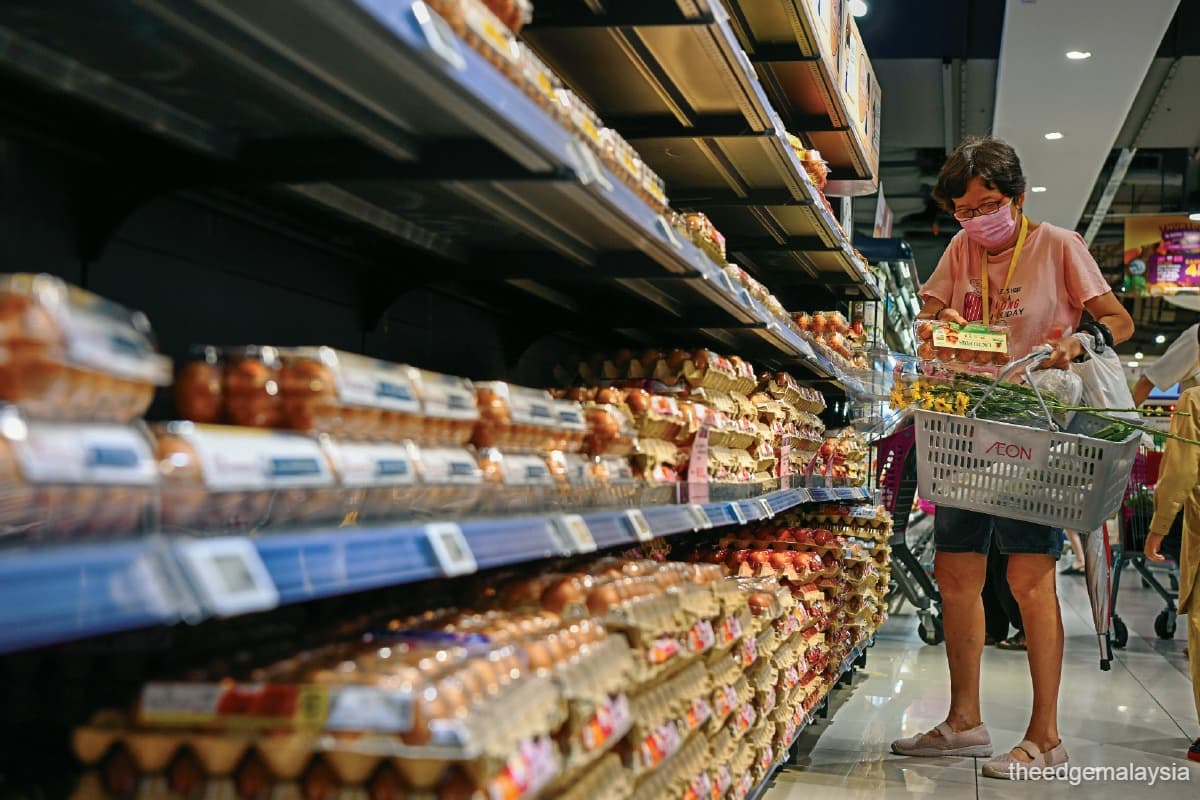
Shoppers would have realised lately that Grade C eggs are now selling at RM5.99 for a tray of 30 (refer to picture). This is equivalent to 19.66 sen per egg.
According to MIDF Research, chicken prices edged higher in January while egg prices have been on a decline, reflecting better supply conditions and easing input costs.
“The persistent year-on-year decline in egg prices is attributed to lower feed costs and improved production output, helping to stabilise supply,” it says in a March 17 report.
The research house expects poultry players to benefit from stable input costs, improving their margins despite the softer selling prices, supporting a more resilient earnings outlook.
It adds that feed constitutes 65% to 75% of poultry production costs and that the stable supply of key feed ingredients should help maintain manageable input costs, especially for major players such as QL Resources and Leong Hup. “These companies are well-positioned to capitalise on cost efficiencies, ensuring resilience amid fluctuating poultry prices.”
In addition, it is expected that a stronger ringgit will help ease import costs for food and beverage and poultry companies reliant on US dollar-denominated commodities, supporting margin recovery in sectors sensitive to raw material prices. As at last Friday, the ringgit was trading at 4.4342 against the US dollar compared with 4.7305 a year ago.
According to Bloomberg, there are five “buy” calls for Leong Hup with a consensus target price of 86 sen. Of the 14 analysts covering QL, 10 recommend “hold”, three “buy” and there is one “sell” rating. There is no coverage on Teo Seng.
Both analysts covering CAB Cakaran have “buy” calls on it, with a consensus target price of 82 sen.
There is no analyst coverage for Teo Seng, PWF Corp, LTKM and TPC Plus.
Save by subscribing to us for your print and/or digital copy.
P/S: The Edge is also available on Apple's App Store and Android's Google Play.