

This article first appeared in Forum, The Edge Malaysia Weekly on March 10, 2025 - March 16, 2025
There are two recent interconnected events that I would like to highlight. They represent key opportunities for the country, but which should also make us cautiously optimistic in the face of challenges ahead.
First, the Malaysian Investment Development Authority (Mida) recently reported that the country had attracted RM378.5 billion of approved investments in the services, manufacturing and primary sectors in 2024. This is the highest value of approved investments on record, which would see 6,700 projects being implemented, creating more than 207,000 job opportunities.
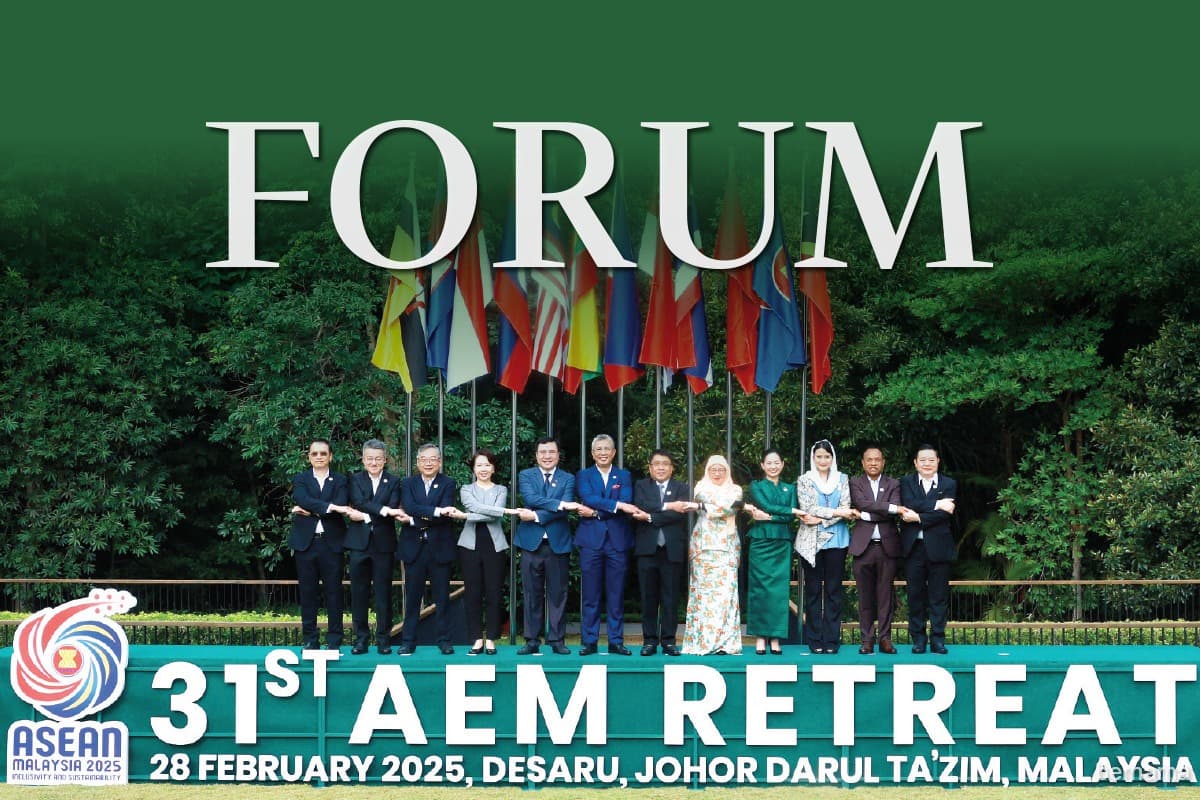
Second, we concluded the 31st Asean Economic Ministers (AEM) Retreat in Desaru, Johor, on Feb 28. The Asean trade ministers endorsed the 18 Priority Economic Deliverables (PEDs) that Malaysia, as Chair, presented for Asean’s Economic Pillar this year. These PEDs were carefully curated to support better integration of the Asean Economic Community.
Nine of the PEDs are under the direct responsibility of the Asean economic ministers while the other nine are in key areas, including climate financing, energy cooperation, critical minerals, tech startups, AI safety network, agriculture and payment connectivity.
So, what is the connection between our approved investment numbers and the nine PEDs under the economic ministers? The key bridge is each Asean country’s industrialisation policy, and how they fit each country’s strategy to continue attracting foreign investment inflow, which has contributed to Asean’s rising foreign direct investment (FDI) numbers in the last few years.
Clearly, Asean has benefitted from the US-China trade and tech war in the form of redirected FDI, but we must also recognise that such inflows are due to strong industrial policies by specific countries. For Malaysia, investor confidence reflects how we have consistently provided clarity of our industrial reform agenda vis-à-vis the New Industrial Master Plan (NIMP) 2030, and other supporting policies such as the National Semiconductor Strategy and Green Investment Strategy.
Notably, our approved investments feature a good balance between domestic (55%) and foreign (45%) investments, and for the latter, a healthy East-West balance of source countries. Of the RM170.4 billion in foreign investment, the top three sources were the US, Germany and China. This highlights Malaysia’s attractiveness to global foreign investors, thanks to our loud and clear calls on the country’s neutral and non-aligned geopolitical and geoeconomic stance.
To recap, approved investments increased 23% year on year (y-o-y) in 2023, and 14.9% y-o-y in 2024 which, of course, clocked in from a higher base in 2023. For the record, we must acknowledge the prime minister’s personal push to finalise many big-name, big-value investments for Malaysia and, of course, the working team in the Ministry of Investment, Trade and Industry (Miti), Mida as well as other key ministries and agencies in helping our industrial sector and economy benefit from increased investments.
For 2025, we are targeting trade and investments to expand at a rate that is at least on a par with GDP growth, which is forecast to be between 4.5% and 5.5% in 2025. And this is where the PEDs will come into play.
Of the nine PEDs directly under the economic ministers, the key ones include the substantial conclusion of negotiations to amend the Asean Trade in Goods Agreement and the Asean Digital Economy Framework Agreement. These will truly enhance intra-Asean trade, which currently stands at only between 23% and 24% of our bloc’s total trade.
Industry-wise, Malaysia’s investments and industry also stand to gain from the adoption of the Asean Sustainable Investment Guidelines, the development of policy recommendations and guidelines to support an Asean EV Implementation Roadmap, and an Asean Framework for Integrated Semiconductor Supply Chain.
In the spirit of our chairmanship’s theme, which is Inclusivity and Sustainability, we are glad that the AEM also approved a PED on creating an Asean Centre of Excellence for MSMEs in Green Transition, which we perceive as key towards building MSMEs’ capacity to scale up sustainably.
Other PEDs are also aimed at boosting engagement with our dialogue partners. For instance, we will develop a Joint Declaration on Asean and the Gulf Cooperation Council (GCC) during the Asean-GCC-China Summit in May.
With all these positive developments, I hope Malaysians will realise that, for all the anxiety some felt in 2024 about the economy — the momentum for our country’s revival is on a healthy trajectory.
But there is a dark cloud, in the form of tariffs and trade restrictions, which the economic ministers discussed in earnest. While it is still too soon to gauge the impact of the new White House policies, Miti as well as our Asean colleagues have been forecasting various scenarios, as well as preparing and engaging appropriately.
The AEM Retreat has proposed that a high-level Asean task force be set up to monitor geopolitical issues as well as formulate common positions on approaches and strategies. We must realise that the implication of these challenging issues extends to other key topics like strategic minerals, supply chain resilience and technology security.
There is no single silver bullet that will automatically carry Malaysia and Asean through the US-China geopolitical and economic rivalry over the next four years or however long the contention lasts. Rather, in this constantly shifting, multi-polar world, the best way forward is to stay the course: to continue to build Asean and its economies, maintain its unity and neutrality while continuously engaging with all sides and diversifying our trade relations. The 18 PEDs mentioned above will support us on this.
Although we may differ in terms of economic and political realities, my personal sense is that every Asean economic minister deeply understood the need to face future challenges together as one region.
Our potential — as a 680-million strong market that will be the fourth largest economy in the world by 2030 and commands roughly 8% of global exports (on a par with the US) — is unrivalled. The global scenario moving forward is tough and it will get tougher.
But, as the record investment figures and the continued development of Asean shows, we have the means to navigate and meet future challenges as one united region. So, yes, let us be cautious but let us not be paralysed by fear or recrimination.
For Malaysians, let us unite behind the Madani government and focus on navigating the headwinds and transforming our country for the better while shutting out the cynics and the naysayers. As former US president Franklin Delano Roosevelt said, there is nothing to fear but fear itself.
Tengku Datuk Seri Zafrul Abdul Aziz is the Minister of Investment, Trade and Industry
Save by subscribing to us for your print and/or digital copy.
P/S: The Edge is also available on Apple's App Store and Android's Google Play.