

This article first appeared in Digital Edge, The Edge Malaysia Weekly on March 10, 2025 - March 16, 2025
Last month was a dramatic one for the artificial intelligence (AI) industry. Just when everyone was super bullish on the industry, especially American giants OpenAI and Nvidia Corp — the developers of ChatGPT and high-performance GPU (graphics processing unit) chips respectively — the chips came tumbling down on the industry and the US stock market darlings of the past year lost US$1 trillion (RM4.4 trillion) in market capitalisation, with Nvidia alone losing US$600 billion in a matter of three days.
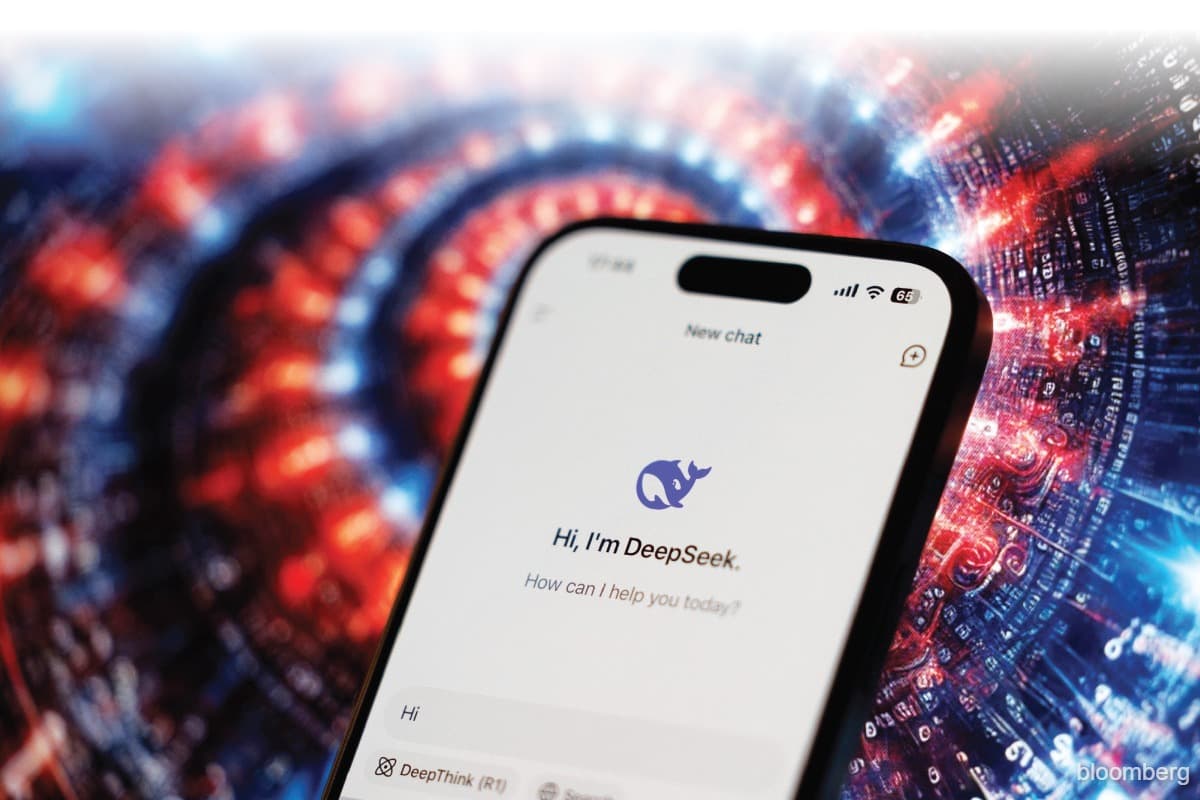
The cause? China’s DeepSeek launched its own AI platform, DeepSeek RI, that performs as well as ChatGPT’s latest iteration, GPT-4o, but at a significantly reduced cost. The reason for Nvidia’s drop is that DeepSeek was developed using older Nvidia gaming GPU chips and not its latest high-performance data centre chips that are used by OpenAI. DeepSeek reported that it used these older chips to train its AI models at a cost of US$6 million while OpenAI has raised US$24 billion in equity and US$4 billion in debt to build its AI technology and train its models.
Some analysts question whether DeepSeek actually spent that paltry amount or whether it was much more, with the amounts bandied about being anything from US$100 million to US$1.2 billion. Either way, what the Chinese spent was only a fraction of what OpenAI spent, yet they created a model that is as good as what OpenAI has done. They also open-sourced the code so anyone can test and build on it, and this has enabled the AI community to really test DeepSeek and prove that it is genuine and not fake. They have been impressed with DeepSeek, with multiple tests showing that it is as good as or, in some cases, even better than GPT-4o.
The reason why the AI industry stocks came tumbling down, especially Nvidia, is the thinking that if DeepSeek can do such a great job using slower, older gaming chips, then perhaps future iterations and developments of AI don’t really need Nvidia’s latest chips. Maybe we don’t even need all the large data centres that are coming up all over the world, including in Malaysia. While the jury is out on whether we need all these data centres, I believe we still do because cheaper processing of AI will create even more access to even more companies and this will actually increase AI processing, not decrease it.
The reason why DeepSeek didn’t use the latest Nvidia chips is because of the US government’s embargo on the sale of any high-performance technology to China, which it perceives to be its biggest technology and economic competitor. Due to China’s tremendous technological progress over the last two decades, in many areas it is far ahead of everyone else including America. According to ChatGPT, “China has already taken the global lead in 5G technology, AI, electric vehicles, quantum computing, fintech and drones, while aggressively closing the gap in semiconductors and space tech.”
By preventing the sale of high-performance technology to China, the US assumed that it could stop the technological progress of China, especially in semiconductors and AI, but this has proven to be a serious miscalculation on its part. A 2021 report by Washington, DC-based Georgetown University’s Center for Security and Emerging Technology (CSET) stated that by 2025, China will produce roughly double the number of science, technology, engineering and mathematics (STEM) PhDs compared to the US — that’s 77,000 versus 40,000 in the US. If we exclude foreign PhD students in the US, then the ratio is actually 3:1. Over the last two decades, China has focused its efforts on STEM education, especially creating more programmes and support for STEM PhD studies and the results are evident in the progress that China has made in the science and technology industries mentioned above.
Instead of killing innovation in China, the embargo has forced Chinese scientists to speed up technology development and innovation, resulting in China taking the lead in many technology fields, and soon, even AI and semiconductors. This US policy has not just awakened the sleeping dragon but incited it to such dramatic advancement that in a matter of years, China will probably be the leading technology nation in the world, not America. What doesn’t kill you makes you stronger and this is exactly what has happened in China. Talk about a serious miscalculation by the US.
What can entrepreneurs learn from China?
1. Do not let adversity slow you down
All entrepreneurs face challenging times throughout their entrepreneurial journey. Instead of allowing adversity to wear them down, they should embrace adversity and use it to motivate and drive employees to be more innovative and creative and to find ways to overcome adversity. The greatest entrepreneurs in the world, from Steve Jobs to Walt Disney, have overcome adversity to become great successes.
2. Be more creative
When times are tough, be more creative in how you do things. Since DeepSeek couldn’t get the high-performance chips from Nvidia, it became more creative and found a way to model its AI around lower-performance chips. It used what was available and found creative ways to build its model to train its AI. In doing this, it has now made it possible for all other AI start-ups to rethink how to model their AI. This will enable start-ups with far less funding to still work on successful AI technologies or applications.
3. Do more with less money
Start-ups are always complaining that they can’t raise money. Some raise up to Series A and find the next round harder to raise and lament the fact that some start-ups can raise tens of millions of dollars, but that they can only raise single-digit millions or less. What DeepSeek has shown you is that money doesn’t equate to success. It is not about raising more and more money, but it is about how you can creatively use less money to do more. In fact, start-ups that raise large amounts of money tend to do silly things with that money and creativity actually drops because they just throw a lot of money and hope that the money works like magic for them. It doesn’t. In the end, they lose more than they gain.
4.Hire talent from less glamorous universities
The Chinese PhDs didn’t come from glamorous Ivy League universities in the US. The vast majority of the 77,000 PhDs a year were homegrown Chinese citizens from all manner of universities, most unknown to non-Chinese. The founder of DeepSeek, Liang Wenfeng, and his co-founder Xu Jin are alumni of Zhejiang University. You have probably never heard of this university until now. Never underestimate students from non-Ivy League or popular universities. They are probably hungrier to succeed and will likely work harder to prove their credentials compared to Ivy Leaguers. Hire the hungry ones and you won’t regret it.
5. Cultivate a strong desire for success
Chinese companies are highly successful because the founders cultivate an environment and have a strong desire for success, not just for themselves but also with their employees. Just like how China is driven to succeed despite the efforts of the Americans to shut down or slow down their technology progress, Chinese entrepreneurs and their staff are equally driven to succeed. Use adversity and difficult times to drive yourself and your employees to succeed.
There is much we can learn from DeepSeek and the AI industry. While everyone was betting big on US companies to be the major or maybe even the only ones who could succeed in AI, a completely unknown start-up has upended all the analysts and investors who completely overlooked China. You probably sometimes feel like that too, that no one believes in you and completely ignores you. Sometimes, the competition seems overwhelming. But it is in times of adversity that you can build the greatest things and a great start-up. If it didn’t kill you, then perhaps what doesn’t kill will indeed make you stronger.
Dr Sivapalan Vivekarajah is co-founder and senior partner at Scaleup Malaysia Accelerator (scaleup.my) and adjunct professor at Sunway University’s School of Science and Technology. He is also the author of Supercharge Your Startup Valuation.
Save by subscribing to us for your print and/or digital copy.
P/S: The Edge is also available on Apple's App Store and Android's Google Play.