

This article first appeared in The Edge Malaysia Weekly on March 3, 2025 - March 9, 2025
MALAYSIA’s ambition to unlock RM747 billion (according to government estimates) worth of rare earth elements (REE) embedded in the country’s hills and soil, has recently come under the spotlight — and for good reason.
China’s ongoing public consultation on new regulations designed to protect its REE industry could add to existing restrictions on magnet-making technology exports. This underscores the urgency for alternative sources for REE, fuelling optimism around Malaysia’s vast deposits at a time when the country seeks high-value sectors to spur investments and long-term growth.
Demand for these prized minerals, used in electric vehicle motors, wind turbines and even radar evasion coating for fighter jets, is surging worldwide.
Yet, technical setbacks, regulatory issues and illicit mining threaten to keep REE’s potential locked beneath the surface — unless policymakers and industry leaders align to build a high-value downstream ecosystem.
Despite the headwinds, multiple parties remain hard at work to take advantage of the country’s vast REE resources. This includes local mining companies looking for a piece of the pie as well as both the federal and state governments seeking to create value from what is described as a “national strategic mineral” in the National Mineral Industry Transformation Plan 2021-2030.

SG4 Group head of secretariat Dr Mohd Hanif Yaacob says: “In the past, our natural resources such as tin were exploited without long-term spillover effects or high-value downstream sector … It w as always about extracting raw materials and selling them by the kilo.
“With these critical minerals, [the government] has to be involved at every level of the ecosystem to grow the downstream sector [processing of raw materials], as this creates high-skilled jobs.” SG4 Group is linked to the state governments of Terengganu, Kelantan, Kedah and Perlis, which together have an estimated 70% of Malaysia’s 16.2 million tonnes of rare earth oxides (REO), according to a federal geoscience and mineral department (JMG) study.
Malaysia “lost a golden decade” when it decided not to act on a comprehensive 2014 blueprint for the establishment of rare earth-based industries published by the National Science Academy, says Lim Wei Hung, founder of MCRE Resources Sdn Bhd, the first company approved to mine and export REE in Malaysia. “We did not seize the opportunity then … but this industry has big potential.”
Now is an opportune moment to develop the ecosystem. According to news reports, the US has been exploring alternative sources, such as those in Ukraine, while the electrification boom drives strong demand for motors and turbines — all of which require super-magnets, which depend on REE to maintain compact and cost-effective motor sizes.
According to sources interviewed by The Edge, the issues in Malaysia are actively being addressed.
Can REE be mined in forest reserves?
In 2023, Putrajaya curbed raw REE export. To monetise REE, Malaysian miners must sell the material domestically to local processing plants, a move supported by players and even opposition-led SG4, as its intention is to grow the local REE supply chain.
There is one problem, though: The processing plants cost billions, and midstream players investing in them need secure, long-term supply of REE to justify the investments.
“If miners can sell to any Tom, Dick and Harry, there’s no sustained supply, and you cannot build the downstream industry,” says Mohd Hanif.
REE is categorised into light and heavy types, with Malaysia’s deposits being of the heavier, more valuable variety typically found in clay form near granite formations (see “What you need to know about REE”). The biggest such formation in Peninsular Malaysia sits along the Titiwangsa Range, which itself is smack in the middle of forest reserve areas.
In September 2023, the federal minister overseeing natural resources Nik Nazmi Nik Ahmad said 80% of REE sites were located outside permanent forest reserves.
In November, however, Kelantan reported that most of its 2.56 million tonnes of REE — 15.8% of the national total — were in forest reserves.
Terengganu has the largest REE deposits in the peninsula, with 7.19 million tonnes, or 44.4% of the national total. Seventy per cent of the state’s deposits are located in forest reserves, according to Mohd Hanif.
Current laws stipulate that forest reserves must be de-gazetted, with the requirement to replace them on at least a one-to-one basis within the same state.
The question is “whether the government allows mining in forest reserves”, says MCRE’s Lim. Without access, there may not be enough resources to develop the downstream ecosystem.
In a reply to The Edge, the Ministry of Natural Resources and Environmental Sustainability (NRES) says it “still maintains a policy of not supporting and approving mining activities in permanent forest reserves, environmentally sensitive areas and protected areas”.
Having said that, some point to the timber industry’s practice of logging forest reserves under “forest plantation” (ladang hutan) programmes, where areas are reforested in 15-year cycles to encourage sustainable logging.
Sustainability concerns persist, however: It has been reported that, in 2022, some 5.2% of reserves had been cleared, but only 30% of that has been replanted.
Meanwhile, REE mining elicits a wide spectrum of fears, primarily concerns over the impact of radioactivity and chemical use on human health and the environment.
Industry players are incentivised to meet environmental benchmarks, though, points out SG4’s Mohd Hanif.
“Our big statement is sustainability,” he says. “Buyers from Europe, the US, South Korea or Japan strictly monitor your process from mining to processing. Any irregularities can jeopardise [the sale of] your product.”
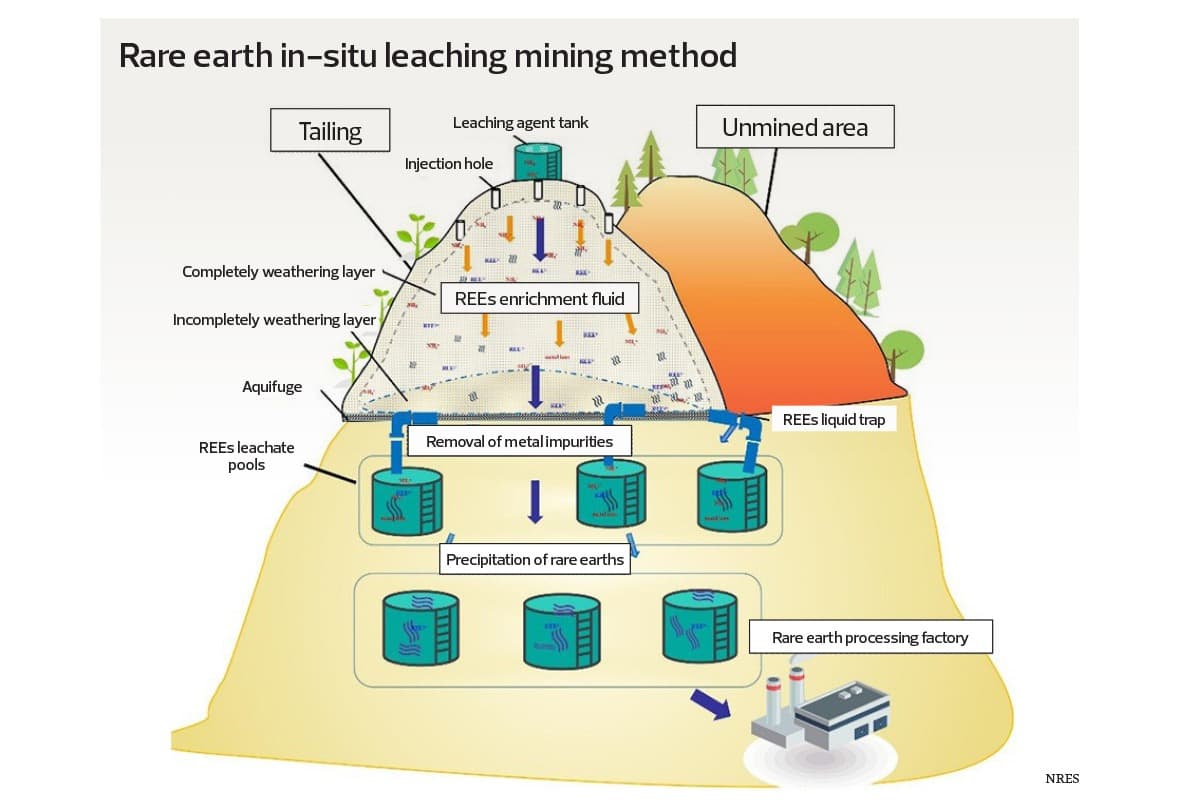
REE deposits located within granite formations, such as in Malaysia, are mined using a process called in-situ leaching, where ammonium sulfate and acids are injected underground to dissolve targeted REE, later precipitated into carbonate form.
Ammonium sulfate is a fertiliser beneficial to the soil, but excessive use can contaminate water and reduce oxygen levels, harming aquatic life, says Mohd Hanif.
Excessive acid use speeds up REE extraction but also dissolves radioactive minerals accompanying it, which could result in radioactivity levels in the final product. This should not be the case for granite-based REE, which typically has a low concentration of radioactive elements.
“In some cases, sample are highly contaminated with radioactive elements. Midstream and downstream customers will review and may reject this, as it suggests excessive amounts of chemicals merely to speed up the REE collection,” says Mohd Hanif. “This is why we must adhere strictly to ESG (environmental, social and governance) standards.”
Meanwhile, MCRE, which operates in Kenering, Hulu Perak, has offered to collaborate with the government on a study of the impact of in-situ leaching on forest reserves, Lim says.
“[The federal government] should improve the standard operating procedure (SOP) and make its implementation super-efficient,” adds Mohd Hanif.

Efforts are being undertaken to pilot the revised SOP in a forest reserve in Peninsular Malaysia, he adds. “If the product is deemed non-ESG compliant, they won’t see demand either.”
Keeping REE within the local ecosystem
In developing a downstream ecosystem for mined REE resources, credible entities are needed to process REE carbonate — which contains both REE and impurities — into individual oxides in their purest form, a process that is the most challenging along the value chain. This presents another obstacle, as China currently controls all of the world’s heavy REE separation capacities, according to NRES.
“In protecting their technical monopoly, the Chinese government has banned the export of in-situ leaching and rare earth separation technologies. Chinese REE operators are encouraged to mine REE overseas but must send the raw mine products back to China,” says NRES.
In contrast, Lynas’ Malaysian operations process light REE. While it is also expanding into heavy REE processing, the company’s backlog of customers, including Japan, means it cannot commit to supplying the processed oxide back to Malaysia. This hampers the country’s goal of growing its downstream segment, which turns the raw elements into end-products such as magnets used in equipment such as turbines, says Mohd Hanif.
“It’s the same with Chinese midstream players. [At this point,] you cannot get back the oxide. So, we have to explore another entity that would give us back [the oxide],” he says. “If you ask me, two processing plants would be enough [in the country, based on the supply potential].”
In keeping resources within the local ecosystem, a Malaysian company, Malaco Mining Sdn Bhd — led by mining veteran Datuk Sia Hok Kiang, whose mining background spans the Americas, Africa, Asean and Australia — is working to develop a local REE processing plant, according to NRES.
“The company has successfully conducted REE processing on a laboratory scale and is continuing the project at its Proof of Concept (POC) Plant,” the ministry adds.
“It is very challenging to try to gain the needed technical knowledge and experience to compete with China. On the other hand, technological innovation could also be an area of competitive advantage if we can overcome initial hurdles, especially if newly developed techniques improve the Chinese methods currently in use.”
At this point, Malaysia has a Centre of Excellence in Rare Earth Elements Research at Universiti Malaya. At this point, Malaysia has a Centre of Excellence in Rare Earth Elements Research at Universiti Malaya. The Terengganu Strategic & Integrity Institute (TSIS), of which Mohd Hanif is CEO, also looks at the sector, in part to support the state’s ambition to tap REE.
Malaysia also has a downstream presence. For instance, Swiss-backed Bomatec AG, which has a Malaysian unit, manufactures plastic-bonded permanent magnets for the automotive, energy and medical industries.
SG4 is also eyeing investments further downstream. Terengganu, for example, has reserved land in the Kemaman Industrial Park for downstream players, according to Mohd Hanif. The idea is to produce end-products in Terengganu and leverage the upcoming East Coast Rail Link (ECRL), which will shorten the transport time between Terengganu and Port Klang.
Clock ticks amid rampant illegal mining
Notably, Singapore-listed Southern Alliance Mining Ltd, of which Lim is executive director and chief operating officer, signed a memorandum of understanding in April to acquire a 40% stake in MCRE. Its Perak mining location has an estimated 33,000 tonnes of REO, Southern Alliance had said. Right now, only MCRE Resources has a permit to export raw REE.
“When we transport our product from the mines, we have to be escorted by the Department of Lands and Mines,” MCRE’s Lim says.
Illegal mining and exports are rapidly becoming more prevalent, owing largely to enforcement challenges, especially when the materials are shipped as clay deposits.
In December, a mining site in Kelantan was raided, and five tonnes of REE worth US$4 million were seized in Selangor.
“We have contacts in other countries with port dockets declaring that the REE was sourced from Malaysia in tonnes. The federal government must facilitate the industry as soon as possible, because illegal mining is rampant,” SG4’s Mohd Hanif says.
What is worse is that illegal mining “could be cheaper because the miner disregards ESG practices”, says Lim.
He explains that getting everything up to speed would take years — from exploration to conducting an environmental impact assessment (EIA) and setting up the mining operations. It then takes another couple of years to build the processing plant, not including the time required for licensing and approval processes before construction can begin.
“It’s not rocket science,” Lim says. “Naturally, we focus on extraction [of the REE from the soil] first, but what’s the end game? How committed are we [Malaysia]? Can the government provide policy certainty?”
For SG4, the ideal scenario is to establish the ecosystem and have a processing plant up and running within the next three years.
“Development of the ecosystem is tricky, but we still want [to establish it] for future generations,” says Mohd Hanif. “This is a strategic asset for the country.”
What you need to know about REE
Malaysia’s rare earth element (REE) deposits are often said to be non-radioactive, but the term itself could be misleading.
REE deposits, as explained by the federal Department of Mineral and Geoscience (JMG), are “a set of 17 metallic elements” which include 15 lanthanides, plus scandium and yttrium.
Used in high-tech consumer products, they are also featured in defence applications such as guidance systems, lasers, and radar and sonar systems.
“Although the amount of REE used in a product may not be a significant part of that product by weight, value or volume, the REE can be necessary for the device to function. For example, magnets made of REE often represent only a small fraction of the total weight, but without them, the spindle motors and voice coils of desktops and laptops would not be possible,” JMG says.
REE is sourced through two common mining processes: open pit mining and in-situ leaching. Open pit mining is done when the REE deposits are found alongside mineral deposits such as iron or tin. This REE category typically is composed of “lighter” REE (named as such because of lower atomic numbers), is more concentrated and has a higher concentration of radioactive elements such as thorium — the same thorium which sparked public pushback when its separation process from the REE was conducted in Lynas’ processing plant in Pahang.

In-situ leaching, meanwhile, can be used for REE deposits found in ionic clay that sits along granites, such as in Malaysia. Ammonium sulphate — a common fertiliser — and sulphuric acid are injected at least six metres underground to dissolve the REE. The dissolved solution is then collected and processed. This type of deposit contains heavier REE, is less concentrated and has a lower concentration of thorium compared to mineral-based REE mining.
In Peninsular Malaysia, REE deposits are abundant in Terengganu, Kelantan and Perak. However, deposits in the west coast of the peninsula are closer to populated areas, owing in part to rapid socioeconomic developments, whereas the bulk of the deposits in the east coast are located in less populated areas.
The collected REE, now in carbonate form, still contains other impurities. In the midstream segment, the carbonate is turned into rare earth oxide (REO) to remove the impurities. It is then turned into the actual elements by removing the oxygen component. In the downstream segment, the product is then combined with other elements to produce final materials such as super-magnets used in equipment such as electric motors and wind turbines.
While in-situ leaching does not require huge clearing of the top soil, debate continues over potential leakage of the chemicals into underground water, which would affect surrounding flora and fauna.
Radioactive residue is also taboo in Malaysia, owing in part to radioactive pollution involving an REE processing plant in Bukit Merah, Perak, in the 1990s, as well as pushback over the handling of thorium byproduct in Lynas Malaysia’s plant to process REE from Australia in the 2010s. Lynas Malaysia’s existing import licence expires in March next year.
In November 2023, a Malaysian Nuclear Agency official told a forum that it sees a market for thorium, which until today is being explored as fuel for nuclear power plants.
The world is still waiting for the first commercial thorium power plant to come online. According to reports, the Chinese Academy of Sciences’ Shanghai Institute of Applied Physics will build a 10mw thorium-powered reactor this year for operations starting in 2030, following the development of a pilot project in 2021 that generated 2mw of thermal power but not electricity.
SG4 is opposition states’ move to safeguard rare earth bargaining power
The opposition-led SG4 Group was formed in part to achieve stronger bargaining power in efforts to monetise the rare earth element (REE) deposits in its member states, says its head of secretariat Dr Mohd Hanif Yaacob.
The four states collectively have 67.9% of Malaysia’s REE resources — Terengganu has 7.19 million tonnes of rare earth oxide resource (44.38%); Kelantan, 2.56 million tonnes (15.82%); Kedah, 1.26 million tonnes, (7.76%); and Perlis has a negligible amount, according to data from the Ministry of Natural Resources and Environmental Sustainability (NRES).
SG4, in which each of the states will jointly participate through their respective Menteri Besar Inc (MBI), seeks to be part of the REE ecosystem and has received positive feedback from potential investors, Mohd Hanif says.
“But they tell us to resolve the long-term supply situation and ‘then we will talk’. The problem is [securing enough volume] of the raw material for the long term,” he adds.

Further, while Perlis’ REE deposits are negligible, it has a critical element required for rare earth mining — dolomite, which has the capability to neutralise chemicals used in the mining process, Mohd Hanif explains.
“That’s why the states set up SG4. It is not political; it is actually for stronger bargaining power. Against whom? Not so much [the] federal [government], but with the midstream and downstream players. This is the right strategy … to invite midstream players to come,” he adds. “Malaysia is actively looking for foreign investments and high-growth sectors. Our next candidate, I believe, is REE.”
Mohd Hanif, who is also CEO of Terengganu state-linked think-tank Terengganu Strategic & Integrity Institute, sees opportunity in the state’s resources, although just 30% of it is located outside of forest reserves.
“According to the International Energy Agency (IEA), future world demand for REE is about 400,000 tonnes of carbonate per year,” he explains, looking at the scribbles on his tablet during the interview.
“If SG4 states can supply 40,000 tonnes per year, which we believe is manageable, that’s 10% of the world market. Of all the SG4 states, REE concentration is the highest in Terengganu, at roughly 50 tonnes per acre. You can imagine the contribution to the country.”
The state has allocated 500 acres of land for exploration of its REE resources. In Kelantan, the exploration process is slightly faster, as most of the non-forest reserve lands explored at this stage are farmlands owned by state entities. The companies that participated are less experienced, however, and still need to fine-tune their technical capabilities, says Mohd Hanif.
Mining activities are governed by both the federal and state governments (see “Regulatory powers along REE value chain”). Perak, which is the first state to legally export REE, received more than RM30 million in royalties from REE last year. As such, it is seen as a new and viable source of revenue by the states with REE deposits, which otherwise rely on federal allocations — in Terengganu’s case, it also has oil royalties — to support their expenditure.
Notably, an earlier proposal to establish a federal entity (similar to Petroliam Nasional Bhd, with its oversight role for Malaysia’s oil and gas reserves) “did not receive a favourable response from the state governments due to concerns about the involvement of the federal government in the jurisdiction regulated by them”, NRES says in a reply to The Edge.
As to how Malaysia will ensure it will not be shortchanged when bringing in foreign investments or expertise to the REE space, NRES says: “All aspects should be considered.” This includes government-to-government collaboration “by leveraging diplomatic channels to negotiate favourable terms” with foreign governments and companies, and clearly defining the transfer of technology, ensuring it is comprehensive and not limited to outdated or less critical aspects.
There is also a need to “negotiate fair profit-sharing arrangements” that reflect Malaysia's contributions, including access to resources and market access. “[The] REE industry needs to involve investment from Malaysian GLCs (government-linked companies)”, it adds.
Save by subscribing to us for your print and/or digital copy.
P/S: The Edge is also available on Apple's App Store and Android's Google Play.